

What Is Answer Engine Optimization? A Complete Guide to AEO
Answer Engine Optimization (AEO) is the process of improving how often AI assistants mention and recommend your brand. A good AEO strategy combines citable content, citation-source coverage, and ongoing measurement across models like ChatGPT, Claude, Gemini, and Perplexity. For marketing teams, AEO performance directly impacts demand capture when buyers ask AI tools for recommendations.

What Is Answer Engine Optimization (AEO)?
Answer Engine Optimization (AEO) is the practice of formatting content so AI search tools like ChatGPT, Perplexity, and Google AI Overviews cite your brand. The goal is to become the trusted source that language models retrieve when answering user questions.
Traditional SEO relies on convincing an algorithm to place a blue link at the top of a page. AEO requires showing a large language model (LLM) that your content contains accurate, concise facts it can use to build an immediate answer. You are not just trying to rank. You are trying to be recommended.
For marketing teams, AEO performance directly impacts demand capture. When buyers ask AI tools for product recommendations or vendor comparisons, they rarely click past the generated summary. If your brand is missing from that initial text, you lose the interaction entirely.
A good AEO strategy combines creating citable content, expanding your presence on third-party citation sources, and measuring results across different model families. It shifts the focus from optimizing for algorithms that route traffic to optimizing for models that synthesize information.
Helpful references: PromptEden Features and PromptEden Pricing.
Why Answer Engine Optimization Matters Now
The search landscape has changed. Users now expect synthesized answers instead of a list of ten possible destinations. Because of this, brands need to adapt how they publish content.
According to Forbes, over 40% of US adults have used an AI chatbot for search-style queries in 2025. Generative AI is not just a niche tool for tech enthusiasts anymore. It is a mainstream utility for everyday research, product discovery, and troubleshooting. When nearly half the adult population changes how they find answers, marketing strategies have to catch up.
Traditional search engines have also integrated these capabilities directly into their core experiences. According to Search Engine Land, AI Overviews now appear on roughly 30% of Google search results pages. Even users who never open a dedicated AI chatbot are consuming AI-generated answers.
This has a huge impact on traditional web traffic. Answer engines provide direct, in-line solutions, giving users less incentive to click through to external websites. Click-through rates for informational queries have dropped. Brands relying entirely on traditional organic traffic to top-of-funnel blog posts are seeing their visibility decline. AEO is the way to reclaim that visibility in generated responses.
AEO vs. Traditional SEO: The Key Differences
While Answer Engine Optimization and Search Engine Optimization share the goal of getting found by potential customers, their mechanics, metrics, and tactics are different.
The Indexing vs. Retrieval Difference Standard search engines crawl the web, index pages, and retrieve relevant links based on keywords, backlinks, and user experience metrics. Answer engines work differently. They use Retrieval-Augmented Generation (RAG). When a user asks a question, the AI searches its training data and real-time web indexes to find factual fragments. It then synthesizes those fragments into a conversational response.
The Output Format SEO results in a list of hyperlinks. The user does the work of clicking, reading, and extracting the answer. AEO results in a direct answer. The model reads and extracts the information, presenting the user with a finished thought.
Metric Differences In traditional SEO, success is measured by keyword ranking position, click-through rate (CTR), and organic sessions. In AEO, success is measured by Presence (are you mentioned?), Prominence (how highly are you featured?), and Recommendation (is the AI explicitly suggesting your product?).
Here is a quick comparison of how the two approaches contrast in practice:
| Feature | Traditional SEO | Answer Engine Optimization (AEO) |
|---|---|---|
| Primary Goal | Drive clicks to a website | Secure brand mentions in AI answers |
| User Experience | Navigating a list of links | Reading a synthesized, direct answer |
| Core Tactics | Keyword optimization, link building, technical audits | Quotable facts, structured data, semantic clarity |
| Key Metrics | Organic traffic, ranking position, domain authority | Visibility score, citation frequency, share of voice |
| Best For | Capturing broad informational traffic | Winning high-intent, decision-making queries |
AEO does not replace SEO. They operate as a combined strategy. Strong traditional search rankings often feed the real-time retrieval systems that power answer engines. But ranking well in Google does not guarantee a mention in ChatGPT or Claude. You need specific AEO tactics to bridge that gap.
How AI Search Engines Choose Which Brands to Cite
To optimize for answer engines, you need to understand how they decide what information to include in a response. The exact algorithms are proprietary and constantly evolving, but the underlying mechanics rely heavily on Retrieval-Augmented Generation (RAG) and source consensus.
The Role of Retrieval-Augmented Generation (RAG) Most modern answer engines do not rely solely on their pre-trained memory. Training data has a cutoff date, and relying on it entirely leads to hallucinations. Instead, when a user enters a prompt, the engine performs a background search across the live internet or a specialized index. It pulls in snippets of text from high-ranking, trusted sources, appends them to the user's prompt, and instructs the LLM to write an answer based only on those retrieved snippets.
If your brand is not mentioned in the snippets the engine retrieves during that background search, you will not appear in the final answer.
Consensus and Authority Answer engines prioritize consensus. If multiple trusted sources state the same fact, the LLM is likely to include it. This is why having your brand mentioned on third-party review sites, industry blogs, and established news outlets is essential. A single mention on your own website is less persuasive to a model than consistent mentions across five different domains.
The Fan-Out Effect Models often break complex queries into smaller sub-queries, a process called "fan-out." For example, if a user asks for "the best email marketing software for small teams," the engine might secretly search for "easy to use email marketing," "affordable email tools," and "email marketing small business reviews." It then compiles the results.
Brands ranking well for these specific, long-tail sub-topics have a much higher chance of being pulled into the context window and cited in the final generated overview. Owning the main head term is not enough. You have to rank for the specific facets of the topic.
The Four Core Pillars of AI Visibility
Measuring success in AEO requires a new framework. Traditional rank tracking tools cannot accurately reflect how often a brand appears in a dynamic, generated paragraph. A strong Answer Engine Optimization strategy evaluates performance across four specific dimensions.
1. Presence Presence answers the question: Did you show up? It measures whether your brand name appears anywhere in the generated text for a specific prompt. This is the baseline metric. If your presence is zero, you have no visibility.
2. Prominence Prominence measures where and how your brand is featured. Are you the primary subject of the first paragraph, or are you relegated to a bullet point at the end of the response? Higher prominence means the AI considers your brand relevant to the core intent of the user's prompt.
3. Ranking While there are no traditional "blue links," AI answers often present lists. If a user asks for "Top 5 CRM tools," ranking measures your position within that generated list. Being listed first carries more weight and user attention than being listed fifth.
4. Recommendation This is the most important metric for conversion. Recommendation evaluates the sentiment and context of the mention. Does the AI merely state that your product exists, or does it explicitly recommend your product for a specific use case? A positive, explicit recommendation from an AI agent acts as a powerful trust signal to the end user.
PromptEden uses these four dimensions to calculate a composite Visibility Score from 0 to 100. This score allows teams to benchmark their performance against competitors and track progress over time.
How to Build an Answer Engine Optimization Strategy
Building a good AEO strategy requires practical, structural changes to how you produce and distribute content. These steps form the foundation of a program designed to maximize AI citations and recommendations.
Add one practical example, one implementation constraint, and one measurable outcome so the section is concrete and useful for execution.
Teams should validate this approach in a small test path first, then standardize it across environments once metrics and outcomes are stable.
Document decisions, ownership, and rollback steps so implementation remains repeatable as the workflow scales.
Teams should validate this approach in a small test path first, then standardize it across environments once metrics and outcomes are stable.
Optimize for Quotable Answers (Generative Engine Optimization)
AI systems look for concise, definitive statements they can easily extract and attribute. Write with clear Generative Engine Optimization (GEO) principles. Start your sections with direct, one-sentence answers. Avoid long preambles. When stating facts or statistics, use clear attribution (e.g., 'According to [Source]...'). Format complex information into bulleted lists or simple markdown tables. The easier your content is to parse, the more likely it is to be cited.
Expand Citation Source Coverage
Do not rely entirely on your own domain. Answer engines build trust through consensus. You need to identify which third-party sites the models frequently cite for your target topics. Use citation intelligence tools to discover these sources, whether they are Reddit threads, G2 review pages, or niche industry blogs. Once identified, work to get your brand mentioned on those specific pages. Securing a mention on a highly-cited third-party page often brings faster AEO results than optimizing a page on your own site.
Publish an LLMs.txt File
Make it as easy as possible for AI agents to understand your product and brand. Publishing an llms.txt file in your site's root directory provides a structured, markdown-formatted overview of your key facts, product features, and pricing. This acts as a direct communication channel to web-crawling bots and automated agents, ensuring they ingest accurate, up-to-date information without having to guess based on marketing copy.
Monitor Multi-Platform Performance
Do not optimize blindly. You must track your performance across the entire ecosystem. Visibility varies between platforms. Your brand might be heavily recommended by ChatGPT but completely ignored by Perplexity. A strong strategy requires monitoring prompts across the multiple major AI platforms, including search-focused tools like Google AI Overviews, chat interfaces like Claude and Gemini, and coding assistants like GitHub Copilot.
Measuring Share of Voice in AI Search
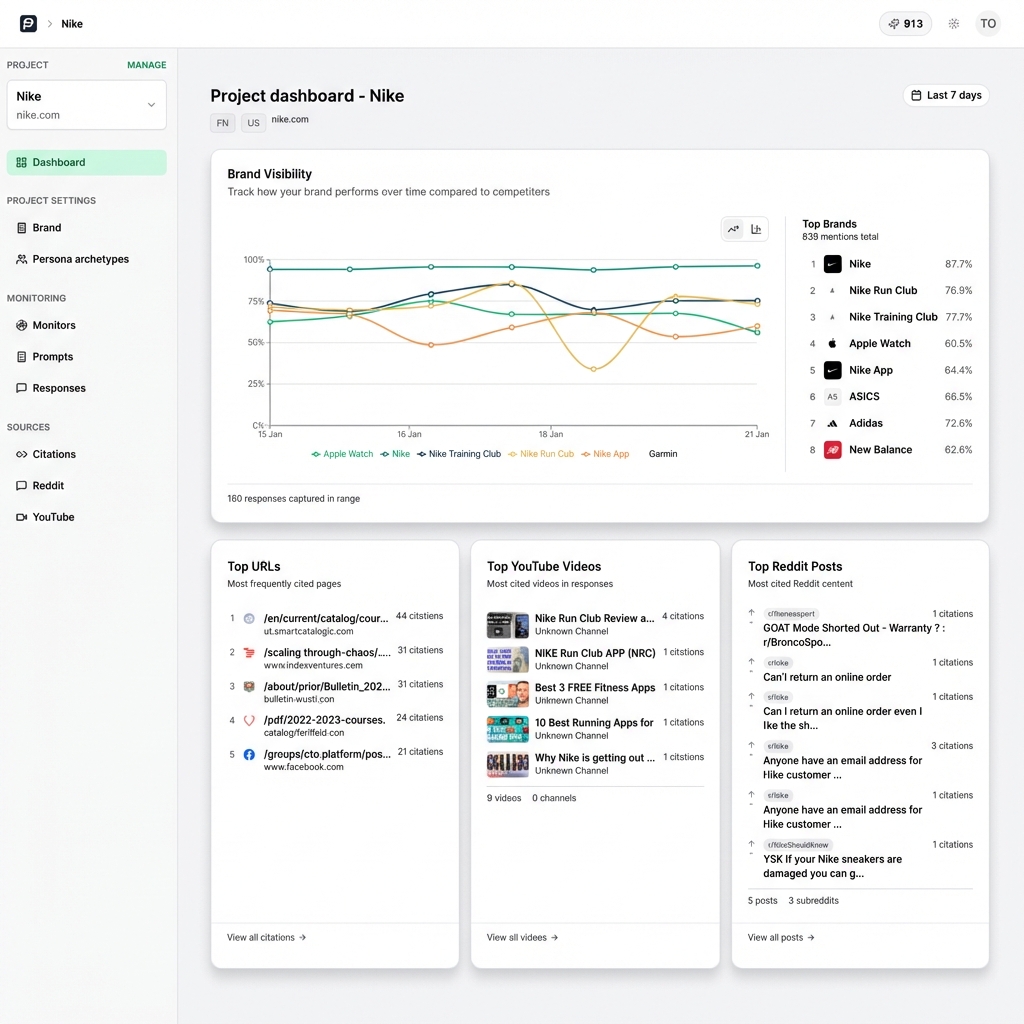
Measuring Share of Voice (SOV) in AEO means tracking your brand's presence compared to competitors in AI-generated answers.
Unlike traditional search, where the competitive set is usually obvious based on keyword rankings, AI search often introduces unexpected competitors. Because models synthesize answers based on broad context, they frequently recommend alternative solutions, tangential products, or emerging tools you might not consider direct competitors.
Tracking Prompt Trends Over Time Visibility in AI search is not static. A model update, a shift in the underlying retrieval index, or a surge in competitor PR can change how a system responds to a prompt. It is essential to track specific, high-intent prompts over time. By monitoring day-over-day and week-over-week changes in your Visibility Score, you can catch shifts early and adjust your content strategy before a drop in recommendations impacts your pipeline.
Discovering Auto-Detected Competitors A good monitoring system should automatically surface the other brands appearing alongside yours. Organic Brand Detection helps you understand the true competitive landscape. If you consistently see a specific competitor recommended in prompts where your brand is omitted, you can reverse-engineer their citation strategy. Analyze which sources the AI cites when mentioning them, and target those same sources for your own brand.
By treating AI Share of Voice as a primary KPI, marketing teams can prove the ROI of their AEO efforts and secure the resources needed to compete in this new channel.
Common Answer Engine Optimization Mistakes
As marketing teams adapt to AI search, several common pitfalls hurt their efforts. Avoiding these mistakes will give you a major advantage over competitors who are still applying outdated SEO tactics to new problems.
Focusing Only on Brand Terms Many teams track how AI models respond to their own brand name. While ensuring the AI accurately describes your product is important, it represents the bottom of the funnel. Users asking about your brand already know you exist. The real value of AEO lies in capturing non-brand, exploratory prompts like "Best software for managing remote teams" or "How to reduce customer churn." Failing to optimize for these discovery-phase queries limits your growth.
Writing Thin, Uncitable Content Answer engines hate fluff. Content padded with vague adjectives, lengthy anecdotes, and corporate jargon makes it hard for a model to extract facts. If a paragraph does not contain a specific claim, a concrete number, or a clear definition, it is invisible to an LLM. Every section of your content must deliver clear value.
Ignoring the Nuances of Different Model Families It is a mistake to assume that optimizing for ChatGPT automatically covers you for Google AI Overviews or Perplexity. Each model family uses different training data, different retrieval mechanisms, and different weighting for source authority. A strong AEO strategy demands multi-platform tracking and a willingness to adjust tactics based on which model you are targeting.
The Future of AEO and Generative Search
Answer Engine Optimization is not a temporary trend. It is the blueprint for the next decade of digital discovery. As AI models become faster, more accurate, and more integrated into our daily workflows, the traditional blue-link search engine will become a fallback option rather than the primary destination.
We are already seeing the rise of agentic workflows, where AI systems do not just provide answers but take action on behalf of the user. In the near future, being recommended by an AI will not just drive traffic. It will drive automated purchasing decisions, software integrations, and direct revenue.
Brands that start building their AEO infrastructure today by structuring their data, securing high-value citations, and establishing strong monitoring systems will build a lasting advantage. They will become the default, trusted entities that language models rely on. Those who wait will find themselves written out of the conversation, invisible to the AI assistants that mediate the digital world.