
How to Get Cited by ChatGPT
Getting cited by ChatGPT means your content appears as a named source in ChatGPT's responses when users ask questions related to your expertise. This guide breaks down the three types of ChatGPT citations, walks through seven practical steps to earn them, and shows you how to track whether your content is showing up.

What Getting Cited by ChatGPT Actually Means
When ChatGPT names your page as a source in its response, that is a citation. With over 800 million weekly active users and 2.5 billion queries processed each day, according to DemandSage, ChatGPT has become one of the biggest referral channels online.
Not all ChatGPT citations work the same way, though. There are three types, and your strategy depends on which one you are targeting.
Training data mentions happen when ChatGPT references information it absorbed during model training. You have limited control here because these depend on what OpenAI included in its training corpus. The content may be months or years old.
Browse-mode citations occur when a user triggers ChatGPT's browsing capability and the model pulls directly from your page to answer a question. These show up as clickable source links in the response.
Search-mode references appear when ChatGPT's built-in search feature, powered by a crawler called OAI-SearchBot, retrieves and cites your content in real time. This is the type that offers the most direct optimization path, because you can control whether the crawler accesses your site and how your content is structured for extraction.
Most guides about getting mentioned by ChatGPT blur these categories together, which makes their advice hard to act on. The steps in this guide focus primarily on search-mode and browse-mode citations, where your content decisions have a measurable effect.
Seven Steps to Get Your Content Cited by ChatGPT
These seven steps each target a content trait that research has linked to higher citation rates in ChatGPT.
1. Write answer capsules after every heading
An answer capsule is a self-contained, two-to-three-sentence explanation that directly answers the question posed by the heading above it. Research published by Search Engine Land found that 77.4% of cited blog posts included an identifiable answer capsule, making this the single strongest predictor of whether content gets cited by ChatGPT.
Keep these capsules between 200 and 400 characters when possible, and avoid including links inside them. More than nine in ten cited capsules contained no links at all. ChatGPT extracts factual blocks that stand alone, so give it clean, link-free text to work with. Place supporting links in the paragraphs below the capsule instead.
2. Front-load your most important information
A study analyzing 1.2 million AI-generated answers found that 58.2% of ChatGPT citations come from the first third of an article's content, according to Search Engine Land. This mirrors the inverted-pyramid structure used in journalism: lead with the conclusion, then provide supporting detail.
Put your definitions, key statistics, and core arguments in the opening paragraphs of each page and each section. Do not bury the answer beneath long introductions or background context. If someone scanned only the first 30% of your article, they should find the most citation-worthy material there.
3. Include original data and proprietary insights
The same research showed that 52.8% of cited posts featured either original data or branded insights. If you run surveys, track benchmarks, or collect product usage data, publish those findings prominently. ChatGPT weights sources that offer information gain, which means content that adds something new beyond what other pages already cover.
For example, if you track brand visibility across AI platforms, publishing quarterly benchmark reports with real numbers gives ChatGPT something concrete to cite. Vague thought leadership pieces without supporting data rarely earn citations.
4. Use question-based headings with clear definitions
ChatGPT's citation patterns favor content with explicit question-and-answer structures. Cited text includes question marks at twice the rate of non-cited text, with a significant majority of those question-linked citations coming from headings. Format your H2s and H3s as questions your audience actually asks, then answer them directly in the first sentence below.
This approach also helps with Google's People Also Ask boxes and featured snippets. One heading structure can win citations from both traditional search and AI-powered search at the same time.
5. Increase entity density in your content
Entity density refers to the ratio of named entities, such as brands, products, people, and standards, to total words in a passage. Heavily cited passages average around 12.6% proper nouns, compared to the typical 5-8% in standard content. When writing about a topic, name the specific tools, companies, frameworks, and standards involved rather than using vague references.
Instead of writing "several AI platforms now offer search features," write "ChatGPT, Perplexity, and Google AI Overviews each handle search-mode citations differently." Specificity makes your content more citable because AI models can attribute concrete claims more confidently.
6. Keep your content fresh and frequently updated
ChatGPT's search mode has a noticeable recency bias. Pages that have not been updated in months get skipped, even when their core information remains accurate. Add a visible "last reviewed" or "last updated" date to your pages, and make sure it reflects a genuine content review, not just a timestamp change.
Revisit your highest-traffic content quarterly. Update statistics, replace outdated examples, and add context about recent developments. Fresh content signals reliability to both traditional search engines and AI retrieval systems.
7. Build external authority through third-party mentions
ChatGPT tends to cite businesses that are frequently mentioned on authoritative websites that also rank well in Google. Wikipedia accounts for a significant share of ChatGPT's citation sources, making it one of the most influential reference points for AI-generated answers.
Earn mentions on industry publications and review sites. Contribute to Wikipedia where you can add accurate, well-sourced information. Participate in forums like Reddit where topical discussions happen naturally. These external signals reinforce your authority in ChatGPT's source selection, making your site more likely to be retrieved and cited.
How ChatGPT Selects Its Sources
Knowing how ChatGPT picks sources helps you focus your effort. The retrieval method changes depending on the mode ChatGPT is operating in.
In search mode, ChatGPT sends queries through OAI-SearchBot, OpenAI's dedicated web crawler. According to OpenAI's documentation, OAI-SearchBot indexes web content specifically to surface websites in ChatGPT's search results, and it does not collect data for model training. This means allowing OAI-SearchBot in your robots.txt directly controls whether your pages can appear as cited sources.
When evaluating which pages to cite, ChatGPT favors several signals. Clear formatting, descriptive headings, and organized lists help. So does strong topical relevance to the query. Pages from domains that other authoritative sites frequently reference also get preferential treatment.
Worth noting: ChatGPT does not pick a single winner for each query. It cites multiple sources side by side, often pulling from several pages in one response. So you do not need to be the top-ranked result to earn a citation. You just need to be among the most relevant and well-structured sources on the topic.
Put , ChatGPT's citation behavior rewards the same qualities that make content useful to human readers: clear writing and real authority. There is no hidden trick. The work mostly comes down to making your best content easier for the system to find and correctly attribute.
What the Data Shows About ChatGPT Citations
Research on ChatGPT citations is still early, but a few large-scale studies have already produced useful numbers.
A study of 1.2 million AI-generated answers by Kevin Indig, published through Search Engine Land, revealed clear patterns in how ChatGPT selects content for citation. At the article level, 58.2% of citations originated from the first 30% of content, 31.8% from the middle section, and 10.0% from the final third. At the paragraph level, 47% of citations came from middle sentences, 30.5% from opening sentences, and 22.5% from closing sentences.
The same study found that cited passages share five traits: clear definitions (cited text was nearly twice as likely to use phrasing like "X is" or "X refers to"), question-based structure, high entity density, balanced tone scoring around 0.35 on a subjectivity scale between pure fact and pure opinion, and moderate readability where grade 8 Flesch-Kincaid scoring outperformed grade 10.1 text.
Separately, an analysis of content traits that predict LLM citation found that 77.4% of cited blog posts included answer capsules, and 52.8% featured original or proprietary data. The combination of both, present in roughly 41% of cited posts, was the strongest predictor of citation.
The pattern across all of these studies is the same: ChatGPT rewards content that is well-structured and front-loaded with specifics, written at a professional but accessible reading level. You do not need to dumb down your writing for AI. You need to organize it so the important parts are easy to extract.
Technical Setup for ChatGPT Crawling
Before any content optimization matters, you need to make sure ChatGPT can access your site. This comes down to two technical steps.
Allow OAI-SearchBot in your robots.txt
OpenAI uses three separate crawlers, each with its own purpose: GPTBot collects data for model training, ChatGPT-User handles direct user-initiated browsing requests, and OAI-SearchBot crawls content specifically for ChatGPT's search results. If you want your pages to appear as cited sources, you need to allow OAI-SearchBot by adding the following to your robots.txt:
User-agent: OAI-SearchBot
Allow: /
You can allow OAI-SearchBot while blocking GPTBot if you want citations without contributing to training data. Each crawler is controlled independently. You can verify your current configuration using PromptEden's free AI Robots.txt Checker.
Add structured data markup
Schema markup helps ChatGPT understand what your pages contain. Article schema, FAQ schema, and Organization schema all provide structured signals that make your content easier to parse and attribute. FAQ schema is especially useful because it maps directly to the question-and-answer format that ChatGPT's citation system favors.
If your site runs on a CMS like WordPress, most SEO plugins handle schema automatically. For custom sites, use Google's Structured Data Markup Helper or test your existing markup with the Rich Results Test.
How to Measure Your ChatGPT Citation Performance
Citations only matter if you can confirm they are happening and watch for changes. Manual checking works for a handful of queries, but it does not scale across your full keyword set.
Start by identifying the prompts that matter most to your business. These are the questions your target customers are likely to ask ChatGPT, such as "what is the best [your category] tool" or "how do I [solve the problem your product addresses]." You can generate a starting list of relevant prompts using PromptEden's free AI Query Generator.
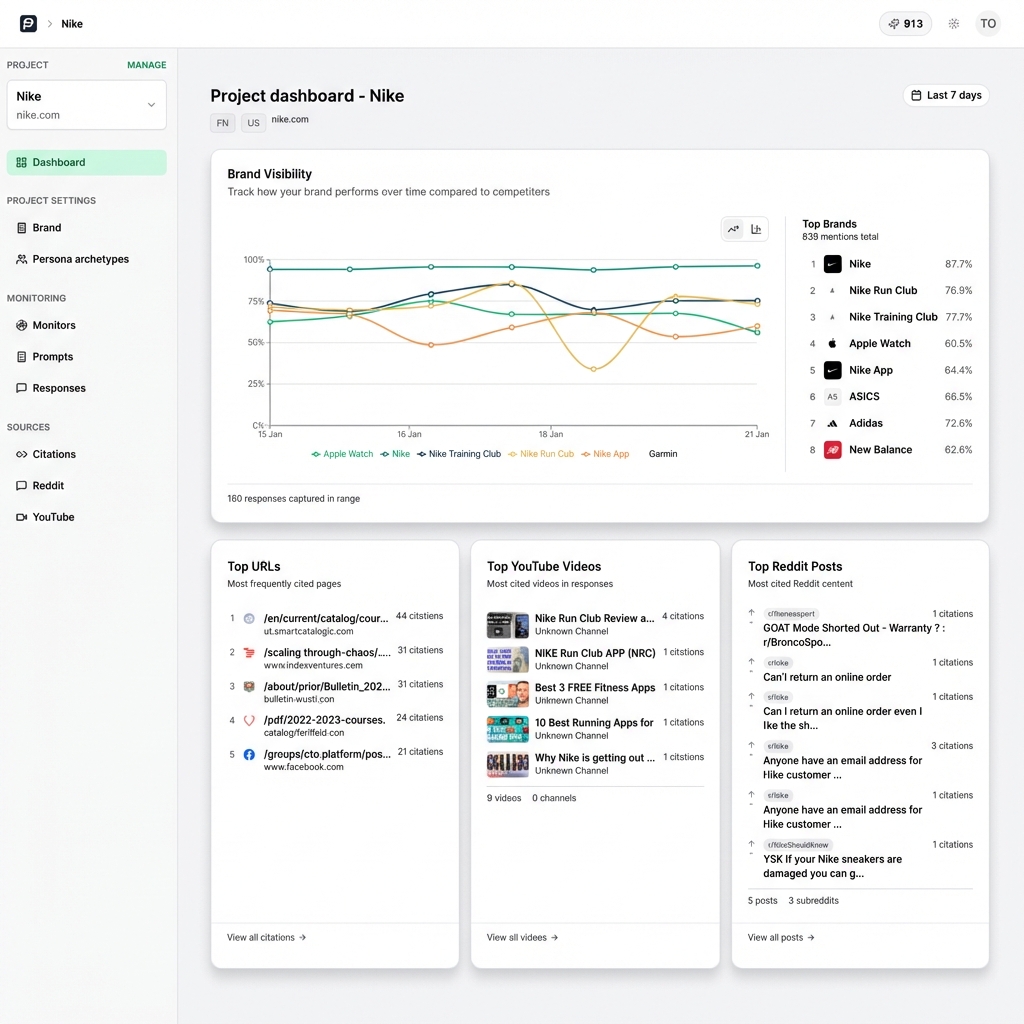
Once you have your prompt list, you need a way to monitor how ChatGPT responds to those queries over time. PromptEden tracks brand visibility across multiple AI platforms, including ChatGPT, Perplexity, Google AI Overviews, Gemini, and Claude. Its Citation Intelligence feature extracts the specific URLs and domains that AI models cite when answering tracked prompts, so you can see exactly which sources ChatGPT pulls from for each query.
The Visibility Score, measured from multiple to multiple, combines four factors: whether your brand is mentioned at all (Presence), how prominently it appears (Prominence), where it ranks in any lists (Ranking), and whether the model recommends it (Recommendation). Tracking these components over time shows you where to focus next.
Set up weekly or bi-weekly monitoring cadences to catch shifts early. AI citation patterns can change when models update their retrieval behavior, so consistent tracking matters more than one-time audits.