How to Optimize Support Content for Intercom Fin AI Visibility
Intercom Fin AI brand visibility measures how accurately and frequently a company's integrations or services are recommended by Fin based on support knowledge bases. Because Fin relies strictly on provided knowledge base content for its answers, undocumented partnerships become invisible to users asking for recommendations. This guide covers how to format your integration documentation so Fin AI can easily read, parse, and cite your product.

The Shift in Customer Support Discovery
Customer support is moving from human intervention to AI resolution. According to Intercom, AI agents like Fin resolve a significant portion of support queries autonomously. This shift means that many of a company's customer interactions never reach a human. For partner companies and third-party integrations, this introduces a visibility problem.
When a mutual customer asks a support bot for an integration recommendation, the bot will not browse the broader internet. Instead, it searches the immediate, approved knowledge base of the host company. If your product is not documented within that specific environment, the AI cannot recommend you. As a result, your brand loses a potential lead when they need it most.
Relying on marketing pages and app store directories is no longer enough. To maintain presence in this new ecosystem, companies must ensure their documentation is structured for AI consumption. This requires focusing on how machine learning models ingest, parse, and retrieve information.
Helpful references: Prompt Eden Workspaces, Prompt Eden Collaboration, and Prompt Eden AI.
What is Intercom Fin AI Brand Visibility?
Intercom Fin AI brand visibility measures how accurately and frequently a company's integrations or services are recommended by Fin based on support knowledge bases.
Fin operates differently from generalized AI models like ChatGPT or Claude. It relies strictly on provided knowledge base content for its answers. This grounding mechanism prevents hallucinations and ensures accurate customer support. However, it also creates a closed ecosystem. If a partner company has a deep integration with a host platform, but that integration lacks complete, AI-readable documentation within the host's help center, Fin will not surface it.
A common issue in partner marketing strategies is failing to address how integrations are cited by a partner's Intercom Fin bot. Companies often launch partnerships with a single press release, ignoring the long-term support documentation required to keep the integration visible. Fixing this requires shifting focus from standard marketing copy to structured, technical documentation that Fin can process and serve to users.
How Intercom Fin Processes Knowledge Base Content
Understanding how Fin retrieves information is the first step toward optimization. Fin uses a Retrieval-Augmented Generation (RAG) architecture. When a user asks a question, the system vectorizes the query, searches the approved knowledge base for semantically similar content, and then synthesizes an answer using only the retrieved snippets.
Here is the sequence of how Fin processes and returns information:
Query Ingestion: The user submits a question, such as "What CRMs do you integrate with?"
Semantic Search: Fin scans the help center articles for related concepts, looking for explicit mentions of "CRM", "integration", and specific brand names.
Snippet Extraction: The system pulls the most relevant paragraphs, lists, and tables from the documentation.
Synthesis and Citation: Fin constructs a direct answer and appends source links to the original articles it used.
Because the system relies on text similarity and structured extraction, vague marketing language fails. If an article says, "We connect smoothly with your favorite sales tools," Fin struggles to map that to a specific user asking about "Salesforce integration." The model requires explicit, factual statements and clear semantic boundaries to function correctly.
Create Dedicated Integration Articles
A common mistake partner companies make is bundling multiple integrations into a single, massive "Supported Tools" article. Fin struggles to extract detailed context from overly dense pages. Instead, you should advocate for dedicated, single-topic articles within your partner's knowledge base.
A dedicated article provides a clear semantic target for the AI. When a user asks about your specific brand, Fin can retrieve the exact page without parsing through unrelated noise.
Article Title Structure: Titles must match natural language user queries. Avoid clever marketing names.
- Bad: "Improving Workflows with [Your Brand]"
- Good: "How to Integrate [Host Platform] with [Your Brand]"
The First Paragraph: The opening sentences of the article must contain a self-contained answer block. This is the text Fin is most likely to extract verbatim. State exactly what the integration does, who it is for, and the primary benefit. Keep this section brief and avoid promotional adjectives.
Use AI-Readable Formatting Patterns
AI models parse structured data much better than dense paragraphs. To ensure your integration instructions are cited correctly, you need to use markdown-friendly formatting patterns. When Fin encounters a clean hierarchy, it can extract individual steps and present them natively in the chat interface.
Implement Clear Headings: Use H2s and H3s as direct questions or clear action statements. If a user asks "How do I find my API key?", an H2 titled "Locating Your API Key" serves as a solid anchor point for retrieval.
Use Numbered Lists for Workflows: When explaining setup processes, always use numbered lists. Fin excels at summarizing linear steps.
- Navigate to the Settings dashboard.
- Click on the Integrations tab.
- Select [Your Brand] from the dropdown menu.
- Paste your authentication token.
Use Comparison Tables: If your integration has different tiers or limitations, present this data in a table. AI models easily read tabular data and can answer conditional queries, such as "Does the basic plan support automatic syncing?" based entirely on table structure.
Embed Troubleshooting and Edge Cases
Fin's primary objective is to resolve queries without human escalation. If your documentation only covers the "happy path" of installation, Fin will hand the ticket over to a human agent the moment a user encounters an error. To maximize your brand's presence within the AI support experience, you should document edge cases.
Provide explicit solutions for common errors. Use clear "If/Then" formatting. For example: "If the sync fails with an authentication error, verify that your API token has not expired." When you include this level of detail, Fin can assist the user, associating your brand with helpful support.
Include exact error codes and specific terminology. When a user pastes a specific error string into the chat, Fin will match it directly to your troubleshooting section and deliver immediate value.
Tracking Your Mentions Across AI Platforms
While optimizing support content is important for platforms like Intercom Fin, your brand's overall AI visibility extends far beyond a single knowledge base. You need systematic measurement to understand if your optimization efforts are working.
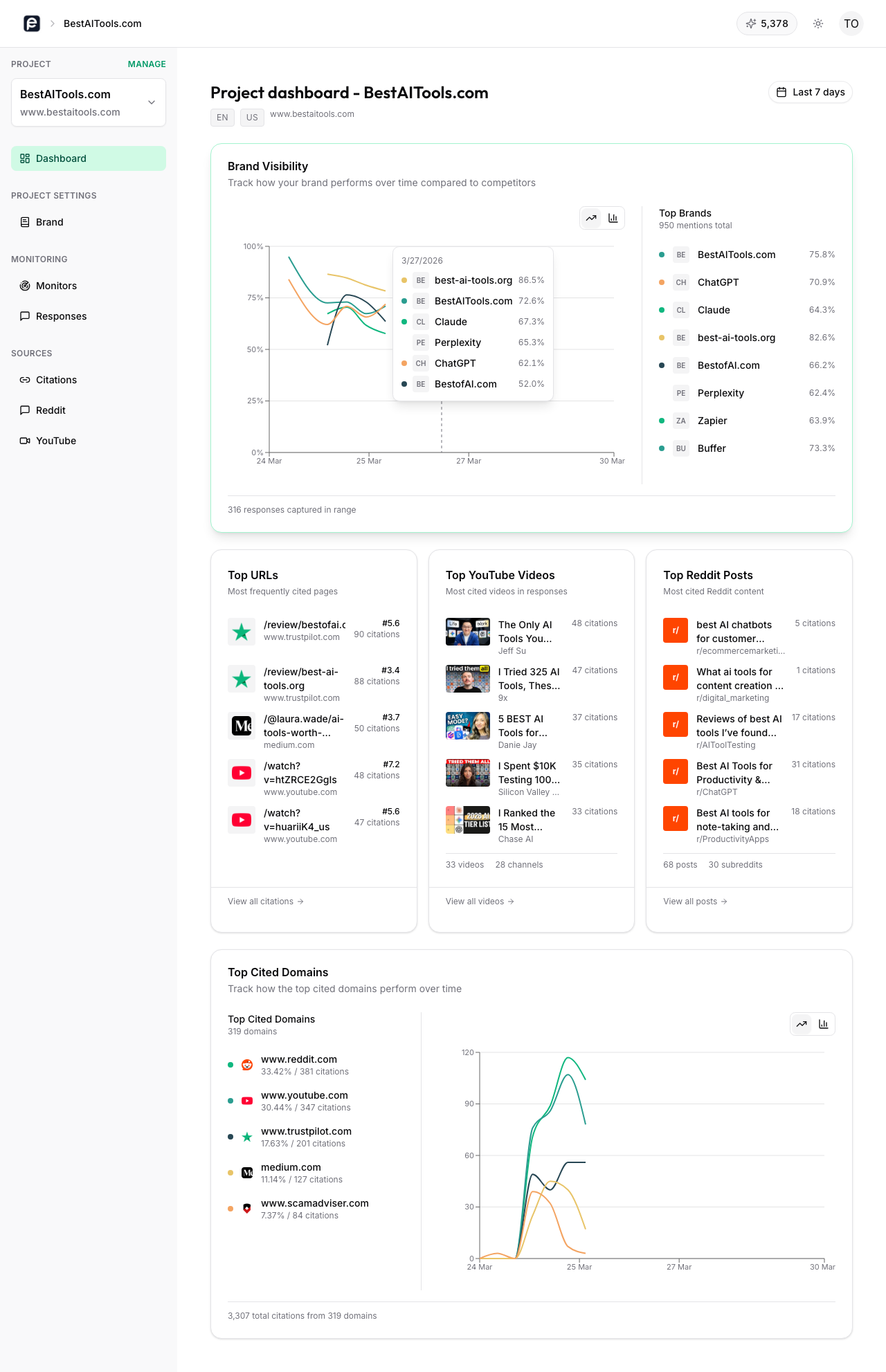
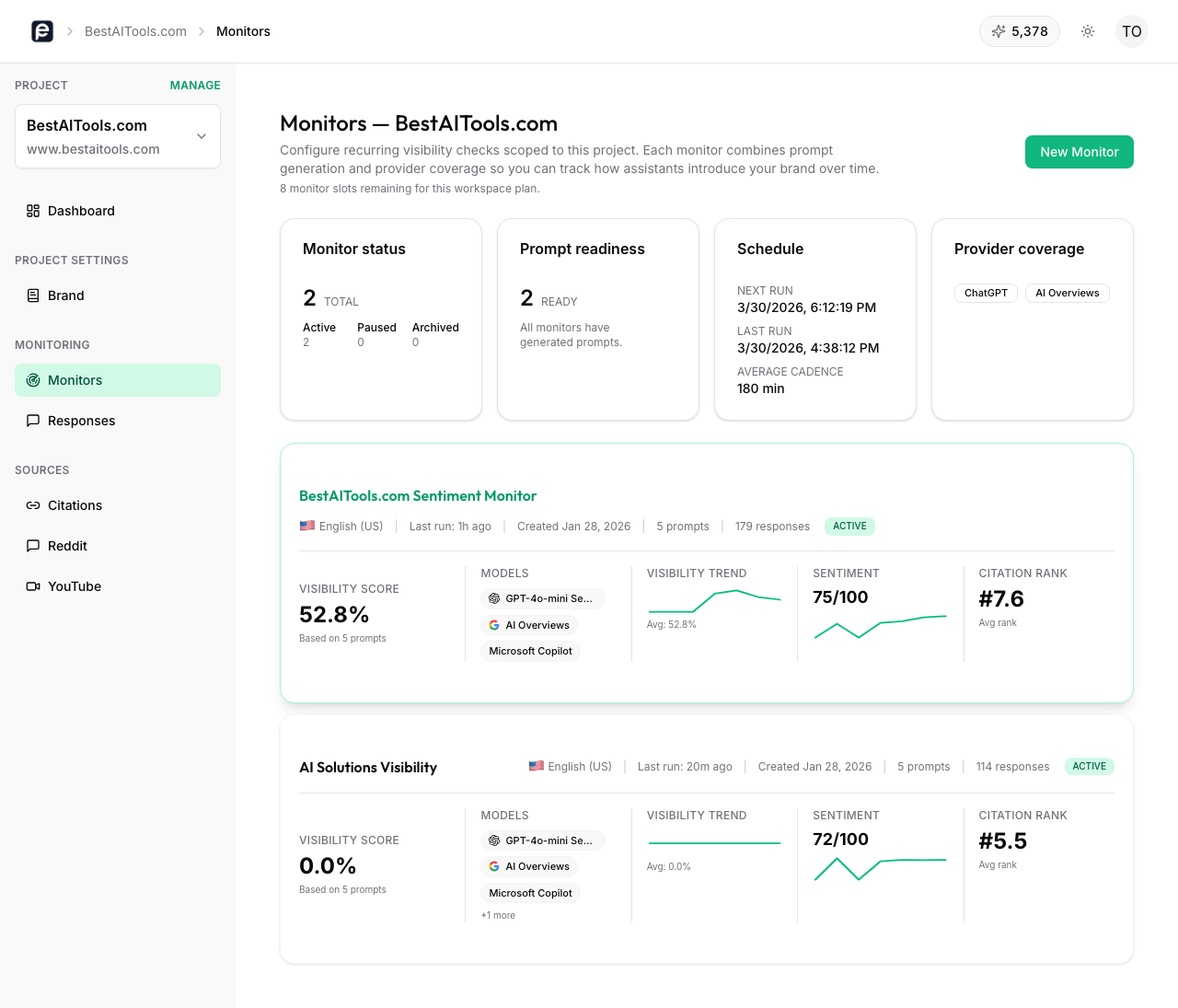
Prompt Eden provides Multi-Platform LLM Monitoring, tracking your brand across five AI surfaces: chat assistants and Google search. By defining relevant queries, you can monitor exactly how often your brand is recommended compared to competitors.
Using the Visibility Score, you can quantify your AI visibility across multiple distinct components: Presence, Prominence, Ranking, and Recommendation. This data allows you to prove the ROI of your content optimization efforts and identify which platforms require more attention. Moving from qualitative guesswork to quantitative tracking is essential for modern AEO.