

How GPT-4o Recommends B2B Software: A Complete Guide
GPT-4o's software recommendation engine relies on real-time web access and aggregate reviews rather than just training data memory. If your brand wants to appear when B2B buyers ask OpenAI models for tool recommendations, you need a strategy that feeds both its live search index and its knowledge base. This guide breaks down exactly how GPT-4o filters and recommends B2B software.

What is the GPT-4o Recommendation Engine?
Answer Engine Optimization (AEO) is the practice of improving how often AI assistants mention and recommend your brand. For OpenAI's flagship model, understanding its retrieval behavior is the key to capturing demand. GPT-4o's software recommendation engine relies on real-time web access and aggregate reviews rather than just training data memory.
Older versions of ChatGPT often showed static lists of popular tools from their initial training sets. GPT-4o operates as an active research assistant instead. When a B2B buyer asks for a software recommendation, the model combines its baseline knowledge with live data pulled from the web. Software vendors cannot rely on historical brand awareness alone. You must prove relevance and maintain positive sentiment across the digital surfaces that GPT-4o queries in real time.
For marketing teams, strong AEO performance directly affects demand capture when buyers ask AI tools for recommendations. If your product is absent from these high-intent AI prompts, you are invisible during the early stages of software evaluation.
Key Factors in How GPT-4o Recommends B2B Software
To secure a spot in GPT-4o's recommendation outputs, you need to understand the criteria it uses to evaluate options. The model balances baseline training with fresh context. Here are the main factors GPT-4o uses to filter and rank B2B software:
- Business Scale and Fit: The model categorizes tools by company size and complexity. It distinguishes between lightweight tools designed for startups and enterprise-grade solutions requiring dedicated IT management.
- Feature-to-Task Alignment: GPT-4o maps specific business tasks directly to a software's documented technical strengths. Examples include real-time customer support or complex data reasoning.
- Cost Versus Value Ratio: The model analyzes pricing tiers relative to expected return on investment. It often suggests mid-tier or specialized versions for high-volume tasks to save money.
- Integration Ecosystem: Software that offers strong APIs or native integrations with existing technology stacks like Salesforce or HubSpot receives priority placement.
- Live Sentiment and Aggregate Reviews: GPT-4o searches the web to find recent user reviews and forum discussions. It uses these to gauge market sentiment and reliability.
Matching your product marketing to these factors helps GPT-4o find the structured signals it needs to recommend your platform.
How Multimodal and Web-Integrated Mechanics Drive GPT-4o Recommendations
Most competitors talk broadly about ChatGPT, missing the specific multimodal and web-integrated ranking mechanics of GPT-4o. GPT-4o is not just a text generator. It is a multimodal engine capable of processing images and code alongside live web pages.
When a user uploads a screenshot of their current tech stack or shares a data dashboard, GPT-4o analyzes these visual inputs to identify operational gaps. It then cross-references those gaps against its live web search capabilities to recommend compatible software. This web-integrated mechanic means your software's documentation and compatibility matrices must be easy to access and structured for machine reading.
If your pricing page relies on complex JavaScript overlays or your integration list is hidden behind a gated PDF, GPT-4o cannot ingest that data during a live search session. Vendors that maintain clean and text-rich digital properties gain an advantage in these evaluations.
Real-Time Search vs. Baseline Training Memory
GPT-4o recommends B2B software using dynamic internet search alongside its baseline training. This dual-path retrieval system creates opportunities and challenges for B2B marketers.
Baseline training provides the model with general awareness of your brand and your category. If your software has been established for years, the model already knows who you are. Baseline training is static though. To answer specific queries like "What is the best CRM for a mid-sized agency focusing on AI workflows?", GPT-4o relies on real-time search.
The model sends search queries to authoritative domains and synthesizes the findings into a tailored response. This explains why a new startup with targeted content can outrank a legacy vendor in GPT-4o's answers. By maintaining fresh content on review sites and your own blog, you feed the real-time search mechanism that dictates final recommendations.
Why Traditional SEO Isn't Enough for GPT-4o
Traditional Search Engine Optimization focuses on ranking pages in a list of blue links based on keywords and backlinks. Answer Engine Optimization requires a different approach. GPT-4o does not care about domain authority alone. It looks for the factual density and citability of your content.
When evaluating software, GPT-4o looks for concrete evidence. It seeks out product comparison tables and clear pricing. If your website is full of marketing fluff, the model will struggle to extract the facts it needs to make a recommendation.
You need to structure facts and statistics so AI can easily attribute them. Use specific figures instead of broad adjectives. Include clear context and state limitations honestly, as this builds credibility with the model. Providing balanced information instead of promotional copy makes your content more likely to be extracted and synthesized into a GPT-4o response.
Measuring Your Share of Voice in GPT-4o
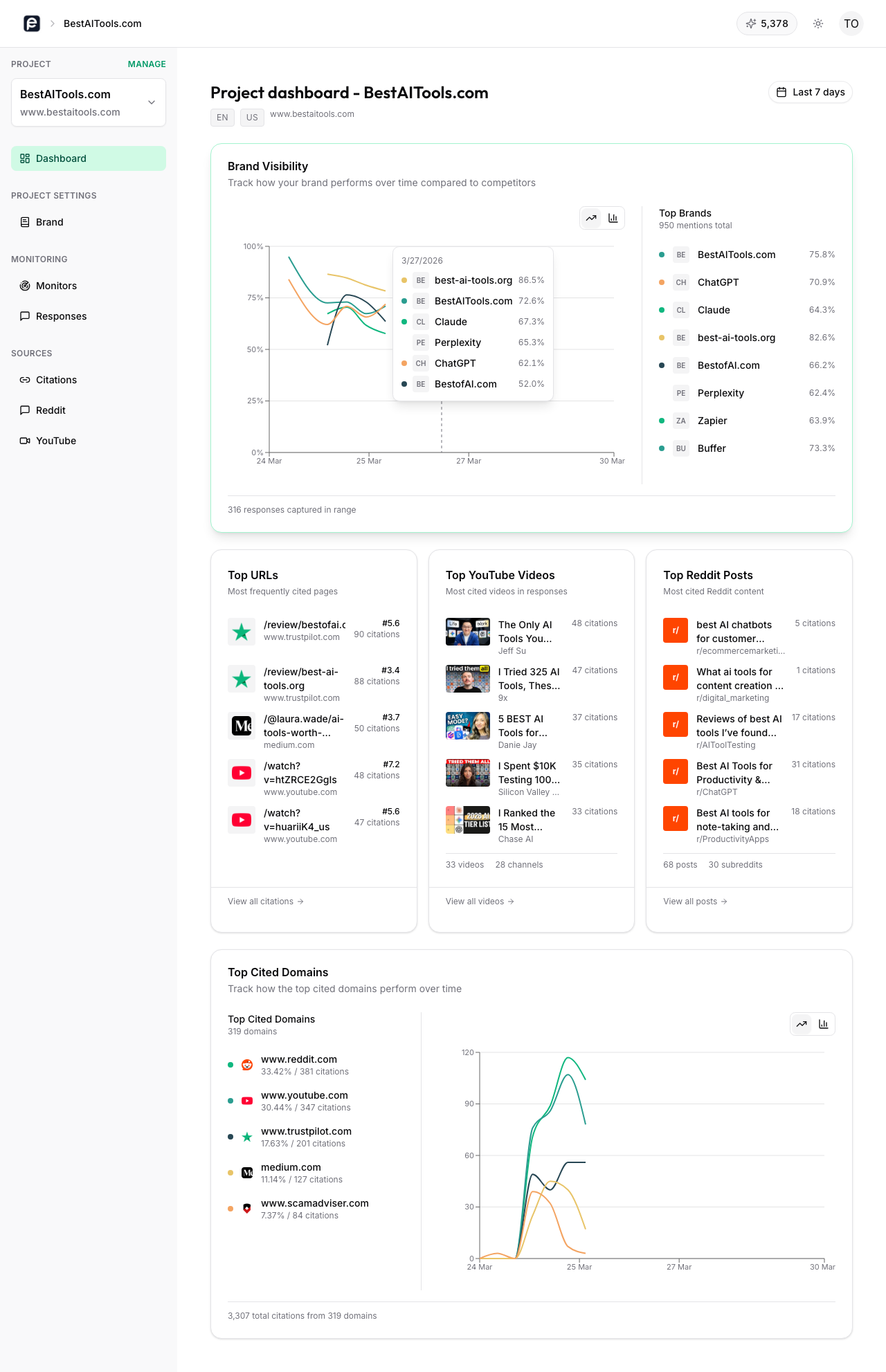
You cannot improve what you do not measure. To master GPT-4o recommendations, you need visibility into how often your brand is cited and recommended compared to your competitors. Prompt Eden is built for AI-search visibility, not retrofitted from traditional rank tracking.
Prompt Eden monitors brand visibility across multiple AI platforms spanning search, API, and agent categories. By tracking how often your software appears in GPT-4o outputs for high-intent queries, you can establish a baseline Visibility Score. This score quantifies your presence and recommendation frequency.
Features like Citation Intelligence allow you to see which sources GPT-4o cites when recommending you or your competitors using competitive intelligence. If you discover that the model frequently pulls from a specific third-party review directory when discussing your category, you know where to focus your marketing efforts.
How to Optimize Your Content for GPT-4o's Generative Search
Optimizing for GPT-4o requires a systematic approach to how you publish and distribute information about your software. Start by establishing quotable definitions for your product category on your homepage and documentation sites.
Create dedicated comparison pages that objectively evaluate your software against alternatives. Use structured tables and pros-and-cons lists with bold category names. This format is compatible with GPT-4o's extraction algorithms. You should also ensure your pricing and integration details are exposed in clean HTML.
Manage your presence on third-party validation sites. GPT-4o uses live web search to gauge sentiment, so reviews on platforms like G2 or Capterra and technical discussions on Reddit serve as important validation points that confirm your software's relevance to the model.