

How Autonomous Data Extraction Agents Handle Infinite Scroll
Dynamic, JavaScript-heavy infinite scroll implementations often cause context window limits and timeouts for AI crawlers. Understanding how autonomous data extraction agents handle infinite scroll is an important part of modern Answer Engine Optimization (AEO). In this guide, we explore how AI scraping works, the hidden costs of dynamic loading, and practical steps to optimize pagination for AI agents so your brand data is reliably ingested and recommended.

How Do Autonomous Agents Process Dynamic Pages?
When traditional search engine crawlers visit a web page, they mostly read the static HTML delivered in the initial server response. Modern autonomous data extraction agents operate differently. They behave more like human users by using headless browsers and complex logic to interact with dynamic interfaces. Understanding this behavior is a core foundation for Answer Engine Optimization in modern web applications.
Simulated Human Interaction The most common approach autonomous agents take with infinite scroll is simulated human interaction. These agents use frameworks like Playwright or Puppeteer to execute a series of programmatic scroll commands. They tell the browser to scroll to the bottom of the visible document, wait a set amount of time, and check the Document Object Model for new elements. If new items appear, the agent captures the data and repeats the scroll loop. This sequential process continues until the page height stops increasing or it detects a specific termination element.
Network Traffic Analysis and API Interception More advanced autonomous agents bypass visual scrolling completely to prioritize efficiency. Instead of rendering pixels and moving a virtual viewport, these agents monitor the background network requests triggered during the page load lifecycle. By analyzing the network traffic, the agent identifies the specific endpoints supplying the feed data. Once it isolates the relevant data source, the agent queries the endpoint directly. This allows the extraction layer to pull structured data without using the graphical interface, resulting in a much faster and more reliable ingestion process.
Vision-Based Extraction Techniques Beyond simple structural monitoring, some modern autonomous agents use computer vision to interpret web pages exactly as a human would. These agents take sequential screenshots of the interface as they scroll, applying optical character recognition and visual layout analysis to identify data patterns. For sites with highly complex, non-standard infinite scroll implementations that hide their underlying code, vision-based extraction provides a reliable alternative. This method is computationally expensive. If your site forces agents to depend on visual extraction because the code is unreadable, you decrease the frequency and depth of their indexing runs.
The Hidden Costs of Infinite Scroll for AI Crawlers
While modern autonomous agents can navigate complex JavaScript interfaces, relying on these dynamic patterns introduces friction. This friction directly impacts how deeply an agent will index your content, which affects your brand visibility in AI-generated answers.
Context Window Exhaustion Every time an autonomous agent triggers an infinite scroll load, new elements are appended to the active Document Object Model. As the page grows longer, the volume of markup increases. Autonomous agents must process this expanding structure while operating within strict memory and context window boundaries. When a page becomes too large, the agent may truncate the extraction process prematurely to conserve computational resources. Any products, articles, or brand mentions located deeper in the scroll feed remain invisible to the underlying large language model.
Timeouts and Orchestration Failures Infinite scroll relies on sequential data loading. An agent cannot request subsequent batches of items without first triggering and waiting for the initial batches. This sequential dependency increases the total time required to extract a complete dataset. AI orchestration layers enforce strict timeout policies to maintain system performance, so a slow sequential scroll process often triggers a timeout error. When an extraction job times out, the agent abandons the current task, leaving your data unindexed and unavailable for future AI recommendations.
The Definition of Effective AI Ingestion Answer Engine Optimization requires removing barriers to data ingestion. Modern autonomous agents can execute JavaScript and simulate user scrolling, but relying on infinite scroll can limit data extraction depth. This makes paginated fallbacks important for AI visibility. If your architecture forces an agent to spend extra resources just to view your content, that agent will prioritize more accessible sources.
Why Static HTML Pagination Outperforms Infinite Scroll
For marketing teams and developers focused on AI visibility, transitioning from infinite scroll to structured pagination provides a measurable advantage. Static HTML pagination aligns with the operational preferences of autonomous data extraction agents.
Predictable Data Structures Static pagination provides a predictable, bounded data structure for every individual page load. When an autonomous agent requests a specific page in a sequence, the server returns a fixed quantity of items. The agent processes this contained dataset quickly, extracts the relevant information, and moves to the next clearly defined target. This removes the risk of continuous document expansion and ensures the agent never exhausts its context window on a massive page.
Direct Linking and State Preservation Infinite scroll interfaces usually fail to preserve the application state in the uniform resource locator. If an agent wants to revisit a specific item discovered deep in an infinite scroll feed, it has to restart the scrolling sequence from the beginning. Traditional pagination provides a distinct, addressable location for every subset of data. An autonomous agent can index these specific addresses and return directly to them during refresh cycles. This capability is necessary for maintaining accurate, up-to-date citation sources in AI models.
Enhanced Answer Engine Optimization AI assistants and generative search features rely on authoritative, easily accessible data. When you implement static HTML pagination, you signal to autonomous agents that your site is a structured source of information. This structural clarity increases the likelihood that AI platforms will fully ingest your content catalog. A complete ingestion profile directly correlates with higher recommendation rates when users ask AI tools for industry specific solutions or product comparisons.
Answer Engine Optimization for JavaScript-Heavy Sites
You do not have to abandon infinite scroll for human users to achieve strong AI visibility. By implementing architectural fallbacks, you can serve a dynamic experience to real visitors while providing an accessible structure for autonomous data extraction agents.
Implementing Standard Relational Links A core optimization technique is to include standard relational links within your document head. Even if your user interface relies on JavaScript to load subsequent items, you should inject elements that point to the previous and next logical pages in the sequence. Autonomous agents look for these relational cues to understand the site architecture. When an agent detects these links, it can bypass the visual scroll mechanism and directly request the next batch of content using the structured addresses.
Providing HTML Fallbacks Another effective strategy is placing standard anchor tags at the bottom of your dynamic feeds. When a human user approaches the bottom of the feed, JavaScript intercepts their progress and loads new items. If an autonomous agent or a search crawler visits the page without executing the dynamic scripts, they will encounter the standard anchor tag pointing to the next paginated segment. This ensures that conservative data extraction agents can discover your full content catalog without relying on simulated scrolling.
User-Agent Detection and Pre-Rendering For complex applications, consider implementing user-agent detection at the edge of your network. When your infrastructure identifies a known autonomous agent or crawler, it can route the request to a pre-rendering service. This service processes the dynamic components and serves a fully rendered, static HTML response containing classic pagination elements. This approach ensures that AI platforms receive an accessible version of your content, removing the friction associated with dynamic data loading.
Structuring the Document Object Model for Clarity Answer Engine Optimization requires you to treat your Document Object Model as an interface for AI agents. When rendering items within a dynamic feed, ensure that each distinct item is wrapped in semantic HTML elements. Use descriptive class names, proper heading hierarchies, and clear boundaries between distinct data entries. When an autonomous agent attempts to parse a continuous stream of elements generated by infinite scroll, a clean semantic structure helps the agent separate individual items. If your feed is a mix of nested divisions without clear semantic markers, the agent will struggle to extract accurate relationships.
Advanced Troubleshooting for Autonomous Crawlers
Even with paginated fallbacks in place, marketing and engineering teams often encounter edge cases where autonomous agents struggle to ingest dynamic content. Anticipating and resolving these challenges is a core component of advanced Answer Engine Optimization.
Addressing Asynchronous Content Rendering A major challenge arises when structural pagination elements load asynchronously. If an autonomous agent requests a page and the relational links or fallback anchors require a secondary JavaScript execution to appear, fast-moving agents may miss them. Agents operating under strict efficiency constraints often parse the initial HTML response and move on if they do not detect immediate navigational cues. To prevent this, ensure that all critical navigational elements and paginated links are rendered on the server side and delivered in the initial document payload.
Managing Bot Protection and Rate Limiting As autonomous data extraction agents become more common, many organizations implement bot protection mechanisms to preserve server bandwidth. These security layers often cannot distinguish between a malicious scraping script and a beneficial AI agent attempting to index content for generative search recommendations. If your site employs aggressive rate limiting or visual challenges to verify human interaction, you will block autonomous agents from accessing your deep content catalogs. Ensure your security infrastructure allows known AI agents and provides a clear path for their extraction routines.
Verifying Network Idle States When autonomous agents interact with dynamic feeds, they rely on network idle states to determine when an action has completed. If your application continuously fires background telemetry requests, analytics events, or persistent connections, the agent may never register the network as idle. This prevents the agent from confirming that the new batch of infinite scroll items has successfully loaded, causing the extraction loop to stall. Streamlining your background network activity during feed interactions helps autonomous agents process your data without getting trapped in indefinite waiting periods.
Tracking Your AI Visibility and Agent Recommendation Rates
Optimizing your pagination strategy is the initial phase of an Answer Engine Optimization program. Once you have removed the technical barriers to data extraction, you must monitor how autonomous agents perceive and recommend your brand.
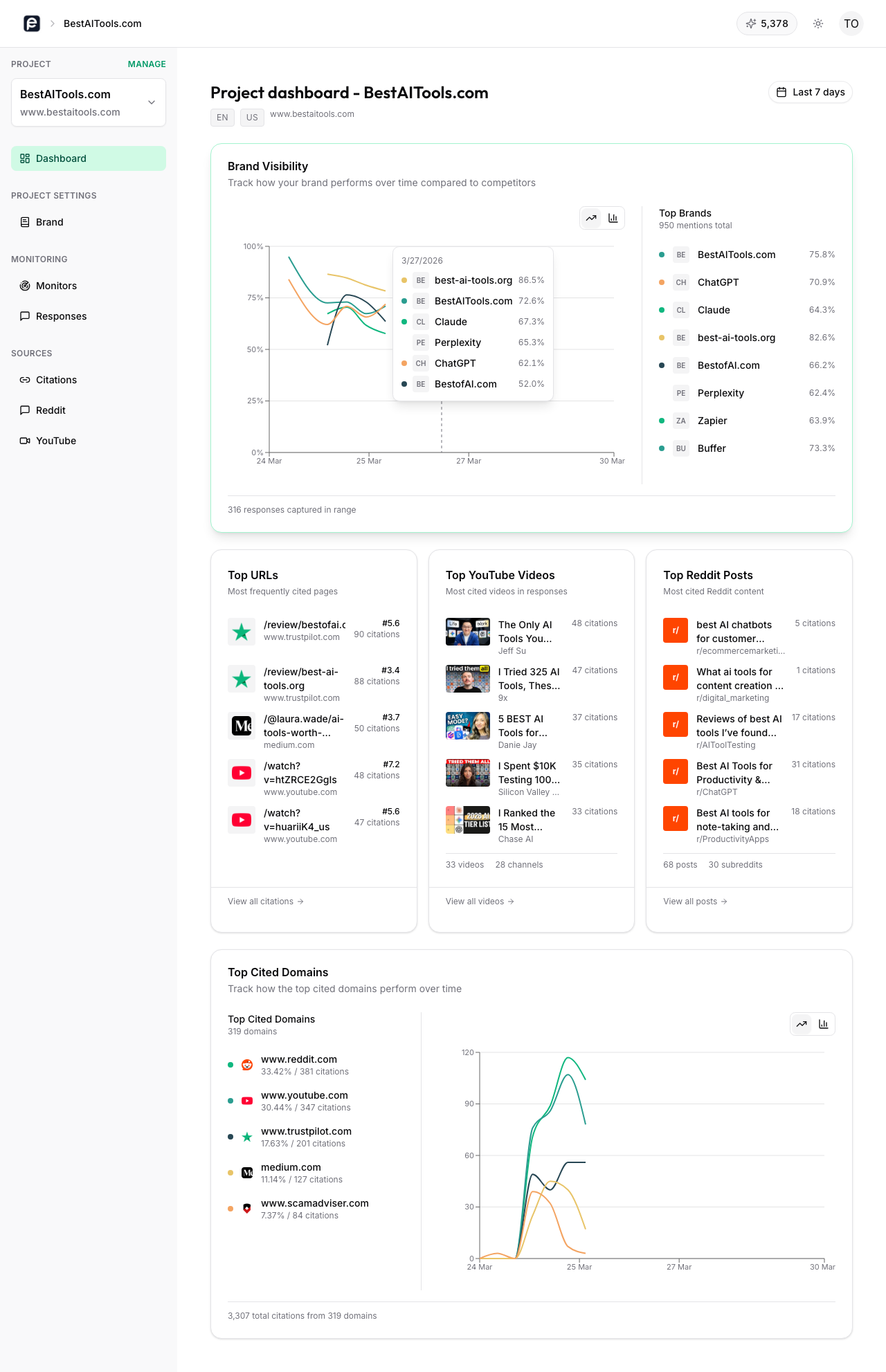
Measuring Platform Ingestion To understand if your architectural changes are effective, you need visibility into how AI platforms process your content. Prompt Eden monitors brand visibility across five AI surfaces: chat assistants and Google search. By tracking these distinct environments, you can verify that your optimized pagination is facilitating deeper data ingestion. When agents can extract your content, your overall presence in AI-generated responses increases.
Tracking the Visibility Score As autonomous agents process your newly accessible content, you should track your performance using a unified metric. The Prompt Eden Visibility Score quantifies your AI brand presence by evaluating core dimensions. It measures whether AI mentions your brand at all, how featured your brand is within the response, where your brand ranks in lists, and whether the AI recommends your brand to users. A rising Visibility Score confirms that your structural optimizations are translating into Answer Engine Optimization success. This insight helps you scale monitoring aligned with your pricing resources.
Analyzing Citation Intelligence You must also monitor which specific pages autonomous agents are citing when they recommend your products. Citation Intelligence lets you track the exact sources AI models use to generate their answers. By analyzing this data, you can confirm that agents are navigating your paginated structures and citing deep, relevant pages rather than just your homepage. This insight lets you refine your technical architecture to maximize AI visibility and drive qualified inbound interest.