

How to Implement Harvey AI Brand Tracking for Legal Tech
Answer Engine Optimization (AEO) improves how often AI assistants mention and recommend your brand in generated answers. Harvey AI brand tracking monitors how this specific legal LLM references legal technology vendors, law firms, and industry resources. This guide shows how to measure your visibility in vertical AI models and improve your digital footprint for legal tech procurement.

What is Harvey AI Brand Tracking?
Harvey AI brand tracking monitors how this specific legal LLM references legal technology vendors, law firms, and industry resources. Lawyers and legal professionals use AI more often for research and decision support. Because of this, showing up in these generated answers is now an important goal for legal tech marketing teams.
Vertical LLMs carry more trust in specialized industries. Horizontal models pull from the general consumer internet. Harvey, on the other hand, runs on specific legal datasets and trains for professional workflows. Because it is specialized, users view its output with high authority when it recommends a contract lifecycle management tool or cites a law firm for compliance expertise.
To monitor this visibility, you need to track queries related to your product category. If a managing partner asks the model to compare e-discovery platforms, your brand should appear in the results. Measuring this presence takes a structured approach. You have to test prompts, analyze citations, and understand the data sources feeding the model. Most AEO content ignores industry-specific models and focuses on generic platforms. Legal tech vendors who optimize for vertical AI visibility can take advantage of this gap.
Helpful references: Prompt Eden Workspaces, Prompt Eden Collaboration, and Prompt Eden AI.
Why Vertical LLMs Influence Legal Procurement
AI recommendations shape how law firms buy technology. Partners and IT directors use AI assistants for initial market research. They compare feature sets and build vendor shortlists before contacting a sales representative. You miss out on high-intent pipeline if your brand does not appear in these early AI-generated lists.
According to Harvey.ai, the platform serves over 1,300 organizations and 100,000 lawyers globally. This scale changes how legal professionals discover tools and services. When an attorney asks the system for the best tools to manage multi-jurisdictional compliance, the resulting list acts as an endorsement.
Vertical LLMs operate differently than traditional search engines, creating a challenge for marketers. They do not rank links using backlinks or standard SEO metrics. They piece together information based on entity relationships, clear definitions, and authoritative citations in their training data. Legal tech companies need to adapt their content strategies. You must define your product capabilities so these models can easily read and retrieve them. Leave the marketing copy behind and focus on factual, structured feature descriptions.
How Does Harvey AI Cite External Vendors?
You have to understand how an AI citation works before building a tracking strategy. When Harvey AI recommends a product or service, it relies on specific patterns in its training data and retrieval systems.
The model looks for highly structured, objective information. It prefers technical documentation, feature matrices, and clear use cases instead of persuasive marketing copy. The model is more likely to extract and cite your information if your website lists integration capabilities, security standards, and specific legal workflows.
Citations in vertical models usually come from authoritative third-party reviews, legal technology directories, and detailed comparison guides. The model learns to connect your brand with specific legal tasks when independent industry publications mention your platform often. Because of this, digital PR and strategic content placement matter just as much as on-page optimization. Legal tech brands need to audit their web mentions. This helps explain why a vertical LLM might prefer a competitor.
Step-by-Step Harvey AI Brand Tracking Strategy
To build a tracking program, you need a system for querying the model and recording the outputs. Closed vertical models do not offer public APIs for automated monitoring. However, you can set up a manual testing routine to get clear visibility metrics.
1. Define Your Core Prompt Categories Identify the specific questions your target audience asks during the research phase. Group these into category prompts (e.g., "What are the top e-discovery tools for mid-sized firms?") and feature prompts (e.g., "Which legal tech platforms integrate directly with Relativity?"). Document a master list of multiple to multiple test prompts.
2. Establish a Testing Baseline Run your master list of prompts through the model and record the results. Note whether your brand is mentioned, where it appears in the list, and the context of the recommendation. Does the model describe your tool accurately? Does it hallucinate features you do not have? Record these details in a spreadsheet to create your baseline.
3. Analyze Competitor Share of Voice Track which competitors appear most often during your baseline testing. Examine the digital footprint of any competitor that dominates the responses for contract analysis queries. Look at how they structure product pages, which industry publications feature them, and how they define their core capabilities. Use this competitive intelligence to guide your own optimization strategy.
4. Implement a Monthly Review Routine AI models update their weights and retrieval databases on a regular basis. A brand dominating responses in January might disappear by March if a competitor publishes an authoritative technical guide. Run your prompt list every month. This helps you catch shifts in visibility so you can adjust your content strategy.
Overcoming Competitor Gaps in Legal Tech AEO
Many legal tech marketing teams treat AI visibility as a single, generic concept. They optimize for broad platforms but ignore the unique requirements of vertical models. This creates a competitive gap that other brands can take advantage of.
To close this gap, focus on the depth and accuracy of your product documentation. Vertical models prioritize technical accuracy. Make sure your website includes thorough glossaries, detailed workflow descriptions, and precise feature definitions. When publishing a case study, cover the specific legal mechanisms involved rather than generic business outcomes.
You also need a consistent brand presence across legal-specific directories and review sites. The model might struggle to connect the entities if your platform is listed differently on various third-party sites. This leads to lower confidence and fewer recommendations. Keeping your naming, feature descriptions, and company positioning consistent builds entity authority in vertical AI ecosystems.
Prompt Engineering for Legal AI Visibility Testing
The quality of your test prompts determines the quality of your brand tracking data. You will get generic answers that miss actual user behavior if you ask broad questions. Legal professionals ask specific, complex questions. Your test prompts have to match how they actually search.
Start with persona-based prompting. Use prompts like, "Act as a compliance officer at a multinational bank. Evaluate the top three regulatory tracking platforms based on European data residency compliance." This applies specific constraints to the recommendations. It shows you exactly how the model understands your product capabilities.
After that, test comparison prompts. Ask the model to compare your brand directly against a primary competitor. Look closely at the pros and cons it lists for each. The model might consistently list a weakness for your brand that you fixed a year ago. If this happens, your recent product updates have not reached the model's retrieval index yet. You will need to publish updated, structured documentation covering those new features.
Connecting Vertical AI Tracking to Broader AEO
Manual tracking is necessary for closed vertical models, but it should not replace your broader Answer Engine Optimization strategy. The same principles that improve your visibility in specialized legal AI will also lift your presence across major horizontal platforms. A strong digital footprint helps everywhere.
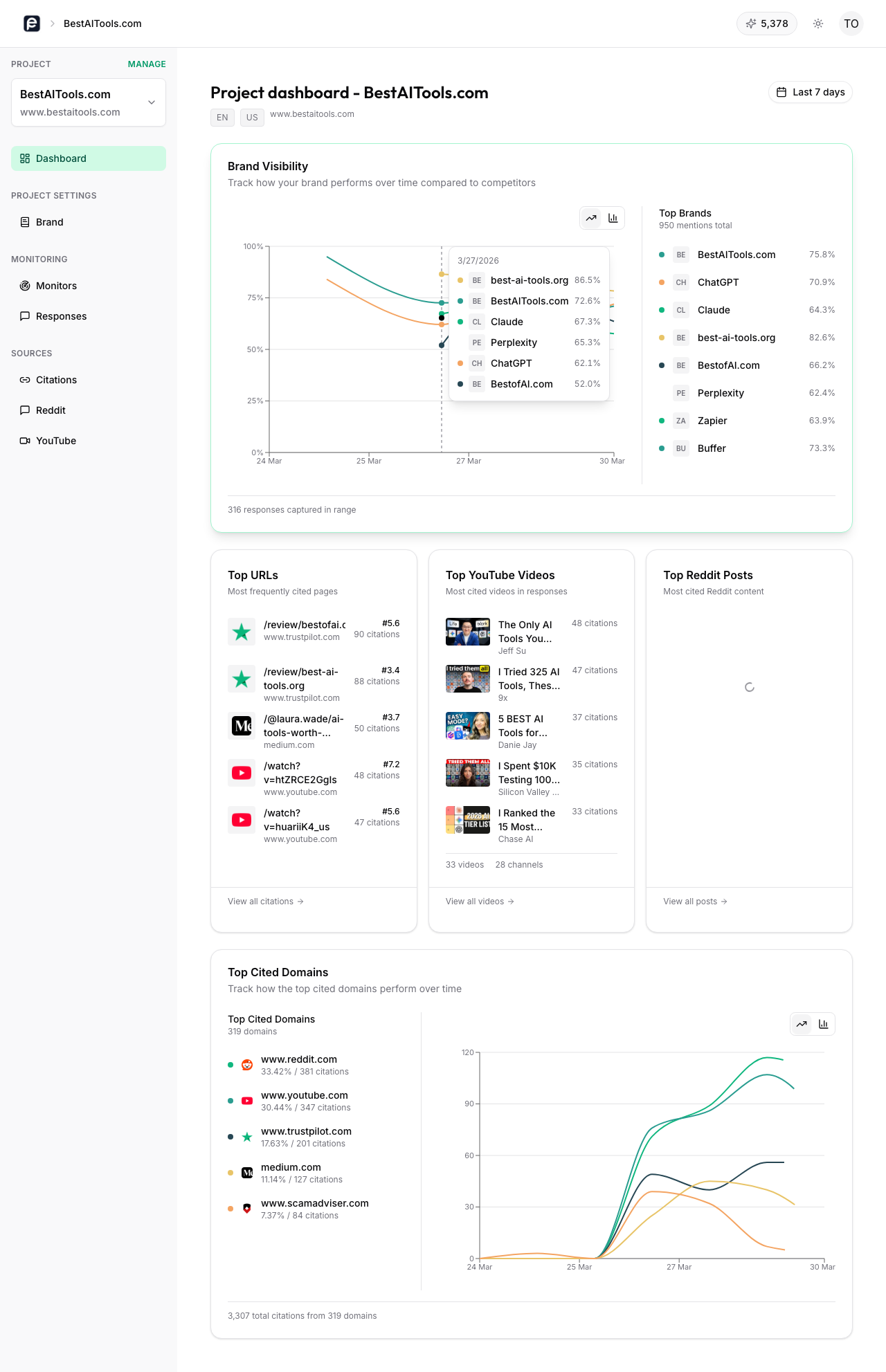
Prompt Eden monitors brand visibility across five AI surfaces: chat assistants and Google search. This includes ChatGPT, Perplexity, Google AI Overviews, AI Mode, Gemini, Claude, Claude Code, Codex, and GitHub Copilot. Using an automated platform to track your Visibility Score across these major models gives you a reliable measure of your overall AI authority.
When you optimize your content to rank better in Perplexity or ChatGPT, you also produce the high-quality, structured information that vertical models need. The Citation Intelligence gathered from broader platforms often reveals the exact third-party sources that influence specialized models. Legal tech brands can capture demand across the entire AI ecosystem by treating AEO as a complete approach. This means combining automated tracking for major platforms with targeted testing for vertical models.