

How to Conduct an AEO Measurement Audit
An AEO measurement audit checks your analytics setup to make sure AI search traffic, citations, and visibility are accurately tracked. Without good tracking, brands lose sight of their true AI-driven referral volume and often label it as direct traffic. This guide provides a complete multiple-step checklist for auditing your Answer Engine Optimization tracking setup. You will learn how to measure what actually matters in the AI era.

What Is an AEO Measurement Audit?: how conduct aeo measurement audit
An AEO measurement audit checks your analytics setup to make sure AI search traffic, citations, and visibility are accurately tracked. Answer Engine Optimization (AEO) goes beyond traditional search optimization to target visibility across large language models and autonomous agents. Because AI platforms frequently hide referral data, standard analytics deployments fail to capture the real impact of this channel.
A measurement audit ensures you can quantify your visibility accurately. You will need to review channel groupings in Google Analytics, validate citation source tracking, and establish baseline metrics across different model families. For marketing teams, a verified tracking setup helps you know where to spend your budget when buyers ask AI tools for recommendations.
A good audit goes beyond checking for broken links. It evaluates the entire data pipeline from the moment an AI assistant generates a citation to the moment the user converts on your site. When your reporting is solid, you can tie AEO efforts to revenue.
Why Your Analytics Setup Is Missing AI Traffic
Default analytics setups fail to isolate AI traffic for a few main reasons. First, AI platforms often strip referrers. When a user clicks a link from a mobile app version of ChatGPT or Claude, the referral header drops. This causes the session to appear as direct traffic.
Second, referral dilution hides specific AI sources. Traffic from platforms like Perplexity and Gemini gets buried in a general referral bucket alongside hundreds of other websites. Finally, the integration of AI Overviews into Google search results creates attribution problems. Google AI Overviews do not show up as distinct AI traffic in default setups. They report as standard organic search traffic. You cannot distinguish an AI summary click from a traditional blue link click without advanced tracking.
Brands relying on out-of-the-box Google Analytics setups are operating blind. They see organic traffic dropping but miss the spike in hidden AI referrals. You cannot optimize a channel that you cannot measure, which is why the audit process is so important.
Evidence and Benchmarks: The Cost of Poor Tracking
Poor AEO measurement has real financial costs. Marketing teams that fail to track AI search referrals will underinvest in content that drives high-intent buyers.
According to Get Passionfruit, up to 30% of AI traffic is miscategorized as Direct or (not set) in standard analytics setups. This means a third of your AI-driven success is invisible to leadership. The quality of this hidden traffic is also exceptional. According to Get Passionfruit, AI-referred visitors convert at 12x to 23x higher rates than traditional organic search. These users have been pre-qualified by the AI's research process and arrive on your site ready to buy.
The volume is accelerating rapidly. According to Taylor Scher SEO, AI-sourced website sessions grew 527% year-over-year. If your tracking setup is broken, you are missing the fastest-growing and highest-converting segment of modern search traffic.
The Five-Step AEO Measurement Audit Checklist
You need a solid measurement setup to track your brand's performance in AI search accurately. Here is the multiple-step checklist for an AEO tracking audit.
Capture these lessons in a shared runbook so new contributors can follow the same process. Consistency reduces regression risk and makes troubleshooting faster.
Teams should validate this approach in a small test path first, then standardize it across environments once metrics and outcomes are stable.
Document decisions, ownership, and rollback steps so implementation remains repeatable as the workflow scales.
Teams should validate this approach in a small test path first, then standardize it across environments once metrics and outcomes are stable.
Phase One: Map Your AI Referral Sources
Start by identifying the specific AI platforms your audience uses. Prompt Eden monitors brand mentions across five AI surfaces: chat assistants and Google search, including ChatGPT, Claude, Gemini, Google AI Overviews, and Google AI Mode.
You need to know which of these platforms are driving traffic to prioritize your tracking rules. According to Superlines, ChatGPT controls 87 percent of all direct AI referral traffic. This makes it the most important source to isolate first. List the known domains and subdomains associated with these models to build accurate matching rules in your analytics platform.
Phase Two: Audit Your Default Channel Groupings in Google Analytics
The most important technical step is reconfiguring your channel groupings. In Google Analytics, create a Custom Channel Group specifically for AI Search.
Navigate to your channel settings and define a rule that matches session sources against a regular expression containing terms like chatgpt, perplexity, gemini, and claude. Make sure to reorder this new AI Search group so it sits above the standard Referral group in your processing logic. This ensures AI sources are claimed before they fall into the generic bucket.
Phase Three: Implement UTM Parameter Enforcement for Owned Links
You cannot control the referral headers sent by third-party AI assistants, but you can control the links you provide to them. Many AI models index your social media profiles, press releases, and directory listings.
Check all external profiles and ensure they use strict UTM parameters. If an AI model pulls data from your LinkedIn page and cites the link provided there, the UTM parameters will stay on the link through the citation click. This creates a clear tracking path even when the AI strips the underlying referrer header.
Phase Four: Configure Source-Level Citation Tracking
AEO is about more than just direct traffic from the AI. You also need to know which pages the AI is citing. Check your analytics to ensure you capture the full landing page path for all AI referrals.
Prompt Eden provides Citation Intelligence to track which sources AI models cite when mentioning your brand. Ensure your internal analytics can validate these citations by tracking the exact entry pages. If Perplexity cites your pricing page, your analytics should confirm that the perplexity.ai referral landed on that specific URL.
Phase Five: Establish Baseline Visibility Scores Across Models
The final step of the audit is measuring total visibility. Traffic is a lagging indicator, but visibility is a leading indicator.
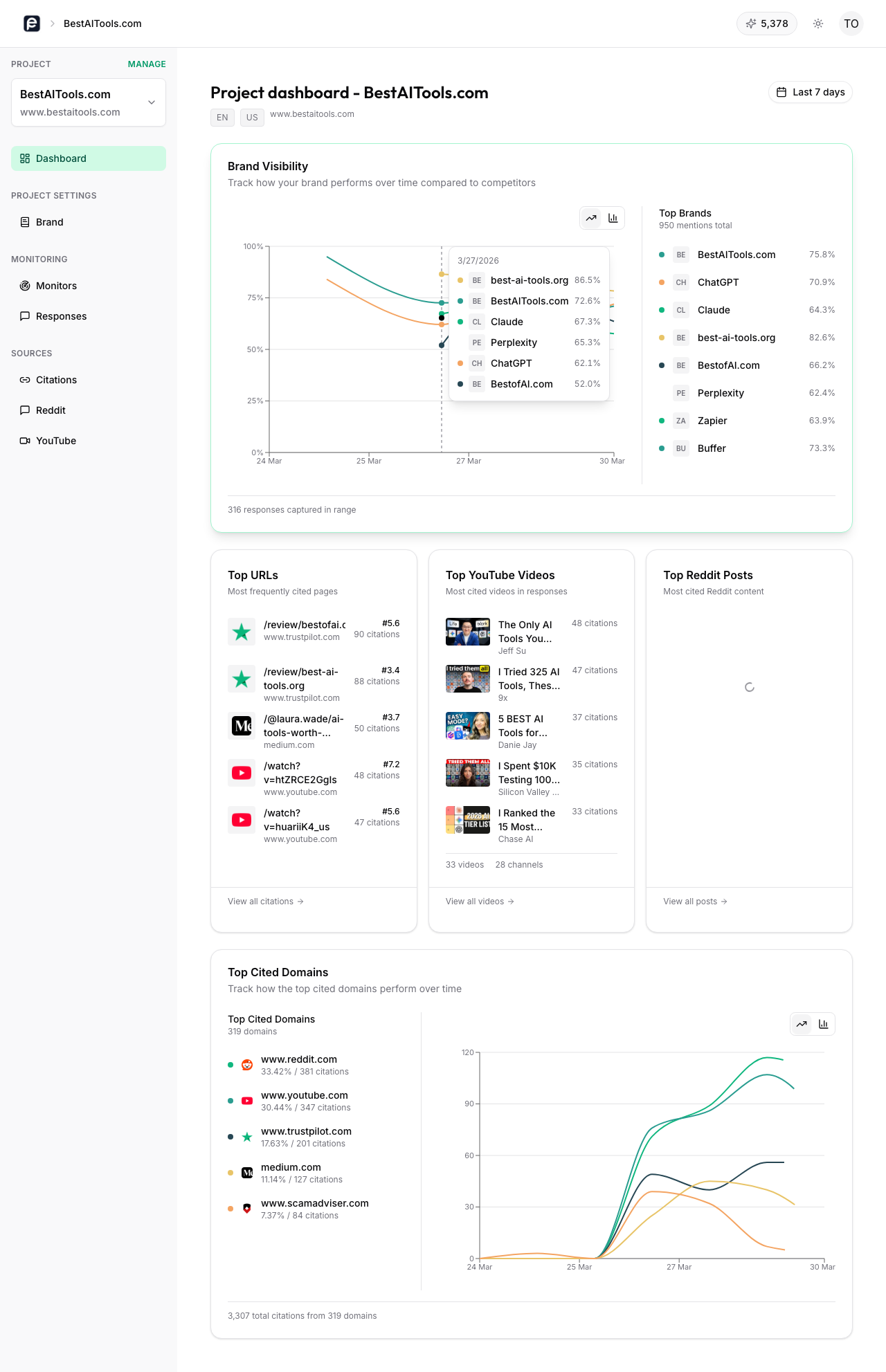
Establish a baseline using a combined metric. Prompt Eden uses a Visibility Score from zero to one hundred that measures Presence, Prominence, Ranking, and Recommendation across model families. Record your baseline score for your primary keywords. This gives you a clear starting point to measure the impact of your future AEO content strategies.
Prompt Eden vs Traditional SEO Rank Trackers
Traditional SEO tools were built for ten blue links. They track static keyword positions on Google and assume ranking equals visibility. This model no longer works in the generative era.
Prompt Eden is built specifically for AI-search visibility. While legacy tools struggle to parse conversational AI outputs, Prompt Eden features Multi-Platform LLM Monitoring across search engines, API models, and autonomous coding agents like GitHub Copilot and Claude Code.
Instead of a meaningless ranking position, Prompt Eden uses Organic Brand Detection to find competing brands appearing in answers alongside you. It provides a single dashboard for multi-platform AI monitoring to solve the visibility gaps a measurement audit uncovers. Explore how this changes your reporting on our Features page.
Turning Audit Findings Into Action
An audit only helps if it leads to changes. Once you isolate your AI traffic and establish your baseline visibility, you can start optimizing.
Look for gaps in your Citation Intelligence. If models cite outdated documentation or third-party review sites instead of your primary landing pages, you need to update your content. If your Visibility Score is high on Perplexity but low on ChatGPT, you can adjust your formatting to better match how OpenAI's search works.
By completing this audit, you stop guessing about AI impact. You can start managing it as a measurable, predictable acquisition channel. For more details on using these insights, check out our Competitive Intelligence workflows.