How to Optimize for What Sources Do AI Models Cite
Understanding what sources AI models cite forms the foundation of Answer Engine Optimization. Different platforms display distinct behaviors when selecting websites to reference. This guide explains how to structure your content to become a trusted source for major AI assistants.

What Are AI Model Citations?: sources models cite
AI model citations are the sources large language models reference when generating answers. These links vary by platform. Perplexity provides inline annotations, ChatGPT sometimes references its training data, and Google AI Overviews point to indexed web pages.
For marketing teams and content creators, becoming a cited source is the primary goal of Answer Engine Optimization. When an AI assistant recommends a product or explains a concept, the linked citations act as the new first page of search results. Missing out on these citations means losing visibility with high-intent buyers.
The shift toward answer engines changes how information is retrieved. Traditional search engines return a list of links for the user to evaluate, while answer engines synthesize details from multiple pages into a single definitive response. To prove their credibility, they append citations to the generated text. Because of this synthesis process, AI models are selective. They look past keywords to find authoritative, structured, and factual data they can easily extract.
Many marketers still focus on traditional blue links. They optimize title tags and meta descriptions to capture clicks from standard search results. But user behavior is changing. People now ask complex questions directly to AI assistants and expect immediate answers. If your brand relies only on the traditional search ecosystem, you remain invisible to this growing audience.
Becoming a cited source requires a different approach. You are no longer writing just for a human reader skimming a page. You are also writing for an algorithmic parser that scans your content to verify specific facts. This dual audience means your material must engage the person who clicks the citation while providing clear structure for the machine creating the link.
Helpful references: PromptEden Workspaces, PromptEden Collaboration, and PromptEden AI.
The Evidence and Benchmarks Behind AI Citations
Analyzing millions of AI-generated answers reveals clear patterns about which sources models prefer. The data shows that AI platforms favor a specific type of trust graph.
According to BrightEdge, Perplexity cites 5-8 sources per response while ChatGPT citations vary by mode. This frequency proves that modern answer engines rely on multi-source verification. They rarely pull an entire answer from a single page. Instead, they assemble facts from several distinct domains to create a balanced response.
According to Search Engine Land, Perplexity provides an average of 5.6 citations per response across standard queries. This metric highlights a major difference between AI and traditional search: you are competing for a small handful of citation slots rather than a full page of organic links.
You have to adapt your strategy to fit these narrow windows. High-authority domains like Wikipedia often take the top citation slots for factual queries. Commercial queries, though, leave room for industry publications, verified review platforms, and structured brand documentation. Understanding how these selections work helps you position your content against larger competitors.
The trust graph in AI search operates differently than traditional link building. In traditional SEO, a backlink from a trusted site passes value directly to your page. In Answer Engine Optimization, the AI model builds a temporary trust graph for every query. It determines authority by looking at factual consistency across multiple references, not just overall domain strength.
When an answer engine processes a prompt, it identifies the core entities and claims required to form a response. It then searches its index or the live web to find sources that corroborate those claims. If multiple separate sites all point to the same statistic, the model gains confidence in that fact. By positioning your content as the definitive source of a unique data point, you integrate your domain into this real-time verification process. This makes your website a valuable node in the AI's temporary trust graph and improves your chances of securing a citation.
Platform-Specific Citation Behaviors
Not all AI models cite sources in the same way. Their underlying architecture and intended use cases dictate how they interact with the web.
How Perplexity Cites Sources
Perplexity operates as a citation-first search engine. It crawls the web in real-time to find the best references for a user prompt and provides detailed inline annotations. This design builds trust by showing the user exactly where each piece of information originated. The platform favors recent publications, established news outlets, and structured technical documentation. For Perplexity, the citation is the product. The user interface focuses on transparency, letting users hover over sentences to see the exact source URL. As a result, Perplexity filters out thin content and hunts for dense, informative pages that aid the user's research process. If your page provides a unique angle or a hard-to-find fact, Perplexity is likely to feature it.
How ChatGPT Handles References
ChatGPT citations vary depending on the prompt and active features. When using its default browsing capabilities, it searches the web and appends source links at the end of its response, often favoring prestige domains and established media. If the query does not trigger a web search, it relies on its training data and may not provide explicit external links. Because of this duality, you need to optimize for both real-time search retrieval and long-term model training. ChatGPT's approach is more opaque but just as important. When users do deep research, they often prompt ChatGPT to browse the web for the latest updates. In these scenarios, the model pulls from top-ranking news and industry sites. Even if it never links to your site directly, embedding your brand in the broader information ecosystem ensures the model understands your value proposition.
Google AI Overviews and Gemini
Google integrates its AI models directly into its search ecosystem. Google AI Overviews frequently cite high-ranking organic search results and pull from platforms like YouTube and Reddit. Gemini, Google's standalone assistant, behaves similarly by checking facts against Google's index. Getting cited by Google's AI tools usually requires strong traditional SEO fundamentals combined with clear answers. Because Google possesses the largest search index in the world, its AI Overviews draw from a huge pool of potential references. The system tries to balance traditional organic ranking signals with the specific needs of a generative answer. Your page must answer the user's question well while maintaining strong technical search engine optimization to be considered for inclusion.
Claude and Document Sourcing
Claude takes a different approach. It often relies on user-provided documents or specific context windows rather than open web searches. While it can access external information, its primary strength lies in analyzing provided text. To get cited by Claude in enterprise environments, your documentation must be clear enough that users naturally include it in their own prompts and internal knowledge bases.
What Makes a Source More Likely to Be Cited?
AI models act like fast, impatient researchers. They lack the time to read sprawling narratives or decipher confusing site architectures. Instead, they look for specific signals indicating a page is a reliable source.
Information Density and Factual Clarity
Models prefer pages packed with concrete facts. Vague statements get ignored, while specific numbers, defined terms, and unambiguous claims get cited. If you write that a software tool is fast, an AI model will probably gloss over it. If you write that the tool processes thousands of records per second, the model can extract and cite that exact data point.
Clean Content Structure
Structure matters just as much as the words themselves. AI parsers rely on HTML tags to understand hierarchy. Proper use of structural headings helps the model read the page. Bulleted lists and numbered steps are especially effective because they break information down into discrete chunks that an AI can incorporate into a synthesized answer.
The Role of Schema Markup
Technical optimization still matters. Schema markup provides a direct language for machines to interpret your content. Formatting your site with the appropriate technical structure gives AI models explicit context about your page. This clarity reduces the computational effort required to process your site and makes it a more attractive citation target.
Authority and Recency
Models prioritize domains with established authority. They also check publication dates to ensure they provide current information. Keeping your content updated and maintaining a strong domain profile increases your chances of being selected as a primary source. A recently updated page will often outrank an older page from a stronger domain.
Visual formatting is easy to overlook in Answer Engine Optimization, but it plays an important role in citation selection. AI parsers struggle with unbroken walls of text. They need structural cues to understand where one concept ends and another begins. Breaking your content into short, focused paragraphs makes it easier for the model to isolate and extract your key points.
The language you use around your facts also matters. Avoid ambiguous phrasing. Instead of saying that your software works alongside popular tools, list the exact integrations. State that your platform connects directly with Slack, Salesforce, and Jira. This level of specificity gives the AI model concrete nouns to index and retrieve. You also have to consider the context window of the AI model. When a model scans your page, it only holds a certain amount of text in its immediate memory. If your most important facts are buried at the bottom of a long essay, the model might drop the context before it ever reaches them. Place your most important, citable claims near the top of the page, right after clear, descriptive headings.
How to Optimize Your Content for AI Citations
Knowing what models look for is only the first step. You must actively format your website to meet these criteria. This process requires a shift from keyword stuffing to intent fulfillment.
Write Quotable Definitions
Start your pages and major sections with clear, definitive statements. Create sentences that an AI can quote directly without needing additional context. For example, begin a glossary page with a single sentence that defines the term, then follow that sentence with supporting details. This pattern makes it easy for models to extract your core point and cite you as the source.
Consolidate Your Facts
Instead of spreading data points across a long article, group them together. Create dedicated sections for statistics, pricing, or feature comparisons. Use tables to organize complex data. When an AI model needs to compare your product to a competitor, a clean feature table provides the exact structure it needs to generate an accurate response.
Address the Negative Space
Most marketing content only talks about the positive aspects of a product. AI models seek balanced, objective answers. Acknowledging limitations or explaining who your product is not for increases your credibility. This objective tone aligns with the neutral voice AI models try to project and makes your content a safer citation choice.
Create Dedicated Resource Centers
Another effective strategy is to create dedicated resource centers. Instead of hiding your technical documentation behind login screens or complex menus, make it freely available and easy to scan. AI models frequently cite technical documentation because it is structured and objective. By formatting your support articles, API references, and product glossaries for public consumption, you create a large surface area for potential citations.
Monitor and Adapt
You should also engage in active brand monitoring. The AI ecosystem shifts constantly, and a strategy that works today might be obsolete next month as models update their retrieval algorithms. Watch how your share of voice changes over time. When you notice a drop in citations for a specific topic, you can investigate the new sources the model favors and adjust your content.
Use the guide on how AI prompts affect brand visibility
You can use PromptEden's guide on how AI prompts affect brand visibility to discover how users ask questions about your industry. Build your content strategy around these specific phrasing patterns. If you answer the exact questions users pose to AI assistants, you improve your likelihood of selection.
Tracking and Measuring Your AI Citation Share
Optimization without measurement is just guesswork. You need to know if your efforts are increasing your presence in AI-generated answers.
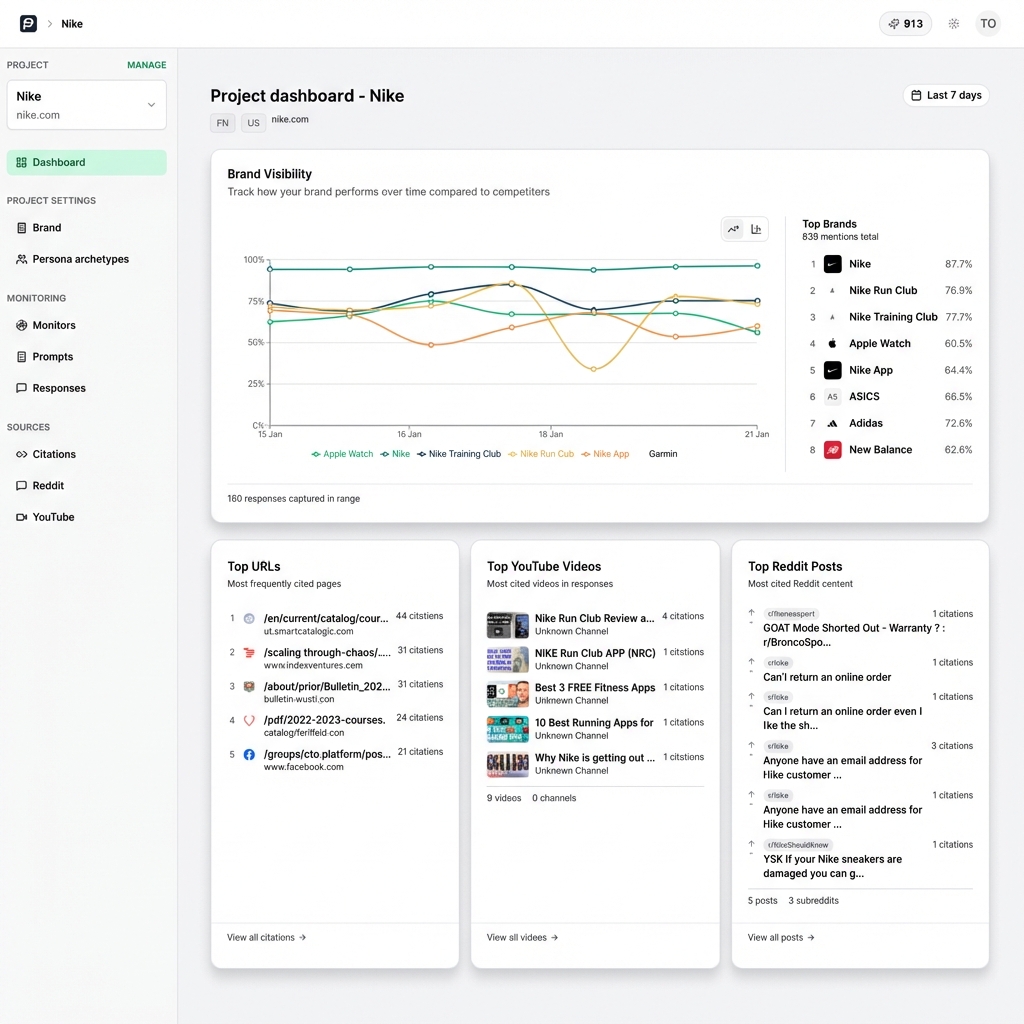
PromptEden monitors brand visibility across five AI surfaces: chat assistants and Google search. This coverage lets you see which models cite your content and which ones ignore you. You cannot rely on traditional web analytics to measure this impact. AI platforms do not always send referral traffic when they cite you, so standard click metrics tell an incomplete story.
Our platform shows you the specific sources models cite for you and your competitors. By analyzing this data, you can identify gaps in your coverage. If a competitor is consistently cited by Perplexity for a certain topic, you can review their page structure and update your own content to compete for that slot.
The stakes for measuring this visibility are high. As more users bypass traditional search engines, the traffic that once flowed to your homepage now stays within the AI interface. If you are not tracking your presence in these generated answers, you are flying blind in an important new channel for organic discovery.
By providing a clear, quantified Visibility Score, we give you the metrics needed to prove the return on investment for your Answer Engine Optimization campaigns. You can demonstrate how your content structure improvements capture market share in the AI ecosystem. Citation Intelligence also allows you to conduct deep competitive analysis. You can enter a competitor's domain and see every instance where an AI model recommended their product instead of yours. Armed with this data, you can rewrite existing pages, deploy targeted new content, and reclaim your position as an authoritative source in your industry.