

How to Track AI Visibility Across the Customer Journey
Tracking AI visibility across the customer journey maps brand mentions and citations in LLMs to specific stages of the buying cycle, from initial vendor shortlisting to final comparison. As buyers increasingly use AI assistants for early research, understanding where and how your brand appears across conversational engines is important. Learn how to align Answer Engine Optimization (AEO) metrics with your funnel, measure share of voice at each touchpoint, and build a dashboard that connects AI visibility to demand capture.

What is Tracking AI visibility across the customer journey?
Answer Engine Optimization (AEO) is the practice of improving how often your brand is cited, mentioned, and recommended in AI-generated answers. Today, this discipline must expand beyond simple keyword tracking to cover the entire customer journey. Modern B2B buyers use AI assistants for initial vendor shortlisting before they ever visit a corporate website or speak to sales. If your brand does not surface in these early conversational queries, you are invisible in the modern evaluation phase.
This shift requires a new measurement framework. Tracking AI visibility across the customer journey maps brand mentions and citations in LLMs to specific stages of the buying cycle, from initial research to vendor comparison. Instead of treating AI as a single channel, marketing and SEO teams must recognize that a buyer's prompt behavior changes as they move closer to a decision.
For example, a prospect in the awareness stage might ask Claude for broad industry trends. A week later, that same prospect might ask Perplexity to compare specific software platforms. Understanding how your brand performs at each of these discrete touchpoints allows you to target content gaps, improve citation intelligence, and measure the true impact of your AEO efforts on down-funnel demand.
In practice, this means moving away from generic rank tracking. Teams need a system that evaluates presence, prominence, and recommendation frequency across multiple model families simultaneously.
How to Map AI Touchpoints in the Buyer Journey
The traditional marketing funnel (awareness, consideration, and decision) still applies to AI search, but the shape of the touchpoints has changed. Buyers no longer click through ten blue links. Instead, they refine their prompts iteratively and ask follow-up questions that narrow their choices.
To map these touchpoints, you must categorize the types of prompts buyers use at each stage. At the top of the funnel, queries are educational. In the middle, they become comparative. At the bottom, they are specific and action-oriented.
Awareness Stage Prompts:
- Broad industry questions and trend analysis.
- "What are the best practices for..."
- "How do enterprise teams solve..."
Consideration Stage Prompts:
- Category evaluations and vendor shortlisting.
- "What are the top platforms for..."
- "Compare [Competitor A] and [Competitor B]."
Decision Stage Prompts:
- Deep feature inquiries and pricing comparisons.
- "What are the limitations of [Your Brand]?"
- "Does [Your Brand] integrate with..."
By defining these touchpoints clearly, you can structure your tracking mechanisms to reflect genuine buyer intent. This alignment ensures that your reporting captures whether you are influencing buyers at the moment they form their vendor shortlists.
Measuring Awareness: The Top of the AI Funnel
At the top of the funnel, your goal is to build initial mental availability. When a buyer asks an AI assistant about a broad industry problem, you want your brand to be cited as an authoritative source or an example of a leading solution. Tracking visibility here requires a focus on broad category keywords and educational prompts.
Step-by-Step Top-of-Funnel Tracking:
- Identify Educational Queries: Build a cluster of prompts that address the overarching problems your product solves, rather than the product itself.
- Monitor Citation Frequency: Use Prompt Eden's Citation Intelligence to track how often your educational content (blogs, glossaries, whitepapers) is referenced by models like ChatGPT and Google AI Overviews.
- Track Unbranded Presence: Measure whether your brand name appears in answers to unbranded industry questions.
The primary challenge at the awareness stage is that AI models favor established publishers and high-authority domains. Your visibility metric here should index on how often your owned content serves as the training data or live-retrieval source for these broad answers.
Consistent tracking at this stage acts as an early warning system. If your awareness-level visibility drops, it indicates that a core model update has shifted its retrieval preferences. This requires an adjustment to your content structure or technical schema.
Tracking Consideration: When Buyers Compare Options
The consideration phase is an important area in AEO. Consideration-phase queries yield valuable AI citations because they influence which vendors make it onto the buyer's final shortlist. When a user asks an AI to "compare the best tools for X," exclusion from that answer means exclusion from the deal.
Tracking Consideration-Phase Metrics:
- Category Inclusion Rate: How often your brand is included when users ask for a list of top vendors in your space.
- Competitor Co-Occurrence: How often you are mentioned in the same response as your primary competitors. Prompt Eden's Organic Brand Detection automatically discovers which competing brands appear alongside you in these answers.
- Sentiment and Context: Being mentioned is not enough; you must track how the model describes your platform. Are you positioned as the enterprise leader or the budget alternative?
To win this stage, you must monitor "vs" and "alternatives" prompts. Buyers ask models to summarize the pros and cons of specific platforms based on Reddit threads and aggregated reviews. Tracking how your brand fares in these direct comparisons provides actionable insights for your product marketing team.
If your brand loses head-to-head comparisons in Claude but wins in Gemini, you can use that data to identify gaps in your public documentation or review presence that are influencing specific model behaviors.
Evaluating Decision: High-Intent AI Search Tracking
At the decision stage, the buyer already knows who you are. They use AI to validate their choice, uncover hidden limitations, or justify the purchase to internal stakeholders. Prompts at this stage are specific. They target pricing, integrations, security compliance, and negative reviews.
Tracking visibility at the bottom of the funnel requires attention to detail. You are no longer measuring broad presence; you are measuring accuracy and recommendation strength.
Key Decision-Stage Tracking Focuses:
- Pricing Accuracy: Do AI models reflect your current pricing tiers, or are they hallucinating outdated information?
- Integration Verification: When a user asks "Does [Brand] integrate with your CRM", does the model answer correctly and cite your documentation?
- Objection Handling: How do models respond to queries about your platform's limitations or weaknesses?
To manage this stage, SEO and marketing teams must ensure their technical documentation, pricing pages, and integration directories are structured for LLM ingestion. Tracking your brand's performance on these high-intent prompts allows you to correct misinformation before it derails an active sales cycle.
Measurement here is binary. The model is either accurate and supportive, or it is inaccurate and detrimental. Prompt Eden allows you to monitor these high-stakes prompts over time and catch shifts early.
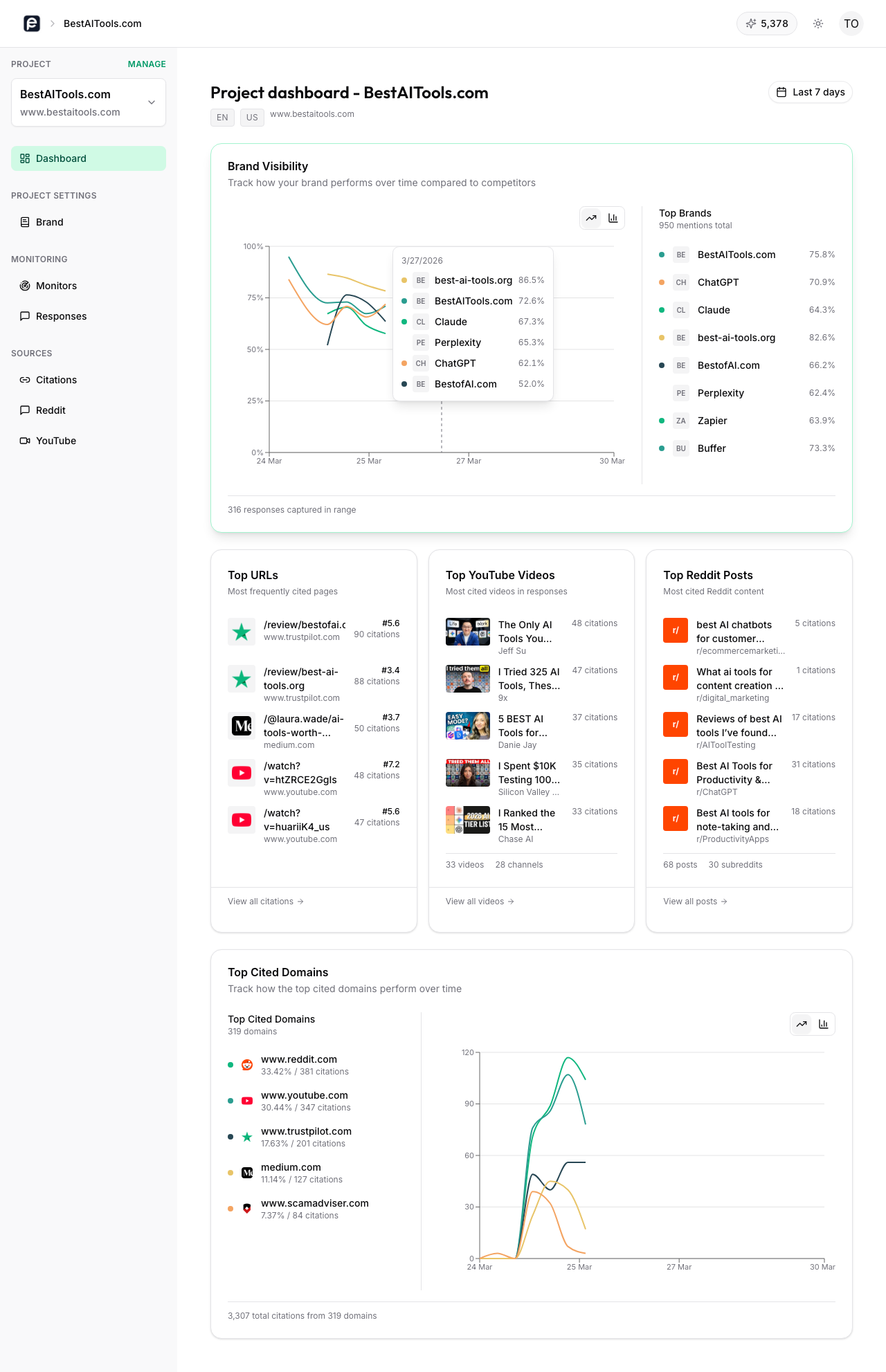
Segmenting AI Visibility Scores by Funnel Stage
Few resources explain how to segment AI visibility scores by funnel stage, yet this segmentation is important for actionable reporting. A blended visibility score that averages broad industry terms with specific branded queries obscures your performance. You must break down your metrics to understand where the leaks in your AI funnel are.
Prompt Eden quantifies AI visibility using a Visibility Score. By applying this scoring model to segmented prompt clusters, you can isolate your performance across the awareness, consideration, and decision stages.
AI Visibility Metrics by Funnel Stage
| Funnel Stage | AI Visibility Focus | Key Metrics |
|---|---|---|
| Awareness | Industry problems, trends, and educational topics | Unbranded presence, Citation frequency, Top-of-funnel content attribution |
| Consideration | Vendor lists, category comparisons, and alternatives | Category inclusion rate, Competitor co-occurrence, Share of voice |
| Decision | Pricing, integrations, limitations, and reviews | Factual accuracy, Recommendation strength, Sentiment analysis |
Segmenting your score in this manner allows you to deploy resources better. If your Awareness score is strong but your Consideration score is weak, it indicates that while models trust your educational content, they do not view your product as a top-tier solution in the category.
If your Decision score is struggling due to pricing hallucinations, you know which pages require structural updates and schema implementation.
Building a Full-Funnel AI Search Tracking Dashboard
To operationalize this strategy, you need a tracking system. Relying on manual, ad-hoc prompt testing is not scalable or accurate, as model outputs vary based on personalization, session history, and regional deployment.
A professional AEO strategy requires automated monitoring. Prompt Eden tracks brand visibility across five AI surfaces: chat assistants and Google search, providing the scale necessary for performance measurement.
Steps to Build Your Dashboard:
- Map Your Prompt Clusters: Organize your target queries into distinct buckets matching the funnel stages outlined above.
- Configure Multi-Platform Tracking: Ensure you are monitoring performance across all relevant engines, including ChatGPT, Claude, Gemini, and Perplexity. Do not assume performance on one platform translates to another.
- Set Baselines: Run an initial analysis to establish your baseline Visibility Score for each funnel segment.
- Automate Trend Analysis: Configure your dashboard to track day-over-day and week-over-week changes. AI models update often; a sudden drop in your consideration-phase visibility requires investigation.
- Integrate Citation Intelligence: Link your visibility drops to citation loss. If you fall out of a vendor recommendation list, check which external sources the model substituted in your place.
By treating AEO and SEO as a combined operating system, you ensure that your brand is present from the moment a buyer begins their research until they sign the contract.
The Role of Technical Documentation in Decision Stage AEO
As buyers progress deeper into the customer journey, their interactions with AI assistants shift from broad discovery to technical verification. At the decision stage, technical documentation, API references, and security portals become your most important Answer Engine Optimization assets. When a developer or technical evaluator asks an LLM, "How does [Brand] handle rate limiting?" or "What are the authentication methods for [Brand]?", the model relies on public-facing technical documentation to formulate its response.
If your documentation is hidden behind a login wall, structured poorly, or written in outdated PDF formats, conversational engines will struggle to retrieve accurate information. This leads to AI hallucinations or the model stating that it "cannot find information regarding [Brand]'s rate limits." This introduces friction into the evaluation process. To prevent this, marketing and engineering teams must collaborate to ensure technical assets are optimized for LLM ingestion.
Structuring Technical Content for AI Retrieval:
- Implement Clean Hierarchy: Use semantic HTML and logical heading structures (H1, H2, H3) throughout your documentation. Models parse hierarchical text better than flat, unstructured paragraphs.
- Adopt Markdown and LLM.txt: Providing a dedicated
llms.txtfile at the root of your documentation domain gives AI models a clean, machine-readable summary of your technical architecture. This speeds up ingestion and improves the accuracy of technical answers. - Answer Edge Cases: Do not rely on implied knowledge. If your platform does not support a specific edge case, state it along with the recommended workaround. Models appreciate and cite explicit statements.
- Maintain Version Control Transparency: Label which documentation applies to which software version. When buyers ask model-specific questions, clear versioning prevents the AI from citing deprecated features.
By treating your technical documentation as a primary AEO channel, you ensure that high-intent, decision-stage queries are met with accurate, confidence-building answers rather than confusion.
Aligning Sales and Marketing on AI Search KPIs
Tracking AI visibility across the customer journey is not just a marketing exercise. It is a revenue operations initiative that requires alignment between marketing, sales, and customer success teams. Historically, marketing measured keyword rankings while sales measured pipeline velocity. With conversational search, these metrics converge. The answers generated by LLMs during the consideration phase impact the quality and volume of leads entering the sales pipeline.
To operationalize AEO, organizations must establish shared Key Performance Indicators (KPIs) that bridge the gap between visibility and revenue. This ensures that improvements in AI search presence translate into business outcomes.
Shared KPIs for Full-Funnel AEO:
- Brand Inclusion to Demo Request Ratio: Track the correlation between your category inclusion rate in AI responses and the volume of inbound demo requests. A rising inclusion rate should precede a lift in high-intent inbound volume.
- Objection Handling Efficiency: Monitor how often sales reps encounter specific objections that were hallucinated or highlighted by AI assistants. If models claim your software is "too complex for small teams," marketing must create citable content to correct this narrative. Sales must then prepare talk tracks to counter it.
- Time-to-Shortlist: Measure whether increased top-of-funnel AI visibility reduces the time it takes for an account to move from initial awareness to a formal vendor evaluation.
Establishing this alignment requires a centralized dashboard where both marketing and sales leadership can view prompt performance. When sales reps understand what the LLMs are telling their prospects, they can tailor their outreach and discovery calls. For example, if a prospect's company mandates Claude for internal research, the sales rep can review Claude's assessment of their product versus the competitor to anticipate the prospect's mindset.
AEO becomes a strategic advantage when the insights from AI search tracking are used to refine sales enablement materials, adjust product positioning, and accelerate deal cycles.
Common Pitfalls in Customer Journey AEO
As teams adopt full-funnel AI visibility tracking, several common mistakes can skew data and misdirect strategy. Avoiding these pitfalls is important for accurate measurement and reporting.
First, many teams overweight branded search. While tracking how models respond to your brand name is necessary for the decision stage, it tells you nothing about your ability to capture net-new demand. You must track unbranded, category-level queries to understand your market position.
Second, there is a tendency to ignore model diversity. Because ChatGPT has the largest market share, teams optimize exclusively for OpenAI's ecosystem. B2B buyers often cross-reference answers using Claude or Perplexity. Your tracking must cover the major conversational engines.
Finally, do not treat AI visibility as a vanity metric. The goal is not to achieve a high score; the goal is to align that score with revenue. If your visibility increases but your pipeline remains stagnant, you are likely tracking the wrong prompts or focusing on the wrong stage of the customer journey. Focus on the consideration phase, as it serves as the bridge between initial curiosity and final purchase.