

How to Choose the Best LLM Monitoring Platform for Brands
Answer Engine Optimization (AEO) requires specialized tools to track how major AI models mention and recommend your brand. While developers use LLM observability tools for internal applications, marketing teams need platforms designed specifically for brand visibility. This guide evaluates the best LLM monitoring platforms for marketers based on share-of-voice tracking, citation intelligence, and model coverage to help you choose the right solution for your strategy.

What are the Best LLM Monitoring Platforms for Brands?
For marketing teams, an LLM monitoring platform tracks how often and accurately a brand is referenced across major AI language models. This software repeatedly prompts artificial intelligence assistants with category keywords to see which brands they recommend.
Most search results for LLM monitoring target developers building custom AI applications. Tools like LangSmith or Datadog track API latency, token costs, and internal workflow errors. Those engineering tools offer no value for marketing teams trying to measure their market presence.
Brand visibility platforms solve a different problem. Marketers use brand monitoring to detect hallucinations and negative sentiment when buyers ask models about their products. These marketing-focused platforms help you understand your Share of Voice in generative search. They reveal whether ChatGPT recommends your software over a competitor when a user asks for alternatives. They show you exactly which domain sources Perplexity cites when generating an answer about your industry.
Choosing the right tool depends on your goals. If you need to optimize a chatbot you built, you need an engineering observability platform. If you want to ensure your brand appears when buyers ask AI for recommendations, you need an Answer Engine Optimization platform.
Prompt Eden: Best for AI Search Visibility and Citation Intelligence
Prompt Eden is built specifically for Answer Engine Optimization. Rather than retrofitting traditional web rank tracking, the platform focuses entirely on how artificial intelligence systems retrieve, process, and recommend brands.
Prompt Eden evaluates responses across five AI surfaces. This covers search engines like Perplexity, APIs, and agents. The platform uses a proprietary Visibility Score that quantifies your AI visibility on a scale from 0 to 100. This score combines presence, prominence, ranking, and recommendation frequency into a single clear metric.
Strengths
- Citation Intelligence: The tool shows exactly which sources models cite for you and your competitors. This tells you exactly which third-party websites you need to pitch for backlinks or partnerships.
- Organic Brand Detection: The system automatically discovers competing brands appearing in answers. You do not need to input every competitor manually.
- Trend Analysis: You can track specific prompts over time to catch shifts early when a model update changes its retrieval behavior.
Limitations
- Focuses only on AI search: The platform does not track traditional blue-link Google rankings. You will still need a standard SEO tool for web search metrics.
Best for: SEO teams, growth marketers, and agencies building dedicated Answer Engine Optimization programs.
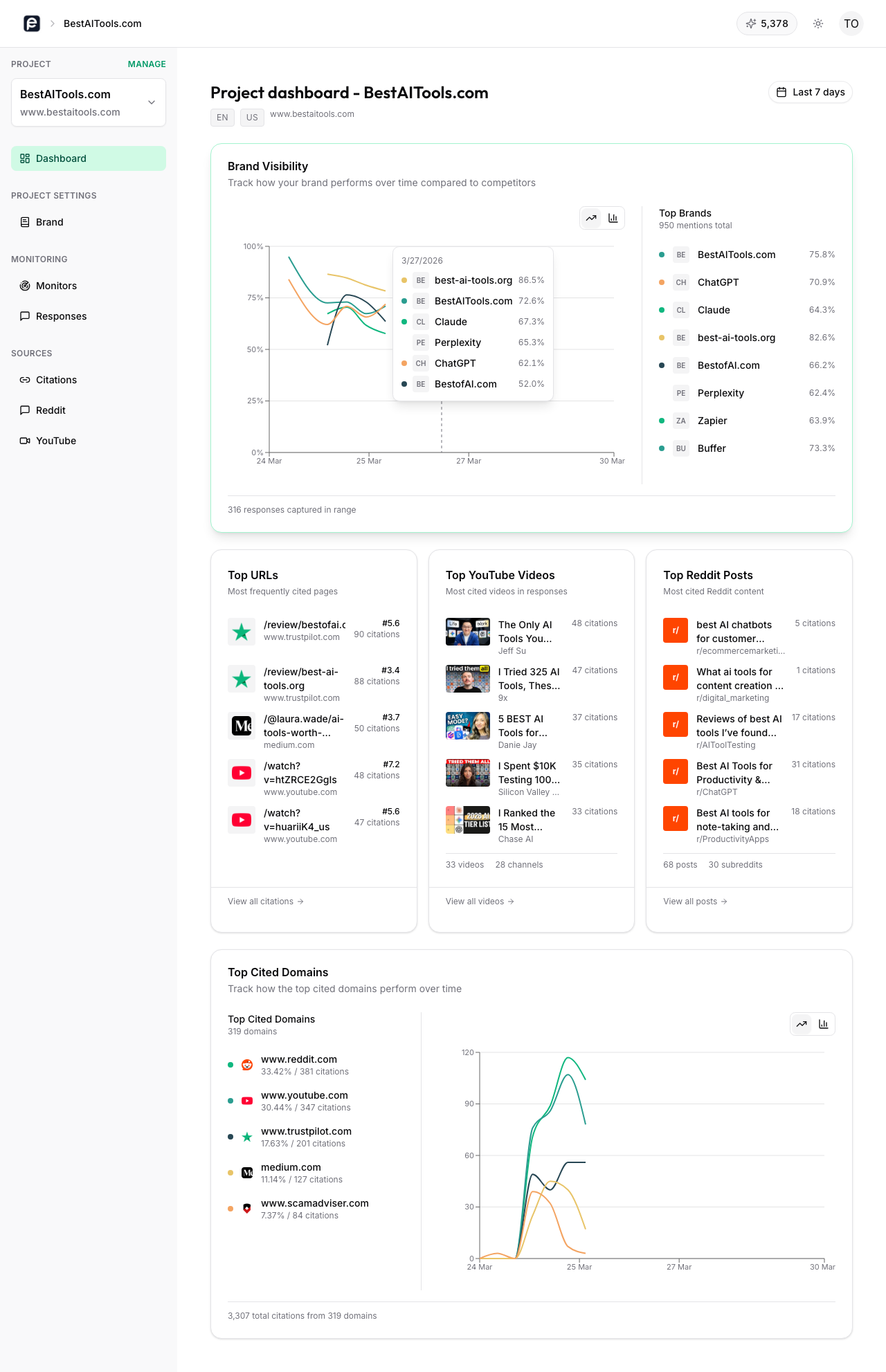
Semrush Enterprise AIO: Best for Unified Search Data
Semrush recently introduced Enterprise AIO to bridge the gap between traditional SEO and generative search. This tool appeals to large organizations that already rely on Semrush for their daily marketing operations.
The platform offers a unified visibility score to track your brand health across different generative engines. Because it lives inside the broader Semrush ecosystem, teams can view their traditional keyword rankings alongside their AI search metrics. This integration makes reporting simple for teams that want to consolidate their software stack.
Strengths
- Unified Dashboard: Teams keep all their search data in one familiar place.
- Workflow Integration: It connects directly with existing keyword research and content planning modules.
Limitations
- Cost and Complexity: The AI features are bundled into a larger enterprise suite, making it an expensive option if you only want LLM monitoring.
- Depth of AI Features: Because it is part of a massive platform, the specific AI tracking features may not offer the same granular citation analysis as dedicated AEO platforms.
Best for: Large marketing departments with established Semrush workflows who prefer all-in-one platforms over specialized point solutions.
AIclicks and Otterly AI: Best for Quick Benchmarking
For marketers just starting with Answer Engine Optimization, tools like AIclicks and Otterly AI offer solid starting points. These platforms provide straightforward ways to track brand mentions without requiring complex enterprise setups.
AIclicks focuses on intelligence coverage. The tool helps marketers track how their brand is recommended across the most popular conversational interfaces. Otterly AI provides visual, easy-to-read charts that make competitive intelligence simple for executive reporting.
Strengths
- Accessibility: Both platforms feature clean interfaces that require minimal training.
- Visual Reporting: They excel at generating simple Share of Voice charts for presentations.
Limitations
- Advanced Diagnostics: These tools may lack the deep citation source analysis required to actually fix visibility problems once you identify them.
- Automated Discovery: You often have to know exactly which competitors and prompts to track, limiting organic discovery of new threats.
Best for: Marketing teams that need a quick snapshot of their AI visibility for a quarterly report or competitive analysis presentation.
Helicone and Datadog: Best for Internal App Observability
It is important to distinguish between marketing visibility platforms and engineering observability tools. When you search for LLM monitoring, you will often encounter platforms like Helicone, Langfuse, and Datadog LLM Observability.
These platforms act as a proxy for your API calls. If your software team builds a custom AI feature inside your product, these tools provide an instant dashboard of your costs, token usage, and response latency. They help engineers see exactly where an AI response went wrong in a complex coding workflow.
Strengths
- Cost Control: They provide excellent tracking for API spend and token efficiency.
- Performance Diagnostics: They identify slow response times and logic failures in custom applications.
Limitations
- Zero Market Visibility: These tools tell you nothing about public LLM search behavior. They cannot tell you if ChatGPT recommends your brand to a buyer.
Best for: Engineering, product, and data teams managing the infrastructure of custom AI applications.
Step-by-Step: How to Measure Share of Voice in AI Search
Implementing a successful monitoring program requires a systematic approach. Typing your brand name into ChatGPT once a month is not a strategy. Follow these steps to build a reliable measurement process.
Step 1: Define Your Category Prompts Start with bottom-of-funnel queries. Think about the exact questions buyers ask when evaluating software in your category. Document prompts like "What are the best alternatives to [Competitor]" or "Which platform should I use for [Specific Problem]."
Step 2: Establish Baseline Visibility Run your defined prompts through a monitoring platform to scan the major models. Record your initial presence, prominence, and recommendation rate. This baseline gives you a clear starting point to measure future growth.
Step 3: Analyze Citation Sources Finding out where models get their facts is the most important step for optimization. Review the sources that models cite when they mention you or your competitors. These URLs are your target list for digital PR and content partnerships.
Step 4: Track Competitor Movement Set up continuous tracking for your category prompts. Use organic detection features to identify new competitors that suddenly start appearing in AI answers. Early detection allows you to adjust your content strategy before a competitor steals your market share.
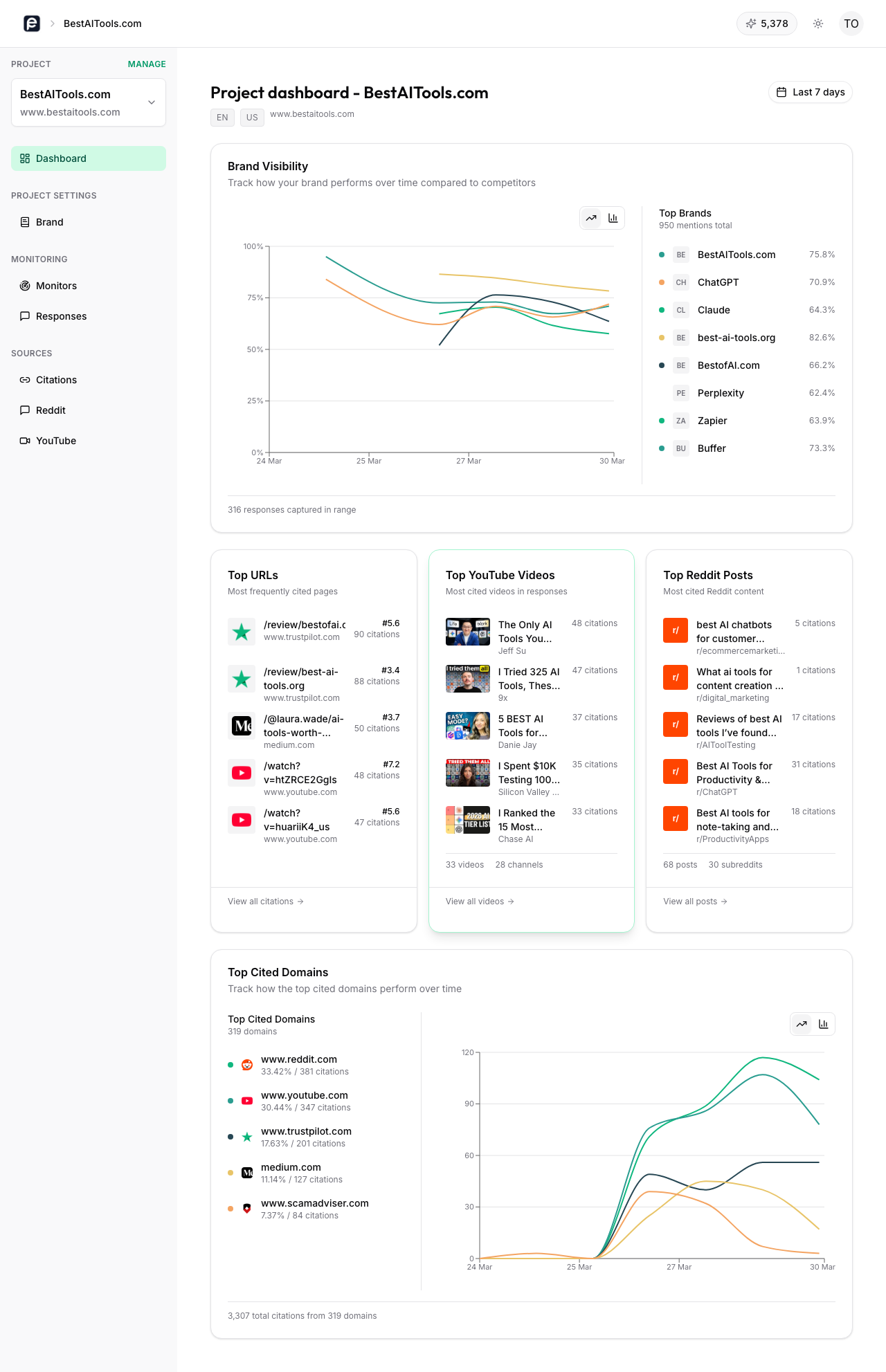
Evidence and Benchmarks: Why Platform Coverage Matters
Relying on a single AI interface to measure your brand health produces dangerous blind spots. The generative search market is highly fragmented, and different audiences prefer different models.
Consumer audiences often default to Google AI Overviews or standard ChatGPT. Researchers and technical buyers favor Perplexity for its deep source linking. Enterprise users increasingly rely on Claude due to its strong corporate adoption and security features.
If you only track your visibility in ChatGPT, you might miss the fact that Perplexity ignores your brand in favor of a competitor. Full-coverage monitoring platforms solve this problem by evaluating responses across many interfaces. This broad coverage ensures you capture the full picture of your brand presence across all potential buyer touchpoints.