

How to Build a B2C Agentic Commerce Strategy
B2C agentic commerce strategy is the framework for ensuring your consumer products are consistently discovered, evaluated, and recommended by AI-driven shopping assistants. As consumer adoption of AI shopping assistants grows rapidly for complex purchase decisions, brands must pivot from human-led catalogs to agent-led execution. This guide breaks down the core pillars, technical requirements, and measurement tactics needed to capture demand in the age of algorithmic customers.

What is B2C Agentic Commerce?
B2C agentic commerce strategy is the framework for ensuring your consumer products are consistently discovered, evaluated, and recommended by AI-driven shopping assistants. Rather than relying on human buyers to browse catalogs, compare options, and click through checkouts, brands must now optimize for autonomous algorithms that handle these steps on the buyer's behalf.
This represents a major shift from human-led shopping to agent-led commerce. In a traditional e-commerce model, the retailer provides a visual interface designed to guide human psychology toward a purchase. In an agentic model, the customer navigating the store is an AI assistant operating with specific parameters, budget limits, and preferences set by its human owner.
The implications for retail are massive. According to industry analysts, agentic commerce could orchestrate a significant portion of US B2C retail revenue in the coming years. The value of consumer commerce mediated by AI agents may reach unprecedented levels globally. This transition forces retail brands to rethink their entire digital infrastructure, moving away from static web pages and toward dynamic, machine-readable API endpoints.
For marketing and growth teams, building a B2C agentic commerce strategy requires accepting that the traditional marketing funnel is collapsing. Search, comparison, and consideration no longer happen across weeks of browser tabs. Instead, an AI agent can execute all three phases in seconds, summarizing the best options and presenting a final recommendation to the consumer. Brands that fail to optimize for this algorithmic evaluation will vanish from the consideration set.
Helpful references: PromptEden Workspaces, PromptEden Collaboration, and PromptEden AI.
Why Traditional E-Commerce Fails the AI Shopper
Most consumer brands have spent the last two decades optimizing for human eyeballs. They invest heavily in high-resolution lifestyle photography, emotional brand storytelling, and complex user interfaces designed to maximize time-on-site. Unfortunately, AI agents do not care about your brand's emotional narrative or your website's color scheme. They care about structured data, explicit constraints, and fast execution.
When an AI shopping assistant evaluates a product, it looks for concrete, machine-readable facts. It needs to know exact dimensions, material composition, shipping timelines, return policies, and real-time inventory levels. If this information is buried in a PDF manual or hidden behind a dynamic JavaScript dropdown, the agent cannot parse it. As a result, the agent will skip your product and recommend a competitor whose data is easier to read.
Traditional e-commerce relies heavily on the search and filter paradigm. A human searches for running shoes, clicks a category, and applies filters for size and color. An algorithmic customer operates differently. It arrives with a specific, multi-variable prompt: Find me trail running shoes available in a specific men's size, under a certain price point, that can be delivered to Chicago by Thursday, and have a return policy of at least a week.
If your store's architecture requires sequential clicks to reveal shipping estimates or stock levels, the agent will fail to retrieve the necessary data. This friction explains why traditional direct-to-consumer playbooks are losing their effectiveness. To win in agentic commerce, brands must decouple their product data from their visual presentation layer, ensuring that AI systems can query inventory and features without delay.
The Six-Level Automation Curve of Agentic Commerce
To understand how a B2C agentic commerce strategy scales, it helps to look at the maturity models used by leading consulting firms. The transition from manual shopping to autonomous purchasing happens across a defined automation curve.
Level 0: Pre-Agentic Commerce At this baseline stage, consumers use standard search engines and retailer websites. The brand controls the visual experience, and the consumer does all the manual work of finding, comparing, and purchasing.
Level 1: Assisted Discovery Consumers use AI tools like ChatGPT or Perplexity to research products. The AI retrieves information and summarizes options, but the consumer must still navigate to the retailer's site to execute the purchase. This is where most early-adopter consumers sit today.
Level 2: Task-Oriented Agents Agents can execute specific, isolated tasks across different applications. For example, a consumer might ask an agent to add the top-rated ergonomic keyboard under a certain price to my Amazon cart. The agent handles the selection and cart placement, but the human handles checkout.
Level 3: Semi-Autonomous Execution The agent handles the entire lifecycle of a specific purchase type, such as routine grocery restocking. The human sets parameters like reordering coffee when it runs low without exceeding a set budget, and the agent executes the transaction autonomously within those bounds.
Level 4 and Beyond: Autonomous Negotiation At the highest levels of maturity, the consumer's agent negotiates directly with the brand's selling agent. This is Agent-to-Agent commerce. The agents might negotiate on price, shipping speed, or bundled discounts, removing human intervention from the transaction.
Your brand's B2C agentic commerce strategy must address Level One and Level Two today, while building the technical foundation required for the autonomous transactions of Levels Three and Four.
Core Technical Pillars for B2C Retailers
Building an infrastructure that supports AI shopping assistants requires more than just updating your website's meta tags. It requires a shift toward an API-first architecture designed for machine consumption.
API-First Architecture and Machine Readability Your product catalog, inventory levels, and pricing must be accessible via clean, public-facing APIs. When a consumer's agent wants to check stock, it should not have to scrape your HTML. It should be able to ping an endpoint and receive a structured JSON response. Adopting emerging standards like the Model Context Protocol ensures your store speaks the same language as the agents querying it.
Headless Checkout Experiences In an agentic workflow, the traditional shopping cart is obsolete. An AI agent does not want to navigate a five-step checkout process filled with upsell pop-ups. Implement headless commerce solutions that allow agents to securely pass payment and shipping details directly to your backend, bypassing the visual storefront.
Persistent and Collaborative Carts Because agentic journeys often involve collaboration, where the AI does the research and the human approves the final choice, shopping carts must be saveable and resumable. A user might start a query on their phone with a voice agent and finish the transaction hours later on a desktop. Your infrastructure must maintain the state of the transaction across these different contexts.
Structured Data Over Storytelling While brand storytelling remains important for human buyers, your technical backend must strip away the marketing fluff. Use detailed schema.org markup and JSON-LD to explicitly define product attributes, warranties, and compatibility. If an agent has to guess whether a phone case fits a specific model, it will recommend a different brand that provides explicit compatibility data.
Generative Engine Optimization (GEO) in B2C
Answer Engine Optimization (AEO) and Generative Engine Optimization (GEO) are the disciplines of improving how often your brand is cited and recommended in AI-generated answers. In the context of a B2C agentic commerce strategy, GEO replaces traditional SEO as the primary driver of top-of-funnel discovery.
Traditional SEO focuses on ranking blue links on a search engine results page. GEO focuses on being the definitive, factual answer that a language model synthesizes and presents to the user. This requires a different approach to content creation and syndication.
First, you must optimize for citation sources. AI models like ChatGPT and Perplexity retrieve information from authoritative sources on the web. If your brand is discussed on trusted review sites, niche forums like Reddit, and industry blogs, the AI is more likely to recommend your products. You must ensure your product details are accurate and consistent across this entire ecosystem of third-party sites.
Second, you must structure your own site's content so that AI can easily extract it. Write clear, quotable definitions for your product categories. Use bulleted lists for specifications. Create dedicated FAQ pages that directly answer the exact, complex questions consumers ask AI assistants. For example, instead of a generic product description, include a clear Best For section that explicitly states who the product serves and what limitations it has. AI models reward this kind of factual density and transparency.
Finally, understand that AI models look for consensus. If your own website claims your product has a long battery life, but independent review sites say it only lasts a fraction of that time, the AI will detect the discrepancy and likely demote your product in its recommendations. Aligning your internal claims with external reality is essential for GEO success.
Measuring Agentic Commerce Success
You cannot improve what you do not measure, and traditional web analytics cannot measure agentic commerce. Tracking page views, bounce rates, and session durations will tell you nothing about how often AI agents are recommending your products. To manage your B2C agentic commerce strategy effectively, you need specialized metrics designed for generative AI.
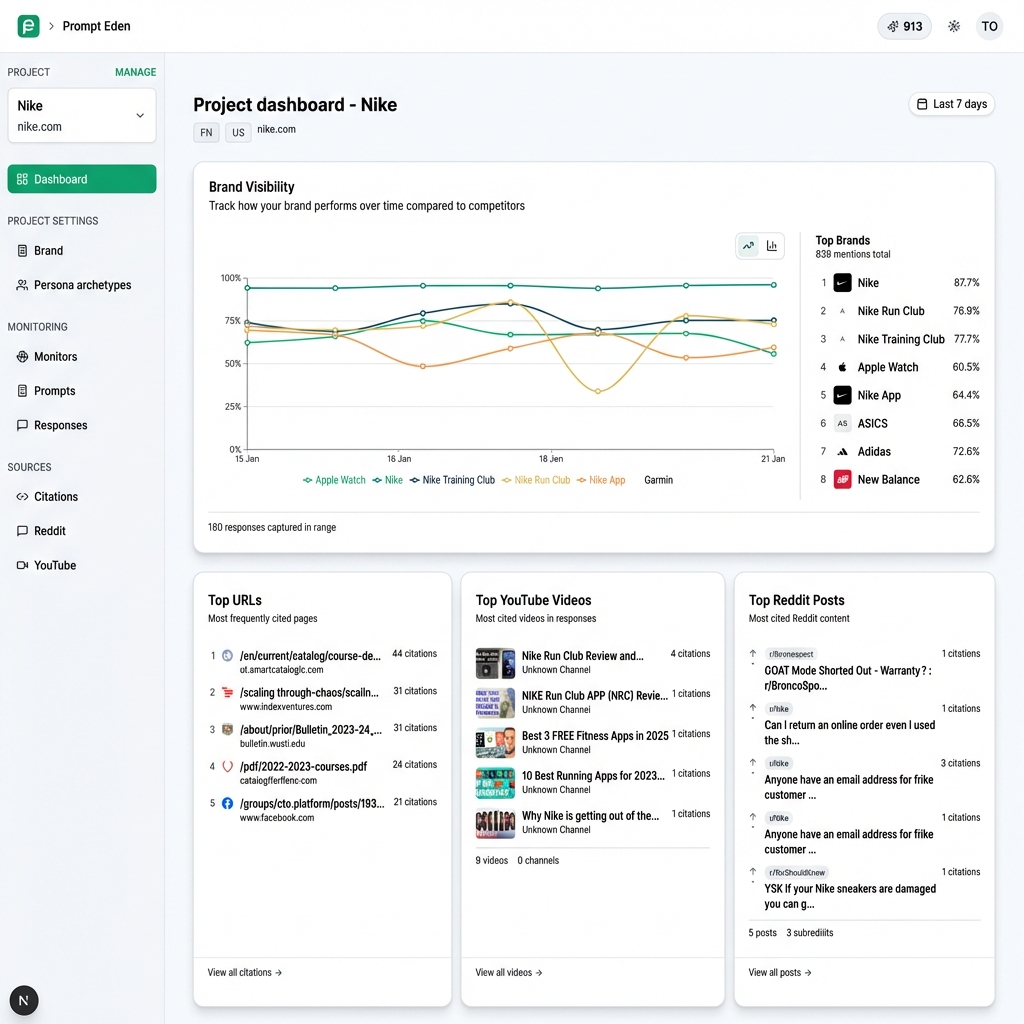
Visibility Score This is the foundational metric for AEO. Your Visibility Score quantifies your brand's presence across major AI platforms, like ChatGPT, Claude, and Perplexity, from zero to one hundred. It measures not just whether your brand appears, but how prominently it is featured and whether it is explicitly recommended over competitors. A rising Visibility Score indicates that your structured data and citation strategies are working.
Citation Intelligence To influence AI models, you must know where they are getting their information. Citation Intelligence tracks the specific external sources that models cite when discussing your category. If you discover that Claude frequently cites a specific tech review blog when recommending smart home devices, your PR and partnership teams now know where to focus their outreach efforts.
Organic Brand Detection AI search is dynamic, and your competitors in AI recommendations may not be the same competitors you face in traditional search or physical retail. Organic Brand Detection automatically identifies which rival brands are appearing alongside yours in AI-generated answers. This allows you to track share-of-voice shifts in real-time and adjust your strategy to counter emerging threats.
Prompt Tracking and Trend Movement Consumer intent in AI search is expressed through complex prompts, not short keywords. Tracking how your brand performs across a basket of high-intent prompts over time helps you catch shifts early. By monitoring day-over-day and week-over-week changes in visibility, you can pinpoint when an algorithm update or a competitor's new product launch impacts your market share.
Building Your Agentic Roadmap
Transitioning to a complete B2C agentic commerce strategy will take time, but the brands that start building the foundation today will capture the outsized early returns. To build your roadmap for the future, focus on execution across three distinct phases.
Phase 1: Diagnostic and Baseline Measurement Before changing your technical infrastructure, establish a baseline. Use AI monitoring tools to measure your current Visibility Score across the major AI platforms. Identify the high-intent prompts your target customers use and see where you currently rank. Audit your existing product catalog to determine how machine-readable your current data is. If your technical specifications are buried in unstructured text, flag them for immediate remediation.
Phase 2: Technical Remediation and GEO Implementation Begin decoupling your data from your presentation layer. Implement detailed schema markup across all product pages. Ensure that pricing, inventory, and shipping details are explicitly defined and easily crawlable. At the same time, launch your Generative Engine Optimization efforts. Audit the external citation sources that influence your category and ensure your brand's presence there is accurate and compelling. Start structuring your internal content to provide direct, quotable answers to complex consumer questions.
Phase 3: API-First Development and Headless Integration This is the most technically complex phase, but it unlocks agentic commerce. Develop public-facing APIs that allow AI agents to query your catalog and execute transactions without loading a webpage. Implement headless checkout flows that support persistent, cross-session shopping carts. Begin testing integrations with emerging agent protocols to ensure your store is ready for the era of Agent-to-Agent negotiation.
By treating AI agents not as a threat to traditional web traffic, but as a new class of high-converting algorithmic customers, you position your brand to thrive in the next evolution of retail.
Evidence and Benchmarks for AI Shopping Adoption
The urgency behind adopting a B2C agentic commerce strategy is driven by rapidly accelerating consumer behavior. Early data shows that when consumers switch from traditional search to AI-assisted shopping, their buying intent and conversion rates increase.
According to early implementations and industry analyses, agentic commerce workflows can result in significantly higher conversion rates compared to traditional browsing. This uplift occurs because AI agents remove the friction of manual comparison and form-filling. When an agent presents a curated list of three products that match the consumer's specific prompt, the cognitive load of decision-making drops.
Traffic originating from AI channels, such as users clicking through a citation link in Perplexity, demonstrates higher buying intent than social media traffic. Users relying on AI for product research are typically further down the funnel; they have a specific problem to solve and are using the AI to find the optimal solution quickly.
The economic projections reinforce this trend. The expectation that agentic commerce could orchestrate a vast share of retail revenue highlights the scale of the disruption. Brands cannot afford to wait for the technology to mature before participating. The models are training on today's data and establishing their baseline recommendations right now.
If your brand secures its position as the default, trusted recommendation in this new era, that historical trust will compound as the models evolve. Conversely, brands that remain invisible to AI assistants today will find it increasingly difficult to break into the consideration set tomorrow. The window to establish algorithmic authority is open, but it is closing quickly as established players solidify their AEO strategies.
Overcoming Implementation Challenges
While the benefits of an agentic strategy are clear, execution presents real organizational hurdles. The most common challenge is internal alignment. E-commerce teams are typically incentivized on traditional metrics like site traffic and time-on-page. Shifting focus toward API usage and AI recommendation frequency requires a mandate from executive leadership.
Another major hurdle is data fragmentation. In many legacy retail organizations, product data lives across multiple disconnected systems. Inventory might be managed in a legacy ERP, while product descriptions sit in a modern content management system. This fragmentation makes it impossible to expose a unified, real-time data layer to AI agents. Solving this requires investing in a centralized Product Information Management system that serves as the single source of truth for all agentic queries.
Finally, brands must manage the lack of standardization in how AI agents interpret data. While dedicated protocols are emerging, they are not universally adopted. Retailers must build flexible data pipelines that can adapt to the parsing requirements of different models. A regular testing cadence, which involves prompting different models with complex queries to see how they handle your product data, is essential for identifying and fixing these parsing errors before they impact real consumer recommendations.
Integrating AEO with Your Broader Marketing Strategy
Your agentic commerce strategy should not exist in a silo. It must works alongside your existing SEO, content marketing, and public relations efforts. While Generative Engine Optimization requires specific technical adjustments, the foundational work of building brand authority remains the same.
Your public relations team plays an important role in your agentic strategy. Because AI models rely on third-party citations to validate their recommendations, securing placements in high-authority publications directly impacts your AI visibility. When PR secures a mention in a top-tier tech blog or lifestyle magazine, they are not just driving human traffic; they are training the next generation of AI models to associate your brand with positive sentiment.
Similarly, your content marketing team must shift its focus from creating high-volume, low-quality blog posts to producing dense, factual, and structured resources. This means creating detailed comparison guides, transparent pricing breakdowns, and complete product documentation. These assets serve as the training material that models rely on when answering complex consumer queries.
Finally, your traditional SEO efforts should run in parallel with your AEO tracking. While AI search is capturing a growing share of complex, high-intent queries, standard search engines remain dominant for direct navigation and simple informational queries. By sharing insights between your SEO and AEO teams, you can ensure your brand maintains dominance across both legacy search results and modern AI-driven recommendations.
The Role of LLMs in Consumer Choice
At the core of agentic commerce is the Large Language Model. These models do not function like deterministic databases. They generate responses based on probabilistic associations. Understanding this mechanic is essential for your strategy.
When a consumer asks an AI assistant to recommend the best durable hiking boots, the model predicts the most statistically relevant sequence of words based on its training data and real-time retrieval. If your brand is frequently mentioned alongside the concept of durable hiking boots in authoritative forums and trusted review sites, the model's probability of recommending you increases.
This means your marketing strategy must extend far beyond your own domain. You must shape the semantic associations that models form about your brand. By monitoring your AI visibility and optimizing your presence across the specific sources that models cite, you can program the probabilistic outcomes of consumer queries, ensuring your brand is the default choice in the agentic era.