

How to Optimize Your Ecommerce Brand for AI Shopping Agents
Answer Engine Optimization (AEO) for ecommerce brands focuses on structuring product data, specs, and reviews so AI shopping agents can confidently recommend your products. Learn how to move past traditional Google Shopping feeds and improve your technical foundation to capture high-intent buyers through conversational AI assistants.

What is AEO in Ecommerce?: aeo ecommerce brands
Answer Engine Optimization (AEO) for ecommerce brands focuses on structuring product data, specs, and reviews so AI shopping agents can confidently recommend your products. While traditional Search Engine Optimization targets keyword rankings on standard search engine results pages, AEO targets inclusion within conversational answers generated by Large Language Models. When a buyer asks an AI assistant for the best waterproof hiking boots under a specific budget, the AI does not just return a list of links. It synthesizes a direct recommendation based on the data it can most confidently read and verify.
For online retailers, mastering AEO means adapting to a landscape where the AI acts as a concierge. If your product specifications, availability, and brand reputation are not easily readable by these models, your products will not be recommended. Effective AEO for ecommerce brands requires a structural shift from presenting visual information to human buyers toward providing logically structured data points for machine interpretation. This shift ensures that when shoppers use ChatGPT, Perplexity, or Google AI Overviews for product discovery, your catalog is positioned as the authoritative answer.
The shift to AI-driven shopping changes how people buy. Instead of browsing category pages and filtering by attributes, consumers now issue complex, multi-variable queries directly to AI agents. These agents evaluate thousands of potential products at once. To win in this new environment, your ecommerce strategy must prioritize data clarity, context, and immediate answerability.
Why Traditional Google Shopping Feeds Are Not Enough
Most ecommerce guides only talk about traditional Google Shopping feeds and miss the AI agent angle. For years, the standard playbook for retail visibility relied on submitting well-formatted XML feeds to Google Merchant Center. While Google Shopping remains important for standard search, conversational AI agents operate on different retrieval mechanisms. They do not rely solely on structured shopping feeds. They actively crawl the web, reading page content, evaluating context, and combining information from multiple independent sources.
Traditional feeds are designed for a specific advertising ecosystem. They categorize products into predefined taxonomies and prioritize bid strategies alongside basic attributes. AI agents look for details. They seek out specific use cases, hands-on reviews, compatibility information, and contextual advantages that a standard XML feed cannot convey. When a user asks an AI to compare specific running shoes for a runner with flat feet, the AI cannot pull that qualitative analysis from a standard product feed. It must read the actual on-page content, the specific details, and the aggregate sentiment of user reviews.
A modern AEO strategy must go beyond the feed. It requires improving the actual product detail pages with rich HTML and thorough structured data. Retailers must build content that answers specific questions natively on their domains, ensuring that AI bots have direct access to the qualitative data required to make an informed recommendation to the consumer.
How Do AI Shopping Agents Find Products?
Understanding how AI shopping agents find products is the first step in optimizing for them. These systems primarily use Retrieval-Augmented Generation. When a user enters a query, the AI does not rely solely on its pre-trained knowledge base. It executes a real-time retrieval process, querying external databases, search indexes, and real-time APIs to gather the most current information available.
The retrieval phase heavily favors authoritative domains that present data in a structured, unambiguous format. AI models look for clear entity definitions, understanding that a specific string of text represents a brand, a product model, a price point, or a technical specification. If your ecommerce site uses generic HTML without semantic markup, the AI has to guess the context of your data. This lowers its confidence score and reduces the likelihood of your product being recommended.
AI agents cross-reference information to verify accuracy. They look at your primary product page, but they also evaluate third-party review sites, digital PR mentions, and aggregate market data. If the technical specifications on your site match the details discussed by authoritative reviewers across the web, the AI's confidence in your product increases. This means your AEO efforts must include both on-page technical optimization and off-page citation consistency, ensuring that wherever the AI looks, the data tells the same verifiable story.
Essential Schema Markups for AI Shopping Bots
To ensure AI shopping agents can accurately read your catalog, implementing precise structured data is necessary. Here is a numbered list of essential schema markups for AI shopping bots:
- Product Schema: This is the baseline. You must define the exact product entity, including the name, image, description, and brand. Without this, AI models struggle to identify the item you are selling.
- Offer Schema: This nested property details the transactional nature of the product. It must include the exact price, price currency, and availability status. If an AI cannot verify that a product is currently available, it will likely recommend a competitor's product instead.
- AggregateRating Schema: This provides the overall review score and the total number of reviews. AI agents use this as a proxy for product quality and trustworthiness.
- Review Schema: Marking up individual, high-quality reviews helps AI models understand the specific context of why people like the product. This feeds directly into long-tail, qualitative recommendations.
- Brand Schema: Establishing your brand entity helps the AI connect your products to your broader corporate identity, building trust and authority within the knowledge graph.
- ItemList Schema: For category pages, marking up the list of products helps AI bots understand the relationship between different items in your catalog. This makes it easier for them to suggest alternatives or complementary items.
- FAQPage Schema: Adding structured FAQs to your product pages feeds the AI's question-answering capabilities, giving it ready-made answers to serve to users.
Optimizing Dynamic Pricing and Availability for LLMs
One of the biggest technical challenges in ecommerce AEO involves real-time data accuracy. Dynamic pricing and availability must be parsable by LLMs for accurate recommendations. If an AI agent recommends a product at a specific price, and the user clicks through to find the item is out of stock or more expensive, the user experience is broken. AI systems penalize sources that frequently provide outdated or conflicting transactional data.
To optimize for this, your dynamic pricing and inventory systems must be tightly integrated with your front-end presentation and your schema markup. When a price changes dynamically based on demand or promotions, the underlying JSON-LD schema must update instantly. Caching layers and Content Delivery Networks must be configured to ensure that search engine bots and AI crawlers always receive the most current product data.
Consider how promotional pricing is communicated. Instead of just displaying a lower number, use the appropriate schema properties to define the regular price, the sale price, and the duration of the promotion. This level of detail allows advanced AI shopping agents to provide helpful context to the user. Noting that a product is currently on a limited-time sale increases urgency and the likelihood of a conversion. Clean, parsable availability data ensures that you only compete for queries where you can actually fulfill the resulting demand.
The Role of Aggregate Review Sentiment
In the AI-driven shopping ecosystem, qualitative data is just as important as technical specifications. AI shopping agents rely heavily on structured product data and aggregate review sentiment when formulating recommendations. When an AI evaluates a product, it does not just look at what the brand says about it. It analyzes what hundreds or thousands of customers have reported. This sentiment analysis forms the backbone of the AI's confidence in suggesting your product for specific use cases.
If a user asks for a laptop that is durable enough for frequent travel, the AI will scan reviews for keywords related to build quality, durability, and travel experiences. If your reviews consistently highlight these traits, your product becomes highly relevant to that specific query. Encouraging detailed, context-rich reviews from your customers is a core component of ecommerce AEO. Simple star ratings are not enough. You need narrative text that describes how the product performs in the real world.
How you structure and display these reviews matters. By using proper schema markup for reviews and highlighting key themes in your product descriptions, you make it easier for LLMs to extract and summarize the sentiment. Addressing negative feedback transparently on the product page can also be beneficial. It provides the AI with a balanced, trustworthy perspective rather than a perfect profile that might trigger algorithmic skepticism.
Measuring Your Ecommerce AI Visibility
You cannot improve what you do not measure. Traditional SEO metrics like search volume and keyword rankings do not provide a complete picture of your performance in AI-driven environments. To manage an AEO strategy, you need specialized tools that can track your presence across modern answer engines.
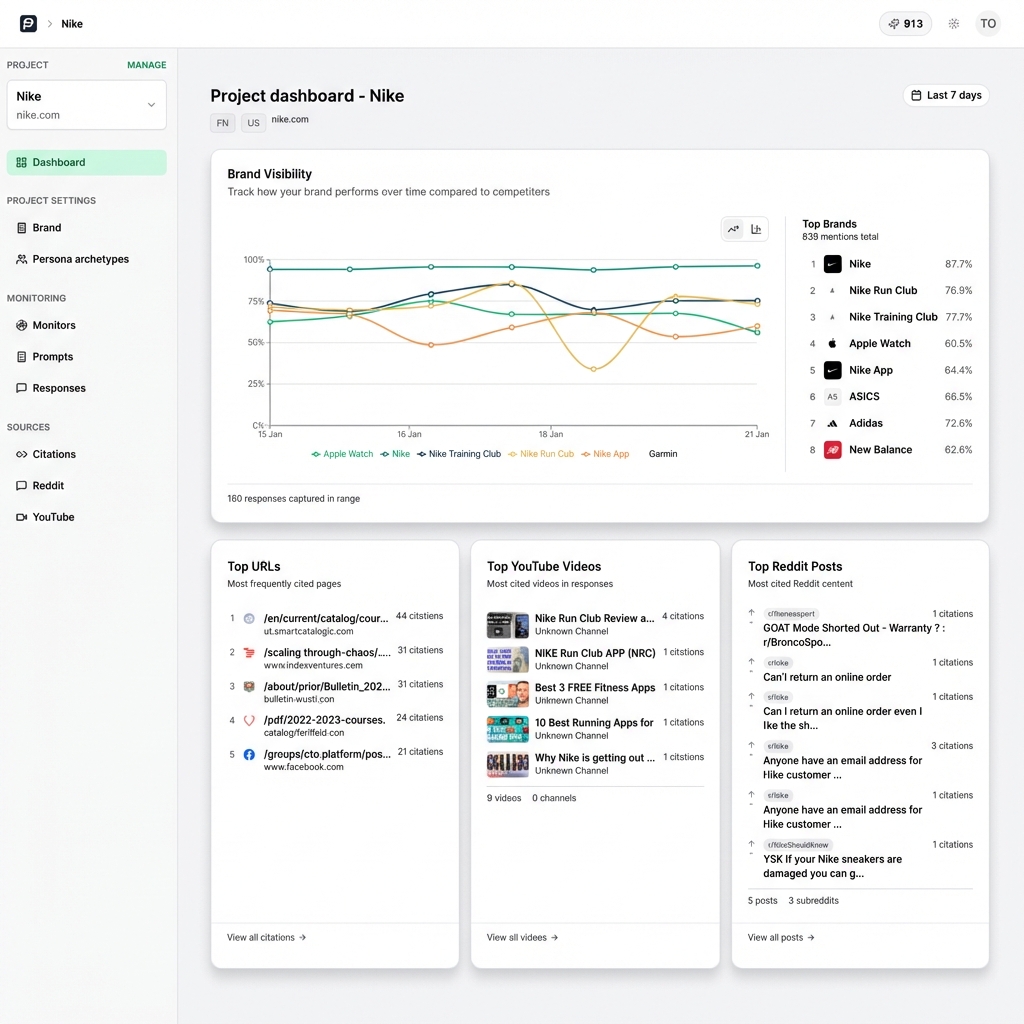
PromptEden allows brands to track their visibility across five AI surfaces: chat assistants and Google search. By calculating a Visibility Score based on presence, prominence, ranking, and recommendation frequency, you gain a clear understanding of how often your products are being suggested to high-intent buyers.
Tools like Citation Intelligence and Organic Brand Detection help you understand not just if you are being mentioned, but why. You can analyze which specific product pages or third-party review sites the AI is citing as its source of truth. By identifying these critical data sources, you can prioritize your optimization efforts, ensuring that you maintain accurate information wherever the AI bots are looking. Tracking prompt trends over time ensures you can adjust your content strategy to capture emerging consumer behaviors before your competitors do.
Advanced Tactics: Structuring Content for AI Parsing
To improve your Answer Engine Optimization strategy, you must rethink how you write product descriptions. Long, unstructured paragraphs are difficult for AI models to read. Instead, adopt a modular, structured approach to content design. Every product page should feature a direct answer block at the top. This concise summary explicitly states what the product is, who it is for, and its primary value proposition. This block acts as a citable snippet that AI agents can extract and present to users.
Beneath the direct answer, use bulleted lists for technical specifications, materials, and dimensions. AI models excel at reading and comparing lists. When a user asks an AI to compare the dimensions of two different backpacks, having your dimensions formatted in a clean HTML list or table increases the likelihood that the AI will use your data. Avoid burying critical specifications in narrative text where the AI might misinterpret the context.
Consider adding instructional content. AI shopping agents are frequently asked how-to questions related to products. By providing step-by-step guides natively on your product pages or within a dedicated resource center, you capture users at the upper and middle stages of the funnel. When the AI cites your instructional content, it associates your brand with the solution, leading to a qualified product recommendation. This approach ensures your brand is visible from initial research to final purchase evaluation.
Adding video transcripts and rich media descriptions also provides supplementary textual data that AI models can scrape. This reinforces your product's relevance in the marketplace. Continuous optimization and testing of structured data are essential for maintaining visibility in an ever-changing algorithmic landscape. The brands that prioritize machine-readable formatting will capture the majority of organic traffic generated by these advanced conversational interfaces. Investing in content strategies that address specific consumer queries ensures that AI models have the necessary context to make accurate product recommendations. As AI models become more sophisticated, they will place a higher premium on verifiable, first-party data and aggregate consumer sentiment. Retailers must adapt their digital infrastructure to meet these new technical requirements, securing their position in the future of online shopping.
Navigating the Future of Conversational Commerce
As conversational commerce continues to evolve, the distinction between search and shopping will blur. Consumers are moving away from opening multiple tabs, reading conflicting reviews, and hunting for discount codes. They are delegating these tasks to intelligent agents that can execute complex shopping workflows autonomously. To survive this transition, ecommerce brands must stop optimizing for human eyeballs alone and start optimizing for machine comprehension. This means adopting a data-first mindset, where every piece of content from the hero banner copy to the technical specs in the footer is designed for clarity and extractability.
The most successful retail brands of the next decade will view their product catalogs as dynamic knowledge bases. They will continuously test and refine their schema markups, actively solicit detailed narrative reviews, and monitor their AI visibility with the same rigor they apply to traditional search engine rankings. By embracing Answer Engine Optimization today, you build a competitive advantage, ensuring that when the AI concierge is asked for a recommendation, your products are the first choice. Investing in these data structures now protects your market share against new entrants and guarantees your brand remains relevant in an increasingly automated digital economy.
Start small by auditing your top products. Implement thorough schema, evaluate your current AI visibility, and watch how your search presence shifts. The results will provide the blueprint for your entire catalog. If you're ready to accelerate this process, check our pricing to monitor your brand across multiple platforms.
Building a Long-Term AEO Strategy for Retail
Transitioning your ecommerce brand for the AI era requires a sustained, strategic commitment. It is not enough to implement schema markup once and forget about it. A strong AEO strategy requires ongoing maintenance, continuous content creation, and performance monitoring. The algorithms powering AI shopping agents evolve constantly, and your approach must remain agile to adapt to new retrieval behaviors and ranking signals.
Start by conducting a thorough audit of your highest-margin product categories. Evaluate how those products currently appear when queried through tools like ChatGPT or Perplexity. Identify the content gaps. Are the AI models missing important specifications? Are they favoring a competitor because their reviews are more detailed or their pricing data is clearer? Use these insights to build a targeted optimization roadmap, systematically updating your product detail pages, category descriptions, and supporting educational content.
Integrate your AEO efforts with your broader marketing ecosystem. Ensure that your digital PR campaigns, influencer partnerships, and customer review programs are aligned with the goal of generating high-quality, citable information across the web. By establishing your brand as an authoritative, transparent, and structurally sound source of truth, you ensure that AI shopping agents will consistently recommend your products to the buyers who need them most.