

How to Optimize Content for AI Citations
AI models cite a tiny fraction of the web. The content they select shares specific structural, topical, and authority traits that most pages lack. This guide breaks down the mechanics of AI citation selection and gives you a repeatable optimization framework you can apply to any page. You will also learn how to measure citation progress and close gaps against competitors.

Why Your Content Isn't Getting Cited by AI
You've published hundreds of pages. Your organic search traffic is solid. But when someone asks ChatGPT, Claude, or Perplexity about your category, your content is nowhere in the response. This is the citation gap, and it affects most websites. AI models do not treat the web the same way search engines do. Google indexes billions of pages and ranks them by relevance signals. AI models, on the other hand, synthesize information from a much smaller pool of sources they consider trustworthy, clear, and structurally accessible. The result: a site that ranks on page one of Google may be completely invisible inside an AI response. Three problems cause this:
- Structural inaccessibility. Your content is locked behind JavaScript rendering, login walls, or formats AI crawlers cannot parse efficiently. - Topical ambiguity. Your pages cover broad topics without providing the kind of definitive, quotable statements AI models prefer to reference. - Authority gaps. AI models weigh third-party corroboration heavily. A claim on your site alone carries less weight than the same claim supported by independent sources. Understanding these three problems is the first step. The rest of this guide walks through how to fix each one.
How AI Models Select Sources to Cite
AI citation is not random. Each model has different retrieval behaviors, but they share common patterns in how they choose which content to reference. ### Retrieval-Augmented Generation (RAG)
Search-connected models like Perplexity, ChatGPT with browsing, and Google Gemini use retrieval-augmented generation. They run a search query, pull candidate pages, then select the most relevant excerpts to include in their response. The selection criteria during retrieval favor:
- Direct answers to the query. Pages that state a clear answer in the first few sentences of a section rank higher as retrieval candidates. - Structured content. Headings, lists, and defined terms help retrieval systems identify the right passage quickly. - Source reputation. Domain authority, publication history, and third-party references all influence which pages the model trusts enough to cite. ### Training Data Influence
Models that do not browse the web in real time (or that supplement browsing with parametric knowledge) rely on training data. Content that was widely referenced, linked, and discussed across the training corpus is more likely to surface in responses. This means your citation strategy has two timelines:
- Short-term: Optimize for retrieval by search-connected models (Perplexity, ChatGPT browsing, Gemini). 2. Long-term: Build the kind of topical authority and third-party coverage that gets encoded into future model training runs. ### What Makes Content "Quotable"
AI models prefer to cite content that contains:
- Specific data points. Numbers, percentages, dates, and named entities are easier to attribute than vague claims. - Clear definitions. When your page is the one that defines a term plainly, models will reference it. - Original research. Survey results, benchmark data, and proprietary analysis that cannot be found elsewhere. - Structured comparisons. Side-by-side evaluations with clear criteria. Content that reads like marketing copy, full of superlatives and thin on substance, rarely gets cited. AI models skip it in favor of pages that look like reference material.
The Citation Optimization Framework
This framework covers six areas. Apply them to any page you want AI to cite. ### 1. Lead With a Definitive Statement
The opening of each major section should contain a clear, quotable sentence that directly answers a question someone might ask an AI assistant. Bad: "There are many factors to consider when thinking about AI citations."
Good: "An AI citation occurs when a language model references a specific source to support a claim, recommendation, or data point in its response."
The second version is the kind of sentence AI models extract and attribute. It is specific, factual, and self-contained. ### 2. Structure for Passage Retrieval
AI retrieval systems work at the passage level, not the page level. Each section of your content should be independently useful:
- Use descriptive H2 and H3 headings that match likely search queries
- Keep paragraphs focused on a single idea
- Place the key takeaway at the start of each section, not buried at the end
- Use lists and definitions when appropriate
Think of each section as a potential answer snippet. If someone pulled just that section out of context, would it make sense on its own? ### 3. Include Original Data and Specific Numbers
AI models cite specific claims far more often than general advice. Compare these two approaches:
- Generic: "Many companies are investing in AI visibility."
- Specific: "According to Gartner, by 2026 traditional search engine volume will drop 25% as consumers shift to AI assistants."
The specific version gives the model something concrete to reference. Your own proprietary data, survey results, case studies with real numbers, and benchmark comparisons all fall into this category. ### 4. Build Entity Clarity
AI models need to understand what your brand is, what it does, and what category it belongs to. This is entity clarity. Steps to improve it:
- Maintain consistent brand descriptions across your site, social profiles, and third-party listings
- Create a clear "About" page with structured data markup
- Define your category positioning explicitly ("Prompt Eden is an AI brand visibility monitoring tool")
- Ensure your Wikipedia page, Crunchbase profile, or industry directory listings are accurate and current
5. Make Content Technically Accessible
If AI crawlers cannot reach or parse your content, nothing else matters. - Check your robots.txt. Make sure you are not blocking AI crawlers. Prompt Eden offers a free AI Robots.txt Checker that tests this for you. - Create an llms.txt file. This emerging standard helps AI models understand your site structure. You can generate one with the free llms.txt Generator. - Serve content as HTML. JavaScript-rendered content is harder for many AI crawlers to process than server-rendered HTML. - Minimize access barriers. Paywalls, mandatory sign-ups, and aggressive interstitials all reduce the chance of citation. ### 6. Earn Third-Party Corroboration
AI models trust claims more when multiple independent sources support them. Your own website is one source. You need others:
- Get covered in industry publications and news outlets
- Earn mentions in independent review sites
- Contribute expert commentary to relevant articles
- Build a presence on platforms AI models frequently reference (Wikipedia, GitHub, Stack Overflow, industry forums)
Third-party coverage acts as a trust multiplier. A claim on your site backed by coverage from two independent sources is far more likely to be cited than the same claim appearing only on your domain.
Measuring Citation Performance
Optimization without measurement is guesswork. You need a way to track whether your changes are actually improving AI citation rates. ### The Baseline Audit
Before making changes, establish where you stand:
- Identify your target queries. What questions should AI answer by citing you? List the prompts most relevant to your brand and category. 2. Test across platforms. Run each prompt on ChatGPT, Claude, Perplexity, Gemini, and other models your audience uses. 3. Record citation status. For each prompt and platform, note whether you were cited, mentioned without citation, or absent entirely. 4. Map competitor citations. Run the same prompts and record which competitors appear and what sources they are cited from. This gives you a citation baseline you can measure progress against. ### Tracking With Prompt Eden
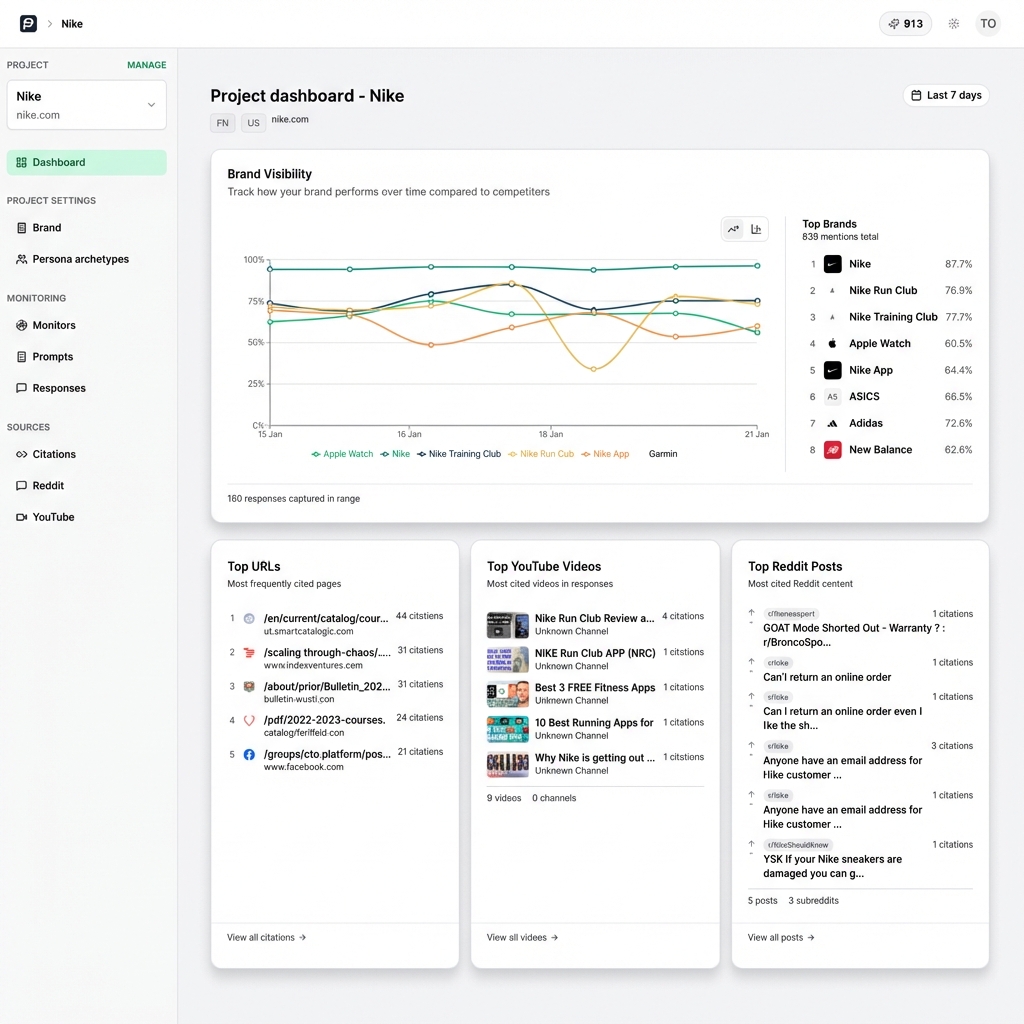
Doing this manually across multiple AI platforms is time-consuming and inconsistent. Prompt Eden automates the process across 9 AI platforms. With Citation Intelligence, you can:
- See which websites AI models cite when mentioning your brand
- Compare your citation sources against competitors
- Identify gaps where competitors are cited but you are not
- Track changes in citation patterns over time
The Visibility Score gives you a single 0-100 metric that combines four components: Presence (does AI mention you?), Prominence (how featured are you in the response?), Ranking (where do you appear in lists?), and Recommendation (does AI actively recommend you?). On the Free plan, you can track 10 prompts with weekly refreshes. The Starter plan ($49/month) supports 100 prompts with daily monitoring, while the Pro plan ($129/month) covers 150 prompts with daily monitoring and API access. ### Key Metrics to Watch
- Citation rate: What percentage of your target prompts result in a citation to your content? - Citation source diversity: Are AI models citing multiple pages from your site, or just one? - Competitor citation gap: How many prompts cite a competitor but not you? - Citation trend: Is your citation rate improving, flat, or declining over time? ### Evidence: Does Citation Optimization Actually Work? Research from Princeton, Georgia Tech, the Allen Institute for AI, and IIT Delhi published in the GEO study found that specific optimization strategies measurably increased source visibility in generative engine responses. Adding citations and quotations to content improved visibility by up to 40% in their experiments. Adding statistics improved visibility by approximately 30%. These are not theoretical claims. They were measured across thousands of queries on generative search systems. The implication is clear: content structure directly affects whether AI models select your page as a source.
Step-by-Step Content Audit for AI Citations
Use this checklist to audit and optimize your existing content for better AI citation performance. ### Step 1: Select Pages to Optimize
Start with pages that have the highest potential:
- Pages that already rank well in traditional search (they have authority signals)
- Product or category pages that match common AI prompts
- Definitive guides and how-to content in your area of expertise
- Pages with original data, research, or unique analysis
Prioritize your highest-potential pages for the first optimization cycle. ### Step 2: Audit Structural Accessibility
For each page, check:
- Content is server-rendered HTML (not JavaScript-only)
- Page is not blocked by robots.txt for AI crawlers
- No mandatory login or paywall before content
- Page loads in under 3 seconds
- Clean semantic HTML with proper heading hierarchy
Use the free AI Robots.txt Checker to verify crawler access. ### Step 3: Rewrite Opening Statements
For each major section on the page:
- Does the first sentence directly answer a question? - Is it self-contained and quotable? - Does it include specific terms an AI model would associate with the topic? Rewrite any opening that starts with vague or contextual language. Put the answer first, then provide supporting detail. ### Step 4: Add Specific Data Points
Review each page for opportunities to add:
- Statistics with named sources
- Dates, version numbers, and concrete timeframes
- Comparison data with clear criteria
- Results from your own research, surveys, or case studies
Every specific data point is a potential citation anchor. Generic advice without numbers rarely gets cited. ### Step 5: Improve Entity Signals
Check that each page:
- Mentions your brand name in a clear, descriptive context
- Includes structured data markup (Article, FAQ, HowTo, or Organization schema)
- Links to your authoritative profiles (About page, social profiles, directory listings)
- Uses consistent terminology for your brand, products, and category
Step 6: Build External Citation Support
For your highest-priority pages, create supporting signals:
- Pitch the topic to industry publications for coverage
- Share findings on social media and professional communities
- Contribute guest posts that reference or link to your content
- Submit data or insights to journalists covering your industry
Step 7: Monitor and Iterate
After making changes, wait a few weeks for AI models to process updated content, then re-run your target prompts to measure improvement. Use the AI Query Generator to build a testing prompt set that covers the queries your audience actually asks AI assistants. Track results monthly. Citation optimization is not a one-time project. It requires ongoing measurement and refinement as AI models evolve and competitors adapt.
Common Mistakes That Block AI Citations
Even well-written content can fail to earn citations if you make these errors. ### Blocking AI Crawlers
Some websites block AI bots in their robots.txt without realizing it. Googlebot, GPTBot, ClaudeBot, PerplexityBot, and others each have their own user agent strings. Blocking any of them removes your content from that model's retrieval pool entirely. ### Writing for Rankings Instead of Answers
Traditional SEO content often buries the answer below thousands of words of context, internal links, and keyword padding. AI retrieval systems prefer pages where the answer appears early and clearly. If your content makes a reader scroll through five paragraphs before finding the point, AI models will skip it for a source that answers faster. ### Relying Only on Your Own Domain
If every mention of your brand comes from your own website, AI models treat that as a single-source signal. It carries less weight than a brand mentioned across multiple independent domains. Invest in earning coverage from third-party sites, not just publishing more content on your own. ### Ignoring Technical Formats
PDFs, image-heavy pages without alt text, and content trapped inside iframes or embedded widgets are harder for AI to parse. When possible, publish your most important content as clean, well-structured HTML. ### Never Updating Content
AI models value freshness signals. A page published three years ago with no updates may be passed over in favor of a more recent source covering the same topic. Review and update your highest-value pages at least twice per year.