
How to Measure AI Visibility, From First Metric to Full Framework
Most articles about AI visibility mention that you should track it, then stop there. This guide provides the complete measurement framework: which metrics actually matter, how to score visibility across 9 AI platforms, what cadence to use, and how to turn raw data into decisions. Whether you are starting from scratch or refining an existing program, this is the operational playbook.

Why You Need a Measurement Framework (Not Just a Spot Check)
Ask ChatGPT about your brand. Note what it says. Repeat with Claude, Perplexity, and Gemini. Congratulations, you just did a spot check. The problem? Spot checks are almost useless for making decisions. AI responses are volatile. A study by Advanced Web Ranking that tracked 481 websites across four industries found that only 49% of brands remained consistently visible across AI platforms over a three-week period. Finance brands had a 35% dropout rate between measurement cycles. Even among brands that did appear, only about 30% stayed visible between consecutive answer runs. That kind of volatility means a single check on a Tuesday afternoon tells you very little. You might catch your brand on a good day, or a bad one, and you would have no way to know which. A measurement framework solves this by replacing guesswork with structured, repeatable observation. It answers four questions that spot checks cannot:
- What is our baseline? You need a starting number to know if things are improving. - What is changing? Weekly or daily monitoring reveals trends that a monthly audit misses. - Why is it changing? Combining visibility data with citation tracking tells you which content and which sources drive your AI presence. - What should we do about it? Metrics without action are just trivia. A good framework connects measurement to decisions. The rest of this guide builds that framework from the ground up.
The Five Metrics That Define AI Visibility
Traditional SEO has a well-understood metric stack: rankings, impressions, clicks, traffic, conversions. AI visibility needs its own stack. Here are the five metrics that matter, in order of importance. ### 1. Visibility Score (Composite)
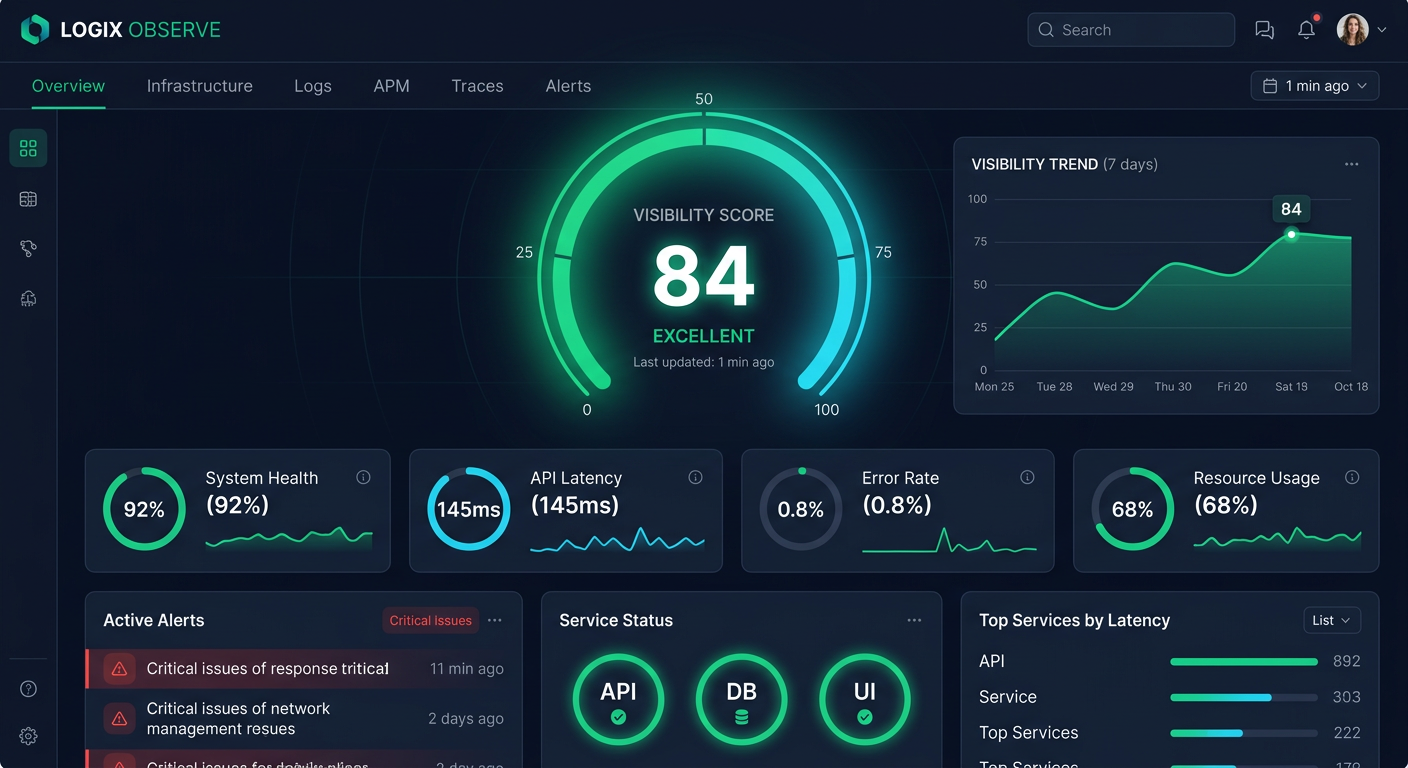
A Visibility Score combines multiple signals into a single number, typically on a 0-100 scale. This is your headline metric, the one you report to leadership and track over time. Prompt Eden's Visibility Score breaks into four components:
- Presence: Does the AI mention your brand at all for a given prompt? This is binary (yes or no) but foundational. If you are not present, nothing else matters. - Prominence: When mentioned, how central are you to the response? Being the first recommendation in a paragraph is different from appearing as a footnote at the end. - Ranking: Where do you appear relative to competitors in the same response? If an AI lists five tools and you are fourth, that ranking signal matters. - Recommendation: Does the AI actively recommend you, or just acknowledge your existence? There is a big gap between "Brand X exists" and "Brand X is a strong choice for this use case."
Each component captures something the others miss. Presence alone cannot tell you if a mention is positive or peripheral. Recommendation without ranking context misses competitive positioning. The composite score gives you one number to track while the components tell you where to dig deeper. ### 2. Share of Voice
Share of voice (SOV) measures the percentage of AI responses where your brand appears compared to competitors for a defined set of prompts. The formula is straightforward:
SOV = (Your brand mentions / Total competitor brand mentions) x 100
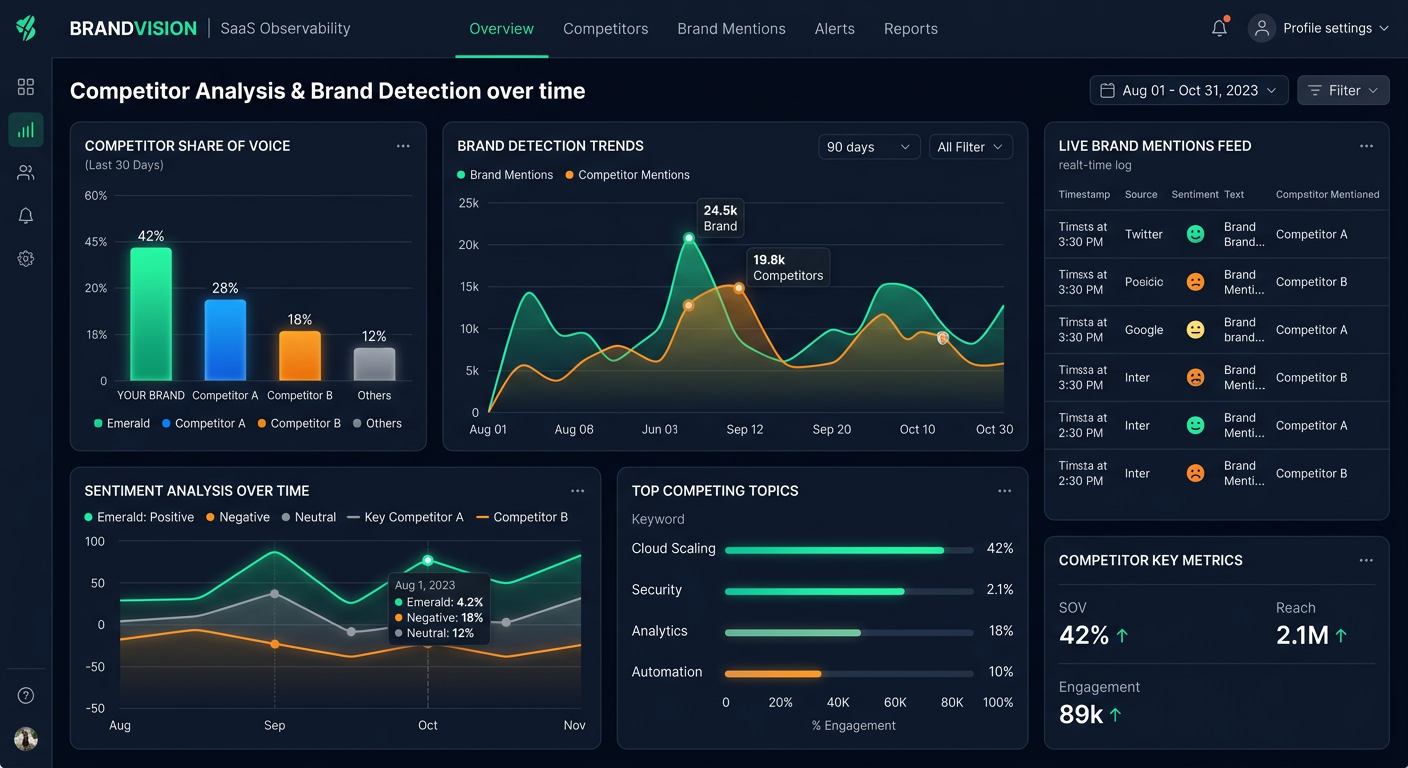
SOV is a competitive metric. Your Visibility Score might be stable while your SOV drops because a competitor is gaining ground. Track both. Define your competitive set carefully. Comparing yourself to the entire market creates noise. Pick your direct competitors and measure against them specifically. ### 3. Citation Rate and Citation Sources
Citations are the receipts. When an AI mentions your brand, citation data tells you which source it pulled from. This matters for two reasons. First, citation rate (the percentage of responses that include a linked source when mentioning you) indicates how "citable" your content is. Higher citation rates mean AI platforms are finding and referencing your material, not just recalling your brand from training data. Second, citation sources reveal your content supply chain. If every citation comes from your own website, you are depending on a single signal. If citations come from industry publications, review sites, and third-party comparisons, your brand has broader authority. Prompt Eden's Citation Intelligence tracks exactly this: which sources AI platforms cite when discussing your brand, and how that compares to competitors. ### 4. Platform Coverage
Not all AI platforms treat your brand the same way. You might appear consistently in ChatGPT responses but be invisible in Gemini or Claude. Platform coverage tracks how many of the major AI platforms mention your brand for your target prompts. With major AI platforms now generating answers for users, including ChatGPT, Claude, Gemini, Perplexity, and Google AI Overviews, platform coverage prevents you from optimizing for one model while ignoring the others. ### 5. Trend Direction
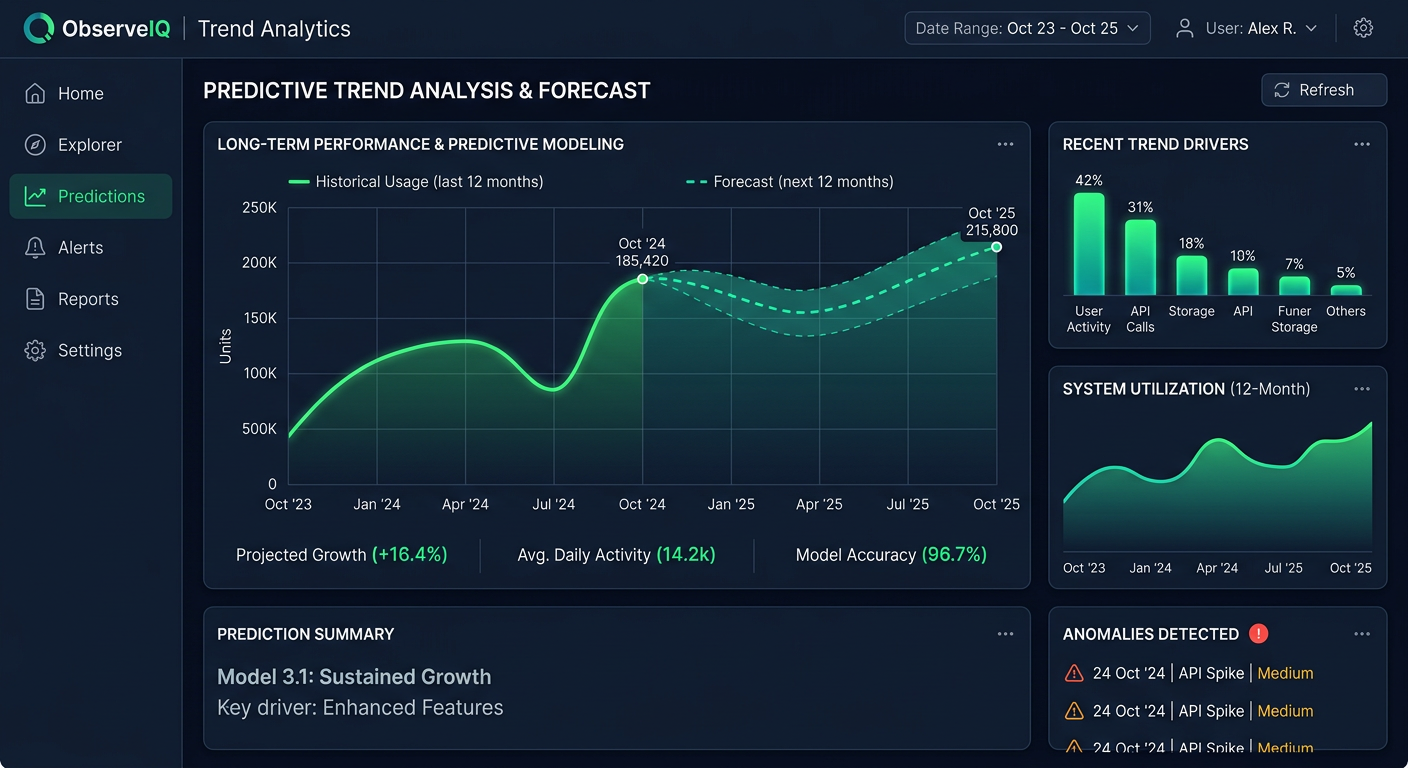
All of the above metrics need a time dimension. A Visibility Score is meaningless without context. Is it up from last month? Down from 78? Stable for the past quarter? Trend direction is the meta-metric that makes all other metrics actionable. Track weekly snapshots at minimum, and compare month-over-month for strategic decisions.
How to Build Your Prompt Library
Every measurement framework starts with what you are measuring. In AI visibility, that means defining your prompt library: the set of queries you will track across platforms on an ongoing basis. Your prompt library is the foundation of your entire measurement program. Get it wrong, and you will track metrics that do not connect to business outcomes. Get it right, and every data point maps to a real question your customers are asking AI. ### Prompt Categories to Include
Build your library across four categories:
Category queries ask about your market segment broadly. Examples: "What are the best project management tools?" or "Which CRM works best for small teams?" These capture top-of-funnel discovery where AI shapes initial consideration sets. Comparison queries pit you against specific competitors. Examples: "Compare Asana vs Monday.com" or "Is HubSpot better than Salesforce for startups?" These are high-intent prompts where a recommendation can directly influence a purchase decision. Problem-solution queries describe a pain point without naming a product. Examples: "How do I reduce customer churn?" or "What is the best way to track website performance?" These reveal whether AI associates your brand with relevant problems. Brand-specific queries ask about you directly. Examples: "What is [Brand]?" or "Is [Brand] good for [use case]?" These test what AI says about you when your name comes up, which affects buyers who are already aware of you and doing due diligence. ### How Many Prompts Do You Need? Start with 10 to 20. That is enough to establish a baseline without overwhelming your analysis. As you learn which prompts generate the most useful signals, expand your library. Prompt Eden supports different scales depending on your plan, from the Free tier through Business. Most teams find that a moderate prompt library covers their core measurement needs, with larger libraries needed for multi-product or multi-market businesses. ### Prompt Maintenance
Your prompt library is not a set-and-forget list. Refresh it quarterly. Add prompts that reflect new product features, emerging competitors, or shifts in how customers describe their problems. Remove prompts that no longer align with your business priorities. A useful check: ask your sales and support teams what questions prospects and customers are asking. Those questions, rephrased as AI prompts, often become your most valuable tracking targets.
Setting Your Measurement Cadence
How often should you measure? The answer depends on your goals, your budget, and how fast your market moves. Here is a practical cadence framework. ### Daily Monitoring
Daily measurement catches sudden shifts. If a competitor publishes a major report and AI platforms start citing them more, daily monitoring shows this within a day instead of a week later. Daily is the right cadence for teams that are actively running AI visibility campaigns or operating in fast-moving categories. Prompt Eden's Starter ($49/month) and Pro ($129/month) plans refresh data daily. ### Weekly Review
Even with daily data collection, your analysis cadence can be weekly. Set a recurring 30-minute review each week to check:
- Visibility Score changes (up, down, or flat)
- Any new competitor entries (Organic Brand Detection catches these automatically)
- Citation source shifts (new sources appearing, old ones dropping)
- Platform-specific changes (did you gain visibility on Gemini but lose it on Perplexity?)
This weekly rhythm keeps you informed without turning measurement into a full-time job. ### Monthly Deep Analysis
Once a month, go deeper. Compare this month to last month across all five core metrics. Look for patterns:
- Are specific prompt categories improving while others decline? - Is your share of voice growing on some platforms but shrinking on others? - Which content changes correlated with visibility improvements? - Are competitors investing in areas where you are losing ground? The monthly review is where you update your strategy. It is the meeting where you decide what to create, what to update, and where to focus your authority-building efforts. ### Quarterly Strategic Review
Every quarter, step back from the metrics and evaluate the program itself. - Is your prompt library still aligned with your business priorities? - Are you tracking the right competitors? - Have new AI platforms emerged that you should be monitoring? - Do your KPIs still connect to business outcomes? The quarterly review is also when you report to stakeholders. AI visibility is new enough that executives often need context. Show them the trend lines, explain what they mean, and connect visibility gains to pipeline and brand health metrics they already care about. ### The Tradeoff: Speed vs. Depth vs. Budget
More frequent monitoring costs more, both in platform fees and in analysis time. Not every team needs the fastest available refresh interval. Here is a simple decision guide:
- Just getting started? Weekly monitoring (Free plan, 10 prompts) is fine. Establish your baseline first. - Running active campaigns? Daily monitoring (Starter or Pro) lets you measure the impact of content changes in near real-time. - Enterprise or agency managing multiple brands? 3-hourly monitoring (Business plan, 400 prompts) provides the granularity needed for client reporting and fast-moving markets. Pick the cadence that matches your operational tempo. You can always upgrade later as your program matures.
From Metrics to Action: Reading Your Data
Raw numbers do not improve visibility. Knowing what to do with them does. Here are the most common patterns you will see in your data and what each one means. ### Pattern 1: High Presence, Low Prominence
You are being mentioned, but only in passing. AI knows you exist but does not treat you as a primary answer. What to do: Improve the depth and specificity of your content. AI platforms give prominence to brands they can describe in detail. If your content is surface-level, you will get surface-level mentions. Create definitive resources that answer the exact prompts where you want more prominence. ### Pattern 2: Strong on One Platform, Weak on Others
ChatGPT mentions you consistently, but Claude and Gemini rarely do. This is common because each AI platform draws from different data sources and has different retrieval behaviors. What to do: Investigate what content the strong platform is citing (use Citation Intelligence to find this) and check whether that content is accessible to the weak platforms. Sometimes the fix is as simple as unblocking an AI crawler in your robots.txt. Other times, it means the weak platform relies more on third-party sources, and you need to build coverage there. ### Pattern 3: Declining Share of Voice
Your Visibility Score is stable, but your SOV is dropping. A competitor is gaining ground. What to do: Identify which competitor is rising and for which prompts. Check what content they have published recently. Often, a new comparison page, a research report, or a significant round of press coverage shifts the balance. Your response should be to fill the gap: create or update content that competes directly. ### Pattern 4: High Citation Rate from Your Own Domain Only
AI cites your website when it mentions you, but no third-party sources appear. This is a single point of failure. What to do: Invest in off-site authority. Get reviewed by industry publications. Contribute data to analyst reports. Publish guest content on high-authority domains. The goal is to give AI platforms multiple independent sources that validate your brand. ### Pattern 5: Volatile Scores with No Clear Cause
Your visibility bounces around week to week with no obvious explanation. This is frustratingly common, especially in categories with high competition. What to do: First, check if the volatility is model-driven (a platform update changed behavior) or prompt-driven (AI responses to specific queries are unstable). For model-driven volatility, patience is usually the answer since scores settle after updates. For prompt-driven volatility, focus on the prompts where you are inconsistent and build stronger, more authoritative content for those specific queries. The Advanced Web Ranking study found that brands with high sentiment scores (85 or above) maintained more stable visibility, suggesting that quality of mention matters as much as frequency.
Your First Month: A Step-by-Step Launch Plan
Theory is useful. But you need a starting point. Here is a week-by-week plan for building your AI visibility measurement program from zero. Week 1: Establish Your Baseline
Sign up for a Prompt Eden plan. The Free plan ($0, 10 prompts, weekly refresh) works for an initial baseline. If you want faster iteration, the Starter plan ($49/month) gives you daily refresh with 100 prompts. - Draft your first prompt library. Pick 10 queries across the four categories: category, comparison, problem-solution, and brand-specific. - Use Prompt Eden's free AI Query Generator at /tools/query-generator/ to brainstorm additional prompts. It suggests queries you might not have considered. - Record your starting Visibility Score, share of voice, and platform coverage. This is day zero. Week 2: Expand and Cross-Reference
Review your initial results. Which platforms mention you? Which do not? - Check your robots.txt using the free AI Robots.txt Checker at /tools/robots-checker/. Make sure you are not accidentally blocking AI crawlers from accessing your content. - Generate and publish an llms.txt file using the free llms.txt Generator at /tools/llms-txt-generator/. This file helps AI models understand your site structure. - Analyze your Citation Intelligence data. Where are AI platforms finding information about you? Week 3: Take Your First Actions
Identify your single biggest gap. Maybe you are absent from comparison queries. Maybe one platform never mentions you. Pick the highest-impact problem. - Create or update one piece of content specifically designed to address that gap. Structure it with clear headings, specific data, and direct answers to the questions in your prompt library. - Check what content your top competitor is being cited for. Build something better. Week 4: Review, Report, and Plan Forward
Compare your Visibility Score to your day-zero baseline. Even small movements in the first month indicate that your measurement system is working and capturing real signals. - Write a one-page summary for your team: current score, top gaps, actions taken, next steps. - Build a quarterly roadmap based on what you have learned. Prioritize by impact: which prompts represent the most valuable customer questions, and where are your biggest visibility gaps? After your first month, you have a working measurement program, a baseline to improve against, and enough data to prioritize your next moves. Most teams discover actionable opportunities in the first week that they did not know existed.