

How to Improve AI Visibility for Your Ecommerce Brand
AI visibility for ecommerce is becoming a direct revenue driver as shoppers ask ChatGPT, Perplexity, and Google AI which products to buy. When someone asks "What's the best running shoe for flat feet?" or "Top rated coffee grinders," the brands that appear in those answers capture buying intent that never touches a traditional search result. This guide explains how AI product recommendations work, what signals influence them, and the specific steps ecommerce teams can take to measure and improve their presence across AI platforms.
Why AI Product Recommendations Are a Buying Signal
When a shopper types a product question into an AI assistant, they are usually close to a purchase decision. This is not casual browsing. Someone asking "best waterproof hiking boots for winter" or "which protein powder is best for recovery" has a specific need and wants a specific answer. The AI provides one, naming products by brand and often explaining why.
That moment is where ecommerce AI visibility matters. If your brand appears in the response, you are in the consideration set. If your brand doesn't appear, you are not. There is no page two.
The numbers back this up. AI-driven traffic to Shopify merchant sites grew 8x between January 2025 and early 2026, and AI-driven orders grew 15x over the same period. A separate survey found that 64% of shoppers said they are likely to use AI when making purchases. These aren't projections. This is happening now, and the brands that optimize for it early will build visibility advantages that compound over time.
The types of prompts that drive ecommerce AI visibility fall into a few clear patterns:
- Product category queries: "What are the best standing desks?" or "Top rated blenders for smoothies"
- Comparison prompts: "Compare Vitamix vs Blendtec for a home kitchen"
- Use-case queries: "Best mattress for side sleepers with back pain"
- Gift and occasion prompts: "Good gifts for a coffee lover under $50"
- Problem-solution prompts: "What skincare products help with hyperpigmentation?"
Each of these carries commercial intent. The person asking is a potential buyer. The brand that gets recommended gets the click, the visit, and the potential sale.
How AI Platforms Decide Which Products to Recommend
AI platforms don't have a category manager curating product picks. They generate recommendations based on patterns in training data, web content they can retrieve, and signals that establish a product's authority in a given category. Understanding these factors helps you know where to focus.
Training Data and Brand Presence
Large language models build their product knowledge from the web content they trained on: product pages, reviews, blog posts, comparison articles, Reddit threads, press coverage, and more. A brand with wide coverage across authoritative sources has a natural advantage. If your products are mentioned frequently and accurately across multiple independent sources, AI models have more signal to draw from when recommending products.
This means your brand's footprint beyond your own website matters significantly. Third-party reviews, editorial coverage, influencer content, and community discussions all contribute to what an AI model knows about your products.
Real-Time Web Retrieval
Platforms like Perplexity and ChatGPT with browsing enabled pull from live web sources when answering product queries. For these platforms, your current content matters as much as historical training data. Your product pages need to be crawlable, your reviews need to be accessible, and your structured data needs to be accurate.
Google AI Overviews and Google AI Mode also pull heavily from indexed content. If your product pages rank well traditionally, that helps, but AI presentation layers have their own logic about which sources to surface and quote.
Review Signals
AI platforms pay attention to independent reviews. When multiple review sites, editorial publications, and community sources consistently describe a product as strong in a particular area, that pattern shapes AI recommendations. A product with 4.8 stars across 2,000 reviews on multiple platforms is much more likely to get recommended than an equivalent product with sparse or mixed coverage.
This is why review strategy is inseparable from ecommerce AEO. AI models aren't reading star ratings directly, but they're learning from the same content that informed those ratings: articles, community discussions, and editorial roundups.
Product Page Clarity
AI models need clear signals to correctly categorize and describe products. A product page that clearly states the product type, target customer, key specifications, and use case gives AI models the structured information they need to mention you in relevant queries.
Vague product descriptions hurt AI visibility the same way they hurt conversion. "Premium multi-functional device" tells an AI model nothing. "Stainless steel French press coffee maker, large capacity, ideal for daily use" gives the model what it needs to recommend you when someone asks for French press options.
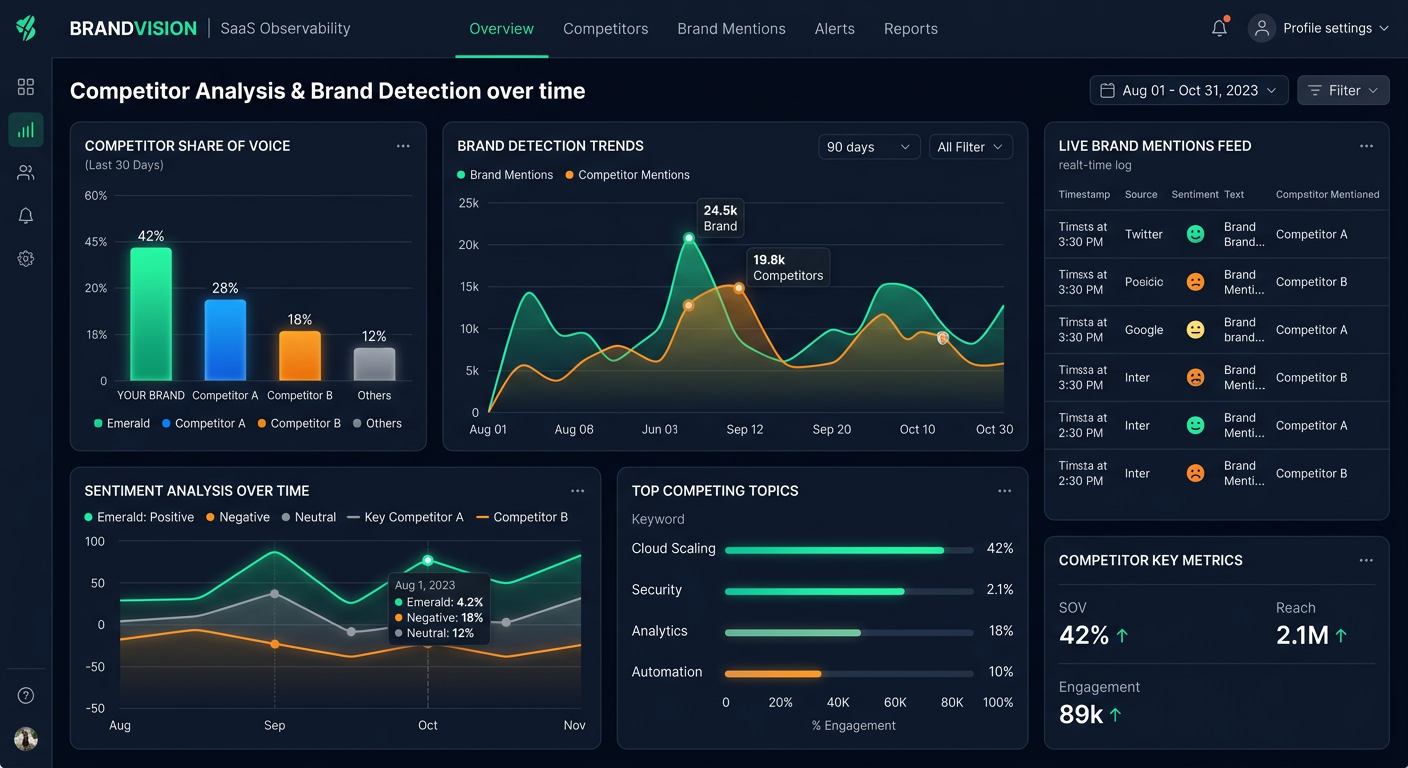
Measuring Your Ecommerce Brand's AI Visibility
Before changing anything, you need to know where you stand. Running a handful of manual queries in ChatGPT tells you almost nothing useful. You need systematic tracking across multiple platforms, a consistent prompt set, and a way to measure changes over time.
Build a Prompt Set That Matches Buyer Queries
Start by documenting the types of questions your customers are actually asking AI assistants. Think about your product categories, your target customer, and the specific problems your products solve. Good ecommerce prompts for AI visibility testing usually fall into these groups:
Category queries: "Best [product type] for [use case]" or "Top [category] brands"
Comparison queries: "[Your brand] vs [competitor brand]" or "Compare [product A] and [product B]"
Attribute queries: "Best [product type] under $[price]" or "[Product type] for [customer profile]"
Gift and occasion queries: "Good [product type] gifts for [occasion or recipient]"
Problem queries: "[Product type] that helps with [specific problem]"
Prompt Eden's free AI Query Generator can help you expand this list, particularly for long-tail and edge-case variations you might not think to write yourself.
Track Across Multiple AI Platforms
Your brand might appear confidently in Perplexity responses while being absent from Claude. Google AI Overviews might feature your products in one category but not another. Each platform has different data sources, different retrieval patterns, and different tendencies in how they structure product recommendations.
Checking only ChatGPT is the most common mistake ecommerce teams make when assessing AI visibility. It gives you a partial picture that can be actively misleading. Prompt Eden monitors brand mentions across 9 AI platforms, including ChatGPT, Perplexity, Claude, Gemini, Google AI Overviews, and Google AI Mode. For ecommerce brands competing in category-level queries, that cross-platform view shows you where you're winning and where you're not.
Understand What a Visibility Score Means
Raw mention counts are a starting point, not a measurement. Being mentioned as an afterthought in a list of ten brands is different from being the top recommendation in a direct answer. Prompt Eden's Visibility Score (0-100) measures four dimensions that matter for ecommerce specifically:
- Presence: Does the AI mention your brand at all in relevant queries?
- Prominence: Are you featured clearly or buried in a long list?
- Ranking: Where do you appear relative to competitors in responses?
- Recommendation: Does the AI actively recommend your products or just acknowledge they exist?
For ecommerce, the Recommendation dimension is often the most commercially meaningful. A brand that gets recommended by name in response to "what should I buy" queries is capturing real buying intent.
Find Out Which Sources AI Cites About You
When an AI platform recommends your products, it's drawing from specific sources. Prompt Eden's Citation Intelligence shows you which websites AI references when discussing your brand. This is actionable data. If competitors get cited from four review platforms, two editorial publications, and several independent blogs while you only appear from your own product pages, you know exactly where the gap is and where to focus your content strategy.
An Ecommerce AEO Playbook
Here's a practical sequence for improving AI visibility, organized by where you'll see the fastest impact.
Step 1: Audit Your Current Presence
Before changing anything, run your highest-value category and comparison queries across at least three AI platforms. Document which products get mentioned, how your brand is described, and what sources the AI cites. This baseline tells you whether you have a presence problem (not being mentioned at all), a positioning problem (being mentioned inaccurately), or a prominence problem (being mentioned but not recommended).
Prompt Eden's Organic Brand Detection auto-discovers which competitors appear in your category queries without manual setup, so you get a competitive map from the start.
Step 2: Fix Technical Access
AI crawlers need to be able to reach your content. Ecommerce sites have several common issues that block AI visibility:
- Robots.txt blocking: Some ecommerce platforms include broad AI crawler restrictions by default. Check your robots.txt to see if you're blocking GPTBot, PerplexityBot, ClaudeBot, or Googlebot.
- JavaScript-rendered content: Product descriptions and reviews that only render via JavaScript may not be accessible to AI crawlers. Key product information should be in the HTML.
- Thin product pages: Pages with minimal content give AI models little to work with. Product pages that include detailed descriptions, use cases, and specifications perform better.
Use Prompt Eden's free AI Robots.txt Checker to see if your site is inadvertently blocking AI platforms. If you're also looking to help AI models navigate your site structure, the free llms.txt Generator creates a structured summary that AI platforms can reference.
Step 3: Improve Product Page Content
AI models pull product information from your pages when constructing recommendations. Product pages that clearly answer buyer questions tend to get cited more often.
For each major product or category page, check that you've addressed:
- What the product is and what category it belongs to
- Who it's for (customer type, skill level, use case)
- Key specifications and features in plain language
- How it compares to alternatives in terms the buyer would use
- Common questions buyers have before purchasing
FAQ sections on product pages are particularly useful. When a buyer asks an AI "Is the [your product] good for beginners?", an AI platform that can find a clear answer on your page will cite it.
Step 4: Build Independent Coverage
Your own product pages have limited influence on AI recommendations by themselves. Independent sources carry more weight. For ecommerce specifically, these are the most impactful:
Review platforms: AI models draw heavily from product reviews on platforms like Amazon, Trustpilot, Google Shopping, and category-specific review sites. Actively managing your review presence across these platforms builds the signal AI models use.
Editorial roundups: Articles like "Best [product type] of the Year" or "Top [category] brands reviewed" are highly cited by AI platforms answering category queries. Getting included in these roundups, either through PR outreach or product seeding, contributes directly to AI visibility.
Comparison content: If a blogger or publication has compared your product to competitors, that content often gets cited when AI platforms answer comparison queries. Pitching your products for comparison reviews is a direct path to AI citation.
Community mentions: Reddit, specialized forums, and community sites where customers discuss products organically contribute to training data. Encouraging genuine community engagement around your products builds this layer over time.
Step 5: Add Structured Data
Product schema markup helps AI platforms extract accurate information about your products. Implementing Product, Review, AggregateRating, and FAQPage schema gives AI models structured data they can parse reliably.
This is especially important for Google AI Overviews and Google AI Mode, which integrate closely with Google's indexing infrastructure. Accurate structured data reduces the chance of your products being described incorrectly or incompletely in AI-generated responses.
Real-World Ecommerce Examples of AI Visibility Patterns
Looking at how AI platforms actually respond to ecommerce queries reveals some patterns that inform strategy.
Category Leaders Get Disproportionate Mention
When someone asks ChatGPT or Perplexity for the best products in a category, the top recommendations tend to cluster around brands with the strongest third-party presence. These aren't always the market share leaders. Often, they're brands with consistent coverage across review platforms, editorial publications, and community discussions.
A mid-size brand with strong editorial coverage in four or five key publications often outperforms larger competitors with higher sales but weaker content footprints. AI models are responding to information density, not revenue.
Comparison Queries Favor Documented Differentiators
When shoppers ask AI platforms to compare two products or brands, the AI draws on whatever content exists that covers that comparison. Brands that have documented their own differentiators clearly, whether through comparison pages, PR, or editorial reviews, tend to get described more accurately and favorably.
Brands that leave their positioning entirely up to third parties often find their AI descriptions focus on whatever reviewers happened to emphasize, which may not align with their actual strengths.
Price and Attribute Queries Filter Aggressively
Queries like "best compact coffee maker" or "lightest running shoe for trail running" require AI platforms to filter by specific attributes. Brands that make price, specifications, and target customer explicit in their product content are much more likely to appear in these filtered recommendations.
If your product pages don't mention the weight of a backpack or the specific use case your coffee maker is designed for, an AI can't reliably include you in attribute-filtered recommendations.
Gift and Occasion Prompts Are a Hidden Opportunity
Gift-oriented queries are heavily used and often underoptimized by ecommerce brands. When someone asks "good gifts for a tea lover" or "birthday gift for someone who loves cooking," AI platforms draw from gift guide content, editorial roundups, and community recommendations.
Brands that have earned coverage in gift guide content, seasonal roundups, and editorial "best for" lists tend to appear consistently in these queries. This content is often produced by publishers rather than brands directly, making PR and media relationships a relevant factor.
Tracking Progress and Adjusting Your Approach
AI visibility isn't a one-time fix. AI models update on their own schedules, new content enters training data continuously, and competitor activity can shift your relative position. Setting up a monitoring practice gives you the data to respond.
Set a Baseline Before You Change Anything
Run your full prompt set before making any content or technical changes. Document your Visibility Score, which platforms mention you, how you're described, and which competitors appear. This baseline is your reference point. Without it, you won't know whether changes are working.
Monitor at a Cadence That Matches Your Category
How often you need to check depends on the pace of your category. Fast-moving categories with frequent product launches and active editorial coverage change faster than stable categories. At minimum, check monthly. Prompt Eden's plans support different refresh intervals: the Free plan ($0) gives you 1 project with weekly tracking, the Starter plan ($49/month) covers 3 projects with more frequent updates, and the Pro plan ($129/month) handles 5 projects for teams running broader monitoring programs.
Watch Competitors, Not Just Yourself
Your AI visibility exists in relation to your competitors' visibility. A competitor earning a wave of new editorial coverage can shift AI recommendations within a model update cycle. Prompt Eden's competitive tracking surfaces when competitors gain or lose ground across platforms, so you can identify whether a drop in your visibility is absolute or relative.
Correlate Changes with Actions
When your Visibility Score moves, you want to know why. Keep a log of what you've changed: new reviews collected, editorial coverage earned, product page updates, technical fixes deployed. Over time, you'll see which actions produced measurable visibility gains and which didn't. That feedback loop is what turns a scattered effort into a repeatable strategy.
For teams just starting out, the free AI Query Generator is a useful place to build your initial prompt set, and the features overview shows what tracking and citation data looks like in practice.