
AI Visibility for Agencies: Managing AEO Across Client Brands
AI visibility for agencies is quickly becoming a new service line, one that most clients don't yet know they need. This guide covers how to manage multi-brand AI monitoring, structure competitive benchmarks across client portfolios, and deliver reporting that earns budget. Whether you're an SEO agency adding AEO to your offering or a full-service shop exploring the space, the workflows here are practical and repeatable.
Why Agencies Need to Care About AI Search Now
Agencies live and die by demonstrating value to clients. The challenge is that the channels clients care about keep shifting. Right now, one of the biggest shifts is happening in how their customers discover brands. AI assistants have become a meaningful part of the buyer journey. When someone asks ChatGPT for a software recommendation, a restaurant, a financial advisor, or a local service, they get a curated AI-generated answer. Whether your clients appear in those answers is a new kind of brand visibility question, and it's one that most agencies have not yet built a practice around.
According to Gartner, traditional search engine volume is projected to drop 25% by 2026 as users shift toward AI-powered answers. For your clients, this isn't hypothetical. Their potential customers are asking AI assistants about their categories right now, and the competitive picture in those AI responses may look nothing like it does in Google results.
The agencies that will own this space are the ones that get ahead of it. And getting ahead of it means building a monitoring and reporting workflow before clients start asking why their competitor appears in ChatGPT and they don't.
What makes agency AEO different from single-brand AEO
When you're managing AI visibility for a single brand, you can focus your prompt set, configure one monitoring project, and report to one stakeholder. Agencies face a different problem. You may be managing five, ten, or twenty clients simultaneously, each with different categories, different competitors, and different audiences across different AI platforms.
The operational challenges are real:
- Each client needs its own prompt library built around their specific category and buyer queries
- Competitive benchmarks need to be scoped per client, since a client's competitors rarely overlap
- Reporting needs to be translated into business language that non-technical clients understand
- Monitoring needs to run on a consistent cadence across all clients without manual oversight
Building an agency AEO practice means solving all of these at once, not just knowing how AEO works in theory.
Setting Up Multi-Brand Monitoring Across Client Portfolios
The foundation of agency AEO work is a monitoring setup that scales. You need one place to manage multiple client brands, each with their own prompt sets, competitive tracking, and data refresh schedules.
Prompt Eden's project structure is designed for this. Each project maps to one client brand and tracks that brand's visibility across 9 AI platforms, including ChatGPT, Perplexity, Google AI Overviews, Google AI Mode, Gemini, Claude, Claude Code, Codex, and GitHub Copilot. The Business plan supports up to 15 projects with 15 team seats, which fits most mid-sized agency client rosters. Smaller agencies can start on the Pro plan with 5 projects.
Configuring each client project
When you set up a new client project, the key decisions are:
Brand context. Give the system a clear description of what the client does, who they serve, and how they position themselves. This context shapes how AI responses get analyzed and which mentions are relevant. Vague descriptions produce noisier data.
Prompt library. Build a prompt set that reflects how the client's buyers actually use AI. A law firm's buyer prompts look nothing like a B2B software company's. The AI Query Generator can help you brainstorm prompts you might not have thought of, especially long-tail variations that reflect how different buyer personas phrase questions.
Platform selection. Not every AI platform matters equally for every client. A developer tools company should definitely track Claude Code, Codex, and GitHub Copilot alongside the standard search platforms. A local service brand probably cares more about Google AI Overviews than about coding agent platforms. Tailor platform selection to where each client's buyers actually are.
Refresh cadence. Daily refresh is the right default for most active clients. The Business plan's 3-hourly refresh is worth it for clients in fast-moving categories or those who have just launched something and need to watch how AI picks it up quickly.
Team workspace structure
The Business plan includes 15 team seats, which lets you give individual account managers access to their clients' projects. Role-based access means each account manager sees what they need without being overwhelmed by data from other clients. For agencies with dedicated analysts, you can configure analyst access across all projects while giving account managers scoped access to only their accounts.
Building Client-Specific Competitive Benchmarks
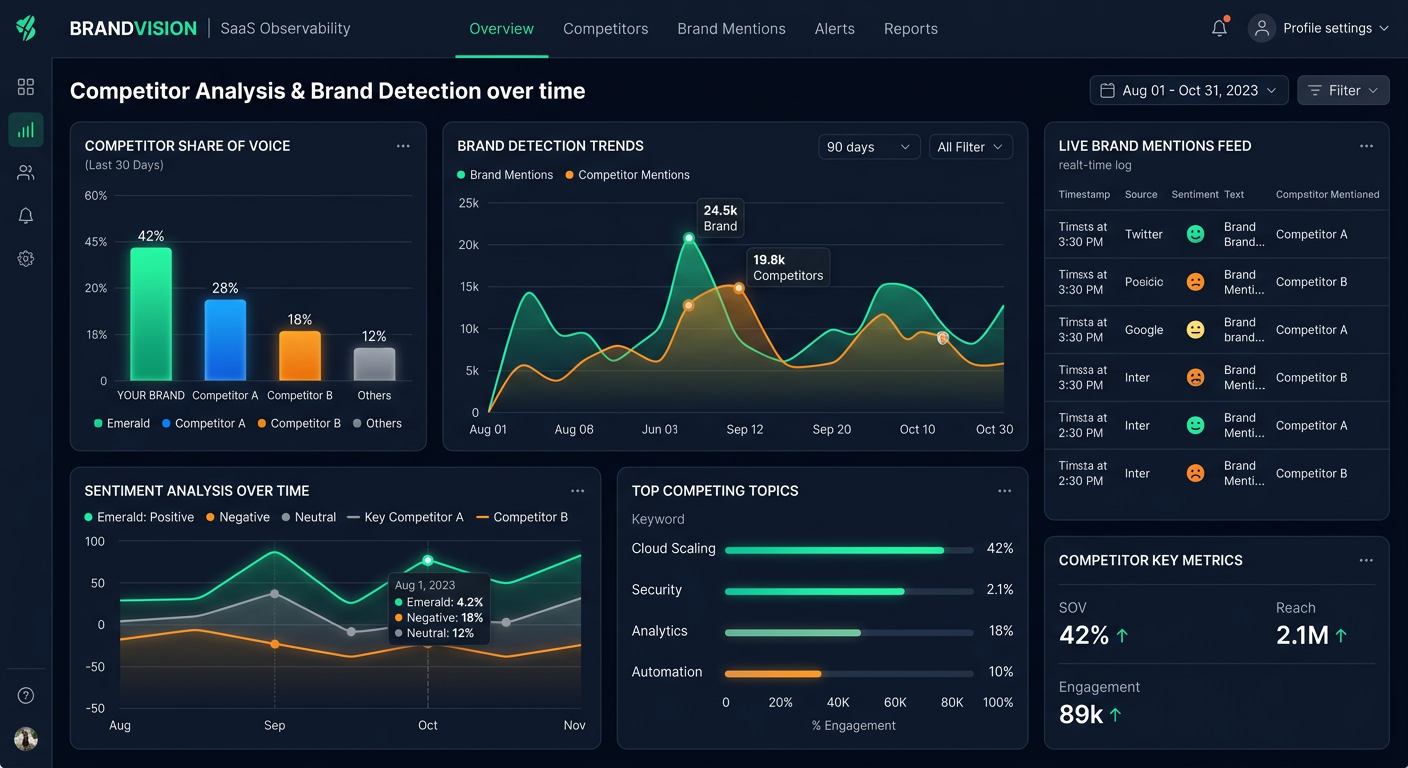
Competitive benchmarking is where agency AEO work gets interesting and where you can generate the clearest business case for clients. When you can show a client that their main competitor appears in 74% of relevant AI responses while they appear in only 31%, the strategic need for AEO work becomes obvious without any persuasion.
How to structure competitive benchmarks for each client
Start by mapping each client's competitive set. This is not always the same as their perceived competitors. Organic Brand Detection automatically surfaces brands that appear in AI responses to your tracked prompts, which frequently reveals competitors the client wasn't tracking or adjacent-category brands that AI treats as alternatives.
Once you have the competitive set, the benchmark breaks into four areas that mirror Prompt Eden's Visibility Score components:
Presence comparison. Which brands appear in AI responses, and how often? Express this as a percentage of prompts where each brand is mentioned. A client whose brand appears in a minority of relevant AI responses while a competitor shows up in the vast majority has a clear gap, and the data tells the story.
Prominence comparison. When the client and competitors both appear, who gets more attention? A client who appears as a footnote while a competitor gets three paragraphs is losing on prominence even when both show up.
Ranking comparison. In ranked lists and recommendations, who comes first? Position in AI-generated lists correlates with buyer consideration. A client who consistently ranks fourth while a competitor ranks first needs to understand that gap.
Recommendation rate. Does AI actively recommend the client's brand, or just acknowledge it exists? The Recommendation dimension of the Visibility Score is often the most telling. A brand can have high presence but low recommendation if AI mentions it without endorsing it.
Prompt-level competitive analysis
Beyond aggregate benchmarks, drill into prompt-level results. Some prompts are high-priority for the client's business, and understanding who wins each one reveals the most actionable opportunities. If a client's primary category query ("best accounting software for small businesses") always surfaces three competitors and never the client, that is a priority gap. If the client appears strongly on product-specific queries but weakly on general category queries, that points to a specific content strategy.
CSV export for responses and citations lets you pull this data into your own reporting formats, which matters when you need to present competitive findings in a client-specific template or combine them with other channel data.
How to Structure AEO Reporting for Clients
Getting the data is one problem. Presenting it to clients in a way that earns ongoing investment is a different one. Most clients don't know what a Visibility Score is, and they definitely don't understand the mechanics of how AI platforms weight training data vs. retrieval sources. Your job is to translate monitoring data into business language.
The monthly AEO report structure
A clear monthly AEO report for clients covers five things:
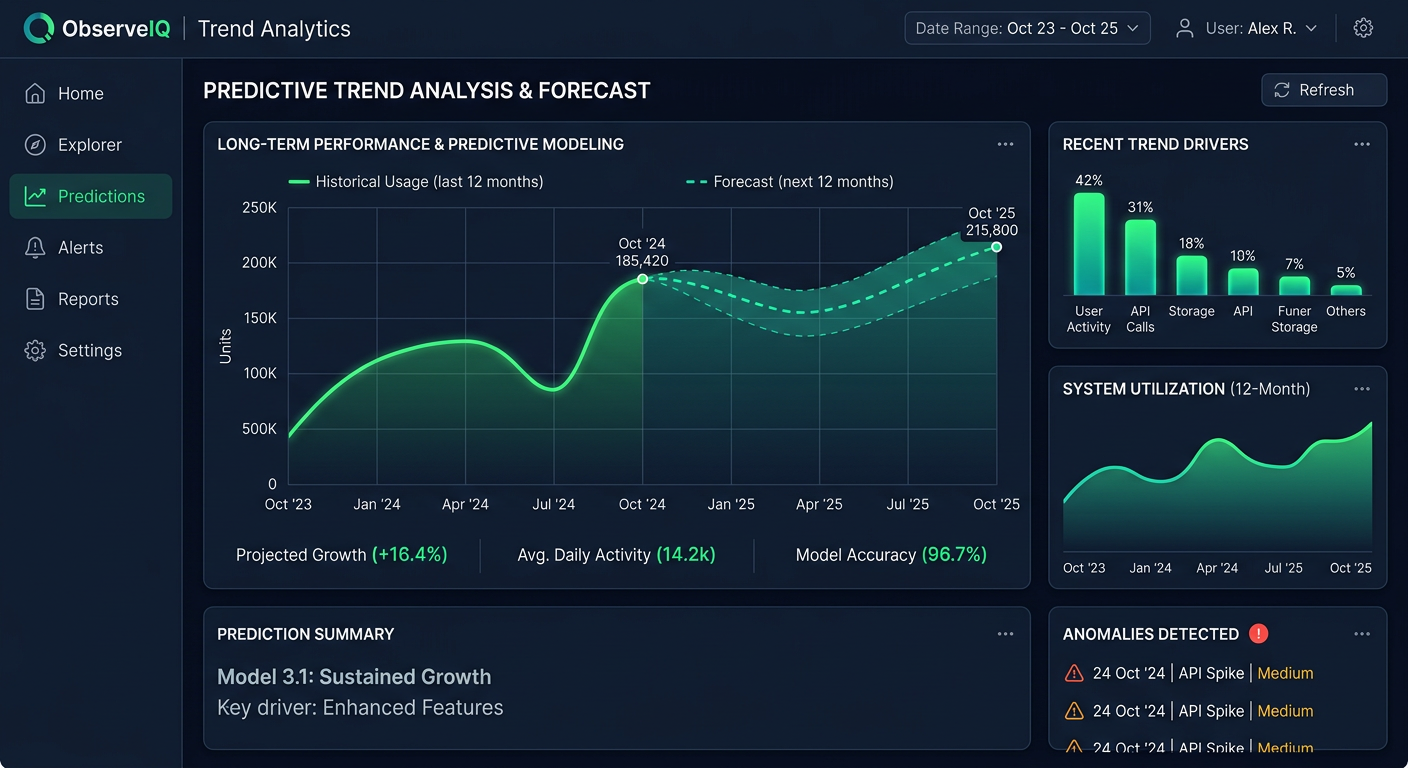
1. Visibility Score trend. Show the client's composite Visibility Score this month vs. last month, and situate it relative to their top two or three competitors. A simple chart with three lines tells this story clearly. If the score improved, explain why. If it dropped, explain that too.
2. Share of voice across prompt categories. Break the client's prompt set into categories (brand queries, category queries, comparison queries) and show share of voice for each. This reveals which areas are improving and which need attention.
3. Platform breakdown. Show how the client's visibility varies across AI platforms. A client who appears consistently in ChatGPT but barely registers in Perplexity or Gemini has a platform gap. This framing helps clients understand that "AI visibility" is not monolithic.
4. Citation sources. Citation Intelligence shows which websites AI cites when discussing the client's brand. Include the top cited domains and compare them against a competitor's top citations. If the competitor gets cited from industry publications and the client only gets cited from their own site, that's a concrete gap with a concrete fix.
5. Priority actions for next month. Close the report with three specific recommendations tied to the data. Not general advice about content quality, but specific prompt gaps to close, specific platforms to improve on, or specific citation sources to pursue.
How to present AI visibility to clients who don't know AEO
Many agency clients will be hearing about AEO for the first time when you bring it to them. The framing that tends to land best is this: when their customers ask AI assistants for recommendations in their category, the AI generates an answer that either includes them or doesn't. Right now, most brands have no idea how they're showing up in those answers. AEO monitoring tells them, and AEO optimization improves it.
Avoid technical language in client presentations. You don't need to explain training data, retrieval augmented generation, or LLM inference. The business question is simple: when your buyers ask AI for a recommendation, does your brand appear? The monitoring answers that question. The optimization work improves the answer over time.
For clients who want the full picture, walking through a live Visibility Score breakdown with their actual competitor data is usually more persuasive than any slide deck.
Positioning AEO as a Billable Service Line
Adding AEO to your service offering is a real business opportunity, but it requires a clear service definition and a pricing rationale clients can understand. Here's how to think about structuring it.
What the AEO service covers
A well-defined agency AEO service has three components:
Monitoring and reporting. This is the baseline. You set up the client's monitoring project, maintain the prompt library, run monthly competitive benchmarks, and deliver the reporting described above. This is a recurring retainer component tied to your ongoing platform access.
Optimization consulting. Based on the monitoring data, you recommend and sometimes execute content and technical improvements. This includes fixing technical access issues (AI crawlers being blocked, missing llms.txt files), sharpening positioning content, building comparison pages, and improving the client's citation footprint through third-party coverage. The free AI Robots.txt Checker and llms.txt Generator are useful tools to reference when walking clients through technical basics.
Strategy and competitive intelligence. For clients with competitive pressure, this means deeper competitive analysis: tracking competitor movements, identifying prompts where competitors are gaining ground, and adjusting the client's AEO strategy in response.
Pricing structures that work
The most common agency AEO pricing models are:
Retainer plus tool cost pass-through. The client pays for the monitoring platform (either you pass through the cost or it's included in your retainer), and you charge a monthly retainer for setup, reporting, and consulting hours. This is the simplest model and works well for smaller clients.
Project-based AEO audits. Some clients want a one-time audit before committing to ongoing work. This covers the initial baseline measurement, a competitive benchmark, a technical accessibility review, and a prioritized action plan. A project engagement positions you as the expert and often leads to ongoing retainer work.
AEO add-on to existing SEO retainer. For clients you already work with on SEO, AEO is a natural expansion. The positioning is that SEO covers traditional search visibility while AEO covers AI search visibility. Both matter. Both require monitoring and optimization. You're extending the same logic to a new channel.
How to scale across your client roster
The operational challenge with agency AEO is that the cost per client drops significantly as you add clients. Your platform cost scales with the number of projects you manage, but your methodology, reporting templates, and prompt library frameworks can be reused across clients with customization. The first few clients cost the most to onboard (building your methodology) and subsequent clients cost much less.
Prompt Eden's Business plan at $349/month covers 15 projects. If you're passing through platform costs, that's a modest per-client monthly cost, which is easy to include in an AEO retainer at any reasonable fee level. Even on the Pro plan at $129/month for 5 projects, the per-client cost is modest relative to the reporting and strategy value you're delivering.
Common Problems Agencies Hit with Client AEO Work
Running AEO for clients is different from running it for your own brand. A few problems come up repeatedly in agency contexts.
Clients who expect SEO-style causality
In SEO, there's a reasonably clear line between publishing content and seeing ranking changes. AEO doesn't work that way. AI models update on different schedules. Changes to citation sources propagate slowly. A piece of content you publish today might influence AI responses in two months or six months, and the path isn't traceable the way a backlink influencing rankings is.
Set expectations clearly at the start of an engagement. AEO monitoring gives you data on current standing and tracks progress over time. The optimization work is building the conditions for better visibility, not flipping a switch. Clients who understand this from the beginning are easier to work with and more patient with the timeline.
Competitive sets that keep changing
AI search surfaces competitors that clients don't expect. A client in B2B project management software might find that AI frequently mentions a workflow automation tool in the same response, or that a startup they've never heard of appears consistently. This happens because AI categorizes products by use case, not by how companies define their own market.
Organic Brand Detection handles this well by automatically surfacing brands from AI responses rather than requiring a fixed competitor list. But you still need to help clients interpret what it means when unexpected brands appear. Usually it's not a crisis. It's a signal about how AI understands the category, which is useful positioning intelligence.
Clients who want to "send a message" to ChatGPT
Occasionally clients ask whether they can contact ChatGPT or Gemini directly to ensure they appear in responses. They cannot, and explaining why is part of client education. AI models respond to the information ecosystem around a brand, not to direct submissions.
The actual levers for improving AI visibility are: making content more accessible to AI crawlers, sharpening positioning language on owned content, building third-party coverage that AI cites, and improving the breadth and quality of the information ecosystem around the brand. These are all things an agency can help with. The monitoring data tells you which lever to pull first.
Measuring success when AI responses vary
AI responses are probabilistic, not deterministic. The same prompt can produce different answers on different days, and across different model versions. This variability is a challenge for reporting because clients want to see clear progress.
The answer is to report on aggregates and trends, not individual responses. A Visibility Score averaged across dozens of prompts and tracked weekly is a reliable trend metric even if individual responses vary. Share of voice percentages smooth out the noise. When you present data this way, clients see meaningful movement rather than confusing response-to-response variation.